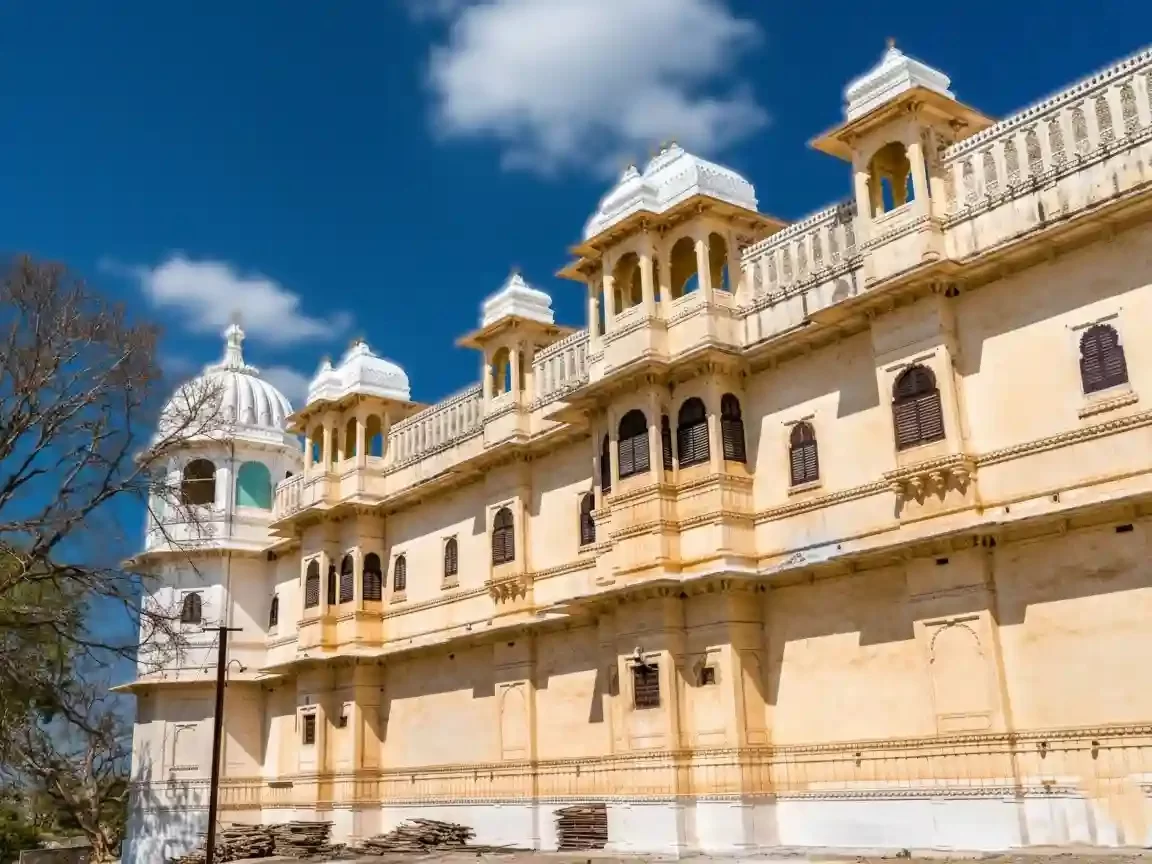
Visiting Fateh Prakash Palace in Chittorgarh, Rajasthan, India

Fateh Prakash Palace , Chittorgarh
Tourists visit to view a specialized collection of Mewar artifacts, including medieval weapons, crystal items, and woodcrafts from Bassi village. The palace is noted for its modern Rajput architectural style, featuring four corner towers crowned by domed chhatris and interior corridors decorated with traditional Rajasthani wall paintings.

Quick Facts About Fateh Prakash Palace

Quick Facts for Fateh Prakash Palace, Chittorgarh

Entry Fee ?10 for Indians; ?50 for Foreigners (Museum entry fee; fort entry is separate)
Timings 09:45 AM – 05:15 PM (Closed on Fridays and Public Holidays)
Altitude (m) ~500 m (Fort elevation; palace height is ~15-20 m)
Ideal Visit Duration 45 to 60 minutes
Best Time of Day 10:30 AM – 12:30 PM (Optimal indoor lighting for museum exhibits)
Crowd Level Low to Moderate
Distance from City Centre (km) 6 km from Chittorgarh Railway Station
Walking Difficulty Easy (Located on level ground within the fort; minimal steps to enter)
Parking Available Yes (Parking space available directly outside the palace/museum entrance)
Last Mile Access Accessible by private car, taxi, or auto-rickshaw via the fort road
Suitable for Kids Yes (Educational exhibits and spacious halls)
Suitable for Seniors Yes (One of the most accessible monuments in the fort with minimal climbing)
Wheelchair Friendly Partial (Ground floor is accessible; upper floor lacks elevator access)

Why Visit Fateh Prakash Palace Chittorgarh: A Portal to Mewar Artistry

Visitors come to Fateh Prakash Palace to explore a refined architectural departure from the rugged military structures of the Chittorgarh Fort. Built by Maharana Fateh Singh, the palace now serves as a dedicated government museum, attracting travelers who seek to examine a rare collection of 11th-century sculptures, traditional Mewari weapons, and intricate woodcarvings recovered from the surrounding ruins.

The atmosphere on the ground is scholarly yet serene, characterized by the cool marble interiors and the rhythmic echoes of the palace’s central vaulted hall. Unlike the exposed, sun-drenched ruins nearby, this space offers a quiet, shaded environment where the scent of aged stone and the sight of sunlight filtering through large windows provide a contemplative backdrop for viewing regional tribal artifacts and royal portraits.

Fateh Prakash Palace is distinct for its preservation of the post-medieval Rajput lifestyle, featuring a unique blend of grand architectural features like domed chhatris and high-ceilinged galleries. It stands out to travelers as the primary interpretive center of the fort, offering the necessary context to understand the complex artistic transitions of Rajasthan through its meticulously curated displays of terracotta figurines from local excavations.

Historical and Cultural Context of the Fateh Prakash Palace Chittorgarh

Commissioned by Maharana Fateh Singh in the early 20th century, the Fateh Prakash Palace represents a departure from the rugged, defensive military architecture of the Chittorgarh Fort toward a more refined Rajput residential style. The palace is characterized by its grand pillars, vast corridors, and a series of domes that overlook the historical complex, reflecting the aesthetic transition of the Mewar dynasty during the British Raj era.

The structure currently serves as a government museum, housing a significant collection of artifacts recovered from the fort. Key exhibits include 11th-century sculptures, traditional Mewari weapons such as daggers and shields, and rare terracotta items. The palace is particularly noted for its large central hall decorated with crystal chandeliers and wall paintings that depict local legends and the architectural heritage of Rajasthan, providing a curated historical record of the region's royal lineage.

Best Time to Visit Fateh Prakash Palace in Chittorgarh

To fully appreciate the extensive museum galleries and the modern Rajput architecture of Fateh Prakash Palace, timing is critical as the structure sits atop the exposed plateau of Chittorgarh Fort. The optimal window aligns with the dry, temperate months that allow for a comfortable transition between the palace’s indoor exhibits and the surrounding open-air historical complex.

  • Ideal Months: October to March is the peak period, with the months of November through February offering the most stable and pleasant conditions for exploring the palace museum and nearby ruins.
  • Weather Conditions: Expect clear skies and mild daytime temperatures ranging from 12°C to 28°C. These cooler conditions are essential for walking between the palace and other fort attractions, as the stone-heavy environment retains significant heat even on mildly sunny days.
  • Periods to Avoid: April to June should be avoided due to the intense Rajasthani summer, where temperatures frequently exceed 43°C, making the walk to the palace's elevated entrance physically draining. Additionally, be aware that the museum is traditionally closed on Mondays and during major public holidays, which can disrupt travel itineraries if not planned in advance.

How to Reach Fateh Prakash Palace Chittorgarh: Practical Travel Guide

Fateh Prakash Palace, which currently houses the Government Museum, is located in the northern section of the Chittorgarh Fort complex. Accessing the palace requires entering the fort and navigating its internal arterial roads.

  • Nearest Airport: Maharana Pratap Airport (UDR) in Udaipur is the closest air link, situated approximately 95 km away. Travelers can hire private taxis or use RSRTC buses from Udaipur to reach Chittorgarh city, a journey that takes roughly 2 hours via NH27.
  • Nearest Railway Station: Chittorgarh Junction (COR) is the primary railhead, located about 7 km from the palace. It is well-connected to major hubs like Delhi, Jaipur, Mumbai, and Ahmedabad. From the station, auto-rickshaws and taxis are the most reliable modes of transport to reach the fort summit.
  • Road Access and Entry: Chittorgarh is a major stop on the Golden Quadrilateral (NH48). To reach the palace, vehicles must pass through the seven historic gateways (Pols) of the fort. While the road is paved, it is steep and narrow in sections; larger luxury coaches often park at the base, requiring a transfer to smaller vehicles for the final ascent.
  • Last-Mile Connectivity: Once inside the fort, the palace is situated near the Rana Kumbha Palace and the Meera Temple. You can use auto-rickshaws or rented bicycles available at the fort entrance to travel between monuments, as the internal distance between sites is too large to cover comfortably on foot under the sun.
  • Travel Conditions and Limitations: The museum is closed on Fridays and public holidays. Visitors should be aware that the interior of the palace involves stone staircases and uneven floorings that are not fully wheelchair accessible. During the peak summer months (April to June), temperatures can exceed 40°C, making midday visits physically taxing.

Note for Visitors: Ensure you retain your fort entry ticket, as it is often checked at the museum entrance. Local guides are available at the Badi Pol (Main Gate) to assist with navigation through the palace galleries.
What to Expect When You Visit Fateh Prakash Palace, Chittorgarh

  • Adaptive Reuse Environment: The 19th-century palace now functions primarily as a Government Museum. Unlike the surrounding ruins of the Chittorgarh Fort, this structure is a well-preserved, double-storied rectangular building with modern architectural features, featuring four distinct corner towers topped with domed chhatris.
  • Gallery Layout and Navigation: Expect a structured indoor experience divided into specialized sections. The ground floor and corridors are organized into themed rooms, including the Weapon Room (armory), Archaeology and Sculpture Room, and a dedicated gallery for Bassi village woodcrafts and tribal life clay models.
  • Facility Standards: Basic public toilets are available on-site, but modern climate control is absent. While the thick stone walls provide some natural cooling, the indoor galleries can become humid and stuffy during peak summer months. Visitors should carry their own drinking water, as reliable filtration points are not available inside the palace.
  • Accessibility and Mobility: The palace is one of the more accessible sites within the fort complex, featuring relatively flat paved approaches suitable for seniors. However, movement between the two floors is restricted to stone staircases, and certain upper-level sections or the top floor may be closed to the public due to ongoing conservation work.
  • Operational Constraints: The museum strictly observes a "Closed on Mondays" policy and typically operates from 9:45 AM to 4:45 PM. Be prepared to pay a separate entry fee in cash at the museum counter, even if you already hold a general Chittorgarh Fort ticket.
  • Photography and Conduct: Photography is generally permitted in the outdoor courtyards and for the architecture, but strict restrictions or additional fees apply for filming or photographing specific artifacts and paintings inside the galleries. Touching of sculptures or leaning against the 17th-century frescoes is strictly prohibited and monitored by staff.

Safety and Essential Visitor Information for Fateh Prakash Palace Chittorgarh

  • Peak and Quiet Hours: To experience the museum exhibits without the midday heat and heavy crowds, arrive at 10:00 AM sharp when the doors open. The palace becomes significantly more congested between 1:00 PM and 3:00 PM as tour groups move from the nearby Vijay Stambha to the museum.
  • Safety and Structural Cautions: As a converted historical structure, many doorways are lower than modern standards and some floor levels are uneven. Taller visitors should remain mindful of low lintels, and all guests should watch for high stone thresholds between the different galleries.
  • Climate Control & Crowds: The palace interior can become humid and stuffy during the peak summer months (April–June) as the building lacks modern central air conditioning. If visiting during this time, prioritize the ventilated galleries near the windows to avoid heat exhaustion.
  • Dress Code & Photography: Photography is strictly prohibited inside certain galleries housing rare idols and artifacts; security personnel are vigilant, and non-compliance can lead to fines. While there is no formal dress code, modest clothing is recommended as the palace is located within the sacred Chittorgarh Fort complex.
  • Practical Safety: Ensure you stay within the marked visitor paths; several sections of the palace are closed for conservation and may have unstable masonry. Keep a safe distance from the monkeys that often congregate on the palace exterior and surrounding gardens—do not offer food or carry open bags.

Capturing Royal Heritage: Photography at Fateh Prakash Palace, Chittorgarh

  • Main Entrance and Exterior Architecture: The best angle for capturing the palace’s double-storied rectangular silhouette and its four corner domes (chhatris) is from the north-facing main entrance during the early morning. This avoids the harsh shadows cast by the building itself later in the day and highlights the modern Rajput architectural details.
  • Golden Hour Refractions: Visit the exterior corridors in the late afternoon when the low-angle sun hits the pillars. The golden light often catches the glasswork and decorative vases integrated into the masonry, providing a natural shimmer that is difficult to replicate at other times.
  • Strict Interior Photography Ban: Photography and videography are strictly prohibited inside the Government Museum galleries. This rule is enforced to protect sensitive 17th-century paintings, royal leaf manuscripts, and delicate crystal ware from flash damage and to maintain security for the extensive weaponry and jewelry collections.
  • Crowd Management near Badi Pol: Located near the major Badi Pol and Rana Kumbha Palace, this site experiences high foot traffic from 11:00 AM to 3:00 PM. For clean architectural shots of the palace facade without tourist interference, plan your shoot immediately at the 9:45 AM opening.
  • External Textures and Jali Screens: Focus on the intricate jali (stone lattice) work and the contrast between red sandstone and white marble on the exterior walls. These features provide excellent subjects for macro photography or detail shots that do not violate the interior restrictions.
  • Strategic Viewpoints from the Fort Edge: Since the palace is positioned on a slight elevation within the fort, the surrounding perimeter offers a wide-angle vantage point. From here, you can frame the palace with the vast Chittorgarh town in the background, providing a sense of scale to the "Mahal" within the context of the larger fort complex.

Near By Attraction

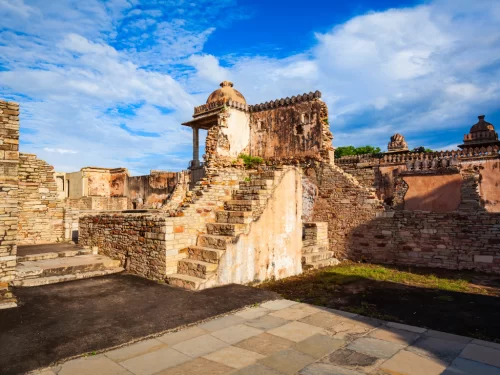
Side view of Rana Kumbha Palace ruins at Chittorgarh Fort in Rajasthan highlighting dome pavilion, stairs and weathered walls under partly cloudy sky, perfect Rajasthan tour package. Fort

Chittorgarh Fort

Chittorgarh Fort is a 7th-century hill fortress and UNESCO World Heritage site extending across 700 acres on a 180-meter high rocky plateau.
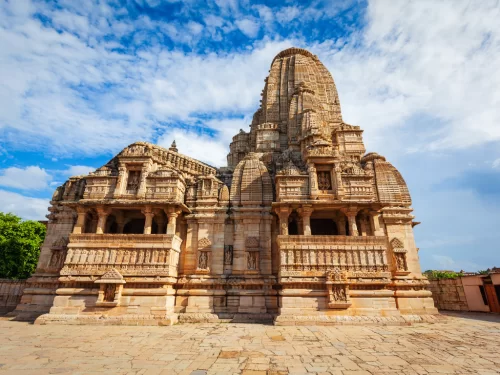
Kalika Mata Temple shikhara at Chittorgarh Fort in Rajasthan during sunny day, featuring intricate carvings and blue sky, perfect Rajasthan tour package. Temple

Kalika Mata Temple

Kalika Mata Temple is an 8th-century Hindu temple originally built as a Sun Temple before being converted to honor the goddess Kali in the 14th century.
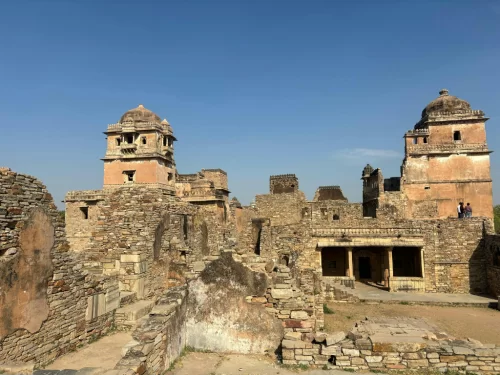
Rana Kumbha Palace ruins at Chittorgarh Fort in Rajasthan with pink sandstone towers, courtyards and walls under clear blue sky, perfect Rajasthan tour package. Palace

Rana Kumbha Palace

Rana Kumbha Palace is a 15th-century ruined royal residence and the oldest standing structure within the UNESCO-listed Chittorgarh Fort complex.

Frequently Asked Questions About Fateh Prakash Palace

Fateh Prakash Palace is located inside Chittorgarh Fort in Chittorgarh city, Rajasthan. It forms part of the historic fort complex overlooking the surrounding plains.
Fateh Prakash Palace is open from morning to evening as per Chittorgarh Fort visiting hours. Timings may vary slightly on public holidays.
There is no separate entry fee for Fateh Prakash Palace, but visitors must purchase a Chittorgarh Fort entry ticket to access the palace area.
Around 30 to 60 minutes are sufficient to explore Fateh Prakash Palace. Visitors touring the entire Chittorgarh Fort should allocate several hours for sightseeing.
The best time to visit Fateh Prakash Palace is between October and March when the weather in Rajasthan remains comfortable for exploring the fort premises.
Fateh Prakash Palace can be reached by road through Chittorgarh city. Visitors can drive or hire local transport up to Chittorgarh Fort and then proceed inside the complex.
Parking facilities are available near the entrance gates of Chittorgarh Fort. From there, visitors can travel within the fort area to reach Fateh Prakash Palace.
Fateh Prakash Palace is suitable for families and general tourists. Some walking across uneven pathways may be required within the fort complex.
Visitors can see palace structures, galleries and museum displays inside Fateh Prakash Palace. The site offers insight into royal architecture and artifacts preserved in the fort.
Fateh Prakash Palace experiences higher footfall during peak tourist season and weekends. Weekday mornings usually provide a quieter experience.
Local guides are available at Chittorgarh Fort who can explain details about Fateh Prakash Palace. Hiring a guide helps visitors understand the layout and historical context better.
Rana Kumbha Palace, Vijay Stambh and Maharani Padmini Palace can be combined with a Fateh Prakash Palace visit. These attractions are located within Chittorgarh Fort in Rajasthan.

Loved this place ? Let’s Plan Your Rajasthan Trip

Get customized Rajasthan tour planning designed around desert climate comfort, long-distance road travel flow, heritage exploration time, and realistic pacing between regions. Whether you are visiting for fort architecture, palace heritage, cultural exper

⚡ Quick Response | 💰 Free consultation | 🕒 24×7 expert support

×

Plan Your Trip