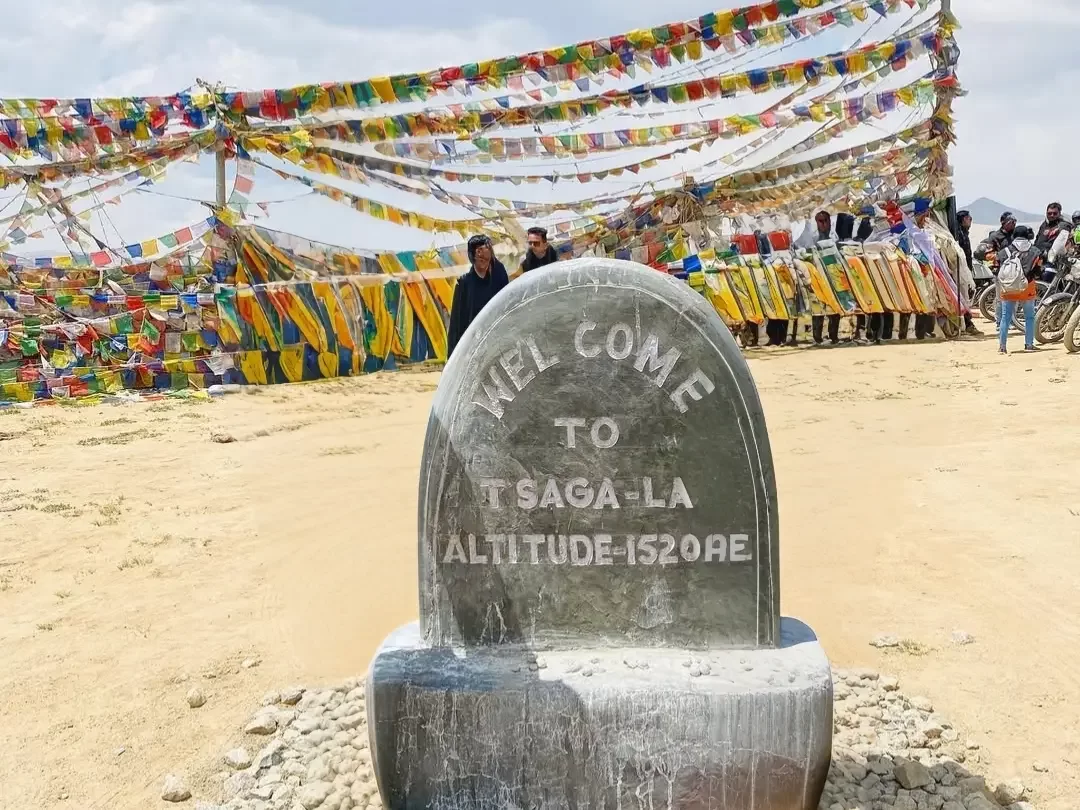
Tsaga La Pass: High-Altitude Mountain Pass in Eastern Ladakh, India

Tsaga la Pass , Pangong
Tourists traverse Tsaga La while traveling the remote border route between Pangong Tso and the Hanle Valley. The pass is a key transit point for high-altitude explorers and photographers, offering views of the vast Changthang plains and providing access to the sensitive border regions characterized by their unique geological formations and proximity to the Line of Actual Control.

Quick Facts About Tsaga la Pass

Entry Fee Free
Timings 06:00 - 18:00
Altitude (m) 4611
Ideal Visit Duration (hrs) 0.25
Best Time of Day Morning
Crowd Level Low
Distance from Leh (km) 165
Walking Difficulty Easy
Parking Available Yes
Last Mile Access Road
Suitable for Kids Yes
Suitable for Seniors Yes
Wheelchair Friendly No

Why Visit Tsaga La Pass in Ladakh

Tsaga La is a remote high-altitude pass situated at approximately 15,200 feet, serving as a critical transit point for travelers moving between the nomadic hub of Hanle and the border village of Chushul. It is visited by explorers who wish to traverse the "Inner Line" frontier, offering a raw and unpaved journey through the sensitive eastern edge of the Changthang plateau near the Line of Actual Control.

The atmosphere at Tsaga La is defined by an immense sense of space and the physical presence of the Indo-China border. The landscape is characterized by wide, sandy valleys and rolling brown hills that stretch toward the horizon, where the only signs of activity are the occasional Indian Army convoys and the solitary tents of the Rebo nomads tending to their herds of pashmina goats in the vast, windswept plains.

What makes Tsaga La distinct is its proximity to the historic Tsaga village and its role as a corridor for observing rare high-altitude wildlife in their natural habitat. It offers one of the best opportunities in Ladakh to spot the Kiang (Tibetan wild ass) and the elusive Black-necked Crane, providing a unique vantage point where the stark beauty of the trans-Himalayan desert meets the quiet resilience of borderland life.

Historical and Geographic Significance of Tsaga La Pass

Tsaga La is a high-altitude mountain pass located at an elevation of approximately 4,650 meters (15,256 feet) in the Changthang region of Ladakh. It serves as a vital connecting point between the villages of Chushul and Loma, facilitating transit along the remote eastern border of India.

Geographically, the pass is situated in a high-plateau desert landscape characterized by vast open plains and salt-encrusted basins. It is a critical landmark on the road leading toward the Rezang La War Memorial and the strategic Nyoma sector. The region surrounding the pass is an essential habitat for the Kiang (Tibetan wild ass) and other rare Trans-Himalayan wildlife that thrive in the sparse vegetation of the high-altitude steppe.

Historically, Tsaga La has been a traditional route for the nomadic Changpa people, who move their herds of pashmina goats through these corridors to reach seasonal grazing lands. Due to its close proximity to the Line of Actual Control (LAC), the pass is of significant strategic importance and is strictly monitored by the Indian Army. It remains a sensitive zone where specific Inner Line Permits (ILP) are mandatory for all civilian travelers.

Best Time to Visit Tsaga La Pass

Tsaga La, situated at approximately 15,207 feet, is a remote and strategically sensitive pass on the high-altitude corridor between Chushul and Hanle. Unlike the major highways of Ladakh, this route consists largely of raw dirt tracks and gravel, making its accessibility dependent on dry ground conditions and the stability of the border region's seasonal weather.

  • Ideal months: June to September is the most reliable window, with September offering the best combination of firm tracks and clear, post-monsoon visibility for the surrounding Rezang La massif.
  • Weather conditions: The pass is notorious for its "silent cold" and aggressive winds that sweep across the Tibetan plateau fringes; daytime temperatures in summer range from 8°C to 15°C, but the lack of cover means wind chill can make it feel sub-zero even in bright sunlight.
  • Periods to avoid: Strictly avoid travel from November to April when extreme arctic temperatures (reaching -35°C) and heavy snow make the dirt trails indistinguishable and treacherous; additionally, early June can be difficult as the melting snow turns the sandy patches near the Loma-bend into soft-soil traps for non-4x4 vehicles.

How to Reach Tsaga La Pass

Tsaga La is a remote, high-altitude mountain pass located in the Changthang region of Ladakh at an elevation of approximately 4,640m (15,223 ft). It is a strategic transit point that connects the Chushul Valley to the Loma-Hanle sector, offering travelers a direct route through the stark, high-altitude desert along the Indus River.

  • Nearest Airport: Kushok Bakula Rimpochee Airport (IXL) in Leh is the nearest airport, located about 230 km away. Due to the remoteness and altitude, travelers must acclimatize in Leh for a minimum of 2–3 days before heading toward the eastern border regions.
  • Nearest Railway Station: Jammu Tawi is the closest major railhead, approximately 860 km away. Access is exclusively via road, typically as part of a multi-day expedition through the Changthang circuit.
  • Road Access and Routes: The pass is primarily reached via the road from Leh through Karu, Upshi, Chumathang, and Loma. From Loma, the road heads north toward Chushul via Tsaga La. Alternatively, it can be accessed from the Nubra Valley side via the Agham-Shyok-Durbuk-Pangong-Chushul route.
  • Last-Mile Connectivity: There is no public transport. Access is limited to private 4x4 SUVs or adventure-grade motorcycles. While the road surface has improved significantly, it still features stretches of sand and loose gravel that require high-clearance vehicles and experienced driving.
  • Permits and Border Security: Tsaga La is situated in a highly sensitive zone very close to the Line of Actual Control (LAC). A valid Inner Line Permit (ILP) for Indian citizens or a Protected Area Permit (PAP) for foreigners is strictly mandatory and must specifically mention "Tsaga" or the "Chushul-Hanle" route. Frequent checks are conducted by the ITBP and Indian Army at Loma and Chushul.
  • Travel Conditions and Logistics: The pass is generally accessible from June to October. There are no facilities—including fuel, food, or medical aid—between Loma and Chushul. Travelers must ensure they have sufficient fuel and a complete emergency kit, as mobile connectivity is non-existent in this sector.

What to Expect When You Visit Tsaga La Pass

  • Environment and Surroundings: At an altitude of approximately 4,660 meters (15,290 feet), Tsaga La is a high mountain pass in southeastern Ladakh. The environment is defined by its extreme isolation and a vast, wind-swept high-altitude desert landscape. Travelers can expect stark, open plateaus with long-range views toward the Tibetan border, characterized by sand-colored ridges and a profound silence occasionally interrupted by intense gale-force winds.
  • Facilities and Amenities: The pass is a total wilderness route with no civilian infrastructure. There are no shops, toilets, restaurants, or medical facilities at the summit or along the immediate approach. While there is a significant Indian Army presence and a frontline outpost nearby due to its strategic location, these are not public service points. Travelers must be entirely self-sufficient with food, water, and fuel before leaving Hanle or Chushul.
  • Accessibility and Movement: Access is via a remote corridor linking the Pangong region (Chushul) to the Hanle Valley (Loma). The road is a mix of broken tarmac and raw dirt tracks that are often unmarked and prone to sudden dust storms. A high-clearance 4x4 vehicle is strongly recommended. Due to its proximity to the Line of Actual Control (LAC), an Inner Line Permit (ILP) with specific mention of the Chushul-Loma-Hanle route is mandatory and will be checked and stamped at army checkpoints.
  • Typical Visitor Behavior and Conditions: Most visitors experience Tsaga La as a transit pass rather than a destination, usually stopping for no more than 5–10 minutes to take photographs. The low oxygen levels and high wind chill make prolonged stays uncomfortable. It is common to encounter zero civilian traffic for hours, making mechanical reliability and proper acclimatization critical, as mobile network coverage is entirely absent.

What to Expect When You Visit Tsaga La Pass

  • Environment and Surroundings: At an altitude of approximately 4,660 meters (15,290 feet), Tsaga La is a high mountain pass in southeastern Ladakh. The environment is defined by its extreme isolation and a vast, wind-swept high-altitude desert landscape. Travelers can expect stark, open plateaus with long-range views toward the Tibetan border, characterized by sand-colored ridges and a profound silence occasionally interrupted by intense gale-force winds.
  • Facilities and Amenities: The pass is a total wilderness route with no civilian infrastructure. There are no shops, toilets, restaurants, or medical facilities at the summit or along the immediate approach. While there is a significant Indian Army presence and a frontline outpost nearby due to its strategic location, these are not public service points. Travelers must be entirely self-sufficient with food, water, and fuel before leaving Hanle or Chushul.
  • Accessibility and Movement: Access is via a remote corridor linking the Pangong region (Chushul) to the Hanle Valley (Loma). The road is a mix of broken tarmac and raw dirt tracks that are often unmarked and prone to sudden dust storms. A high-clearance 4x4 vehicle is strongly recommended. Due to its proximity to the Line of Actual Control (LAC), an Inner Line Permit (ILP) with specific mention of the Chushul-Loma-Hanle route is mandatory and will be checked and stamped at army checkpoints.
  • Typical Visitor Behavior and Conditions: Most visitors experience Tsaga La as a transit pass rather than a destination, usually stopping for no more than 5–10 minutes to take photographs. The low oxygen levels and high wind chill make prolonged stays uncomfortable. It is common to encounter zero civilian traffic for hours, making mechanical reliability and proper acclimatization critical, as mobile network coverage is entirely absent.

Photography Strategy and Viewpoints for Tsaga La Pass

Tsaga La, standing at an elevation of approximately 4,650 meters (15,255 feet), is a strategic mountain pass connecting the Rezang La memorial area with the Indus Valley. Photography here is defined by wide-open vistas of the Changthang Plateau and the stark, dramatic proximity to the mountains marking the Line of Actual Control (LAC).
  • High-Plateau Panoramas: The summit provides an exceptional 360-degree view of the barren, rolling hills of the eastern Ladakh borderland. Use a wide-angle lens (16-35mm) to capture the immense scale of the plateau where the earth meets a deep, high-altitude indigo sky.
  • Roadway Leading Lines: The approach to Tsaga La from the south features long, straight stretches of road that cut through a desolate landscape. Positioning your camera at a low angle on these stretches creates a powerful visual narrative of the "lonely road" typical of the remote Chushul-Loma sector.
  • Optimal Lighting and Shadow Play: Morning light (8:00 AM – 10:00 AM) is ideal for this location. The sun rises over the eastern ridges, casting long, sharp shadows across the valley floor that emphasize the undulating textures of the high-desert terrain.
  • Technical Environmental Considerations: The pass is a natural wind tunnel. If you are attempting long exposures or time-lapses of the fast-moving clouds, use a sturdy, weighted tripod. Due to the fine silt and sand in this region, avoid lens changes to prevent sensor contamination from wind-blown grit.
  • Strict Photography Restrictions: Tsaga La is a highly sensitive military zone. While capturing the natural landscape is generally permitted, it is strictly forbidden to photograph any army checkposts, bunkers, artillery positions, or military convoys. Ensure your GPS-enabled metadata or drone usage complies with the strict "no-fly" regulations active in this border area.

Near By Attraction

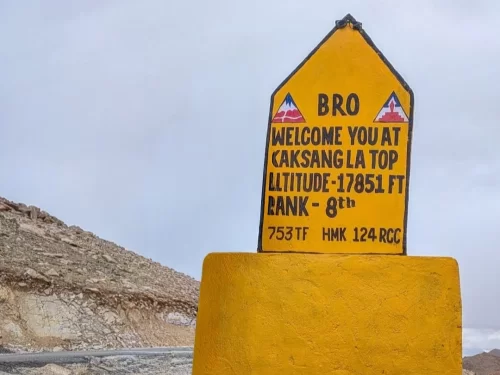
BRO milestone Welcome You at Kaksang La Top Altitude 17851 FT Rank – 8th against barren high-altitude mountains under cloudy sky, ideal for Ladakh road trip photogra Mountain Pass

Kaksang La Pass

Kaksang La is a high-altitude mountain pass situated at an elevation of approximately 5,438 meters (17,841 feet) in the Leh district of Ladakh.
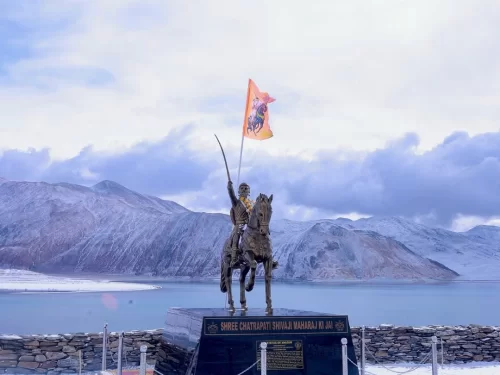
Pangong Lake Ladakh winter Chhatrapati Shivaji Maharaj statue bronze equestrian sword saffron flag pedestal snowy mountains turquoise water cloudy sky stone wall railing, historical monument adventure tour package.  Mountain

Pangong Tso

Pangong Tso is the world's highest saltwater lake, famous for its mesmerizing ability to change colors from turquoise to deep blue.
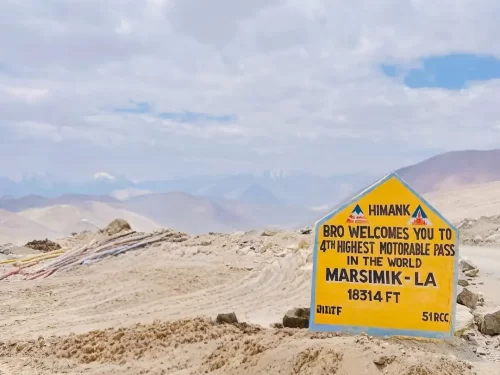
Marsimik La signboard Ladakh during clear partly cloudy day, featuring Himank BRO plaque 4th highest motorable pass 18314 ft, desert mountains, perfect adventure Ladakh tour package. Mountain Pass

Marsimik La Pass

Marsimik La is a high-altitude mountain pass situated at an elevation of approximately 5,582 meters (18,314 feet) in the eastern Ladakh region, near the northern shore of Pangong Tso.

Frequently Asked Questions About Tsaga la Pass

Tsaga La Pass is located in the remote Changthang region of Ladakh on the route connecting Loma to Chushul near the India China border. It lies southeast of Leh city in a restricted high altitude zone of eastern Ladakh.
Tsaga La Pass can be reached from Leh city by driving via Karu, Nyoma, and Loma toward the Chushul sector. The journey takes a full day due to long distances and remote mountain roads.
An Inner Line Permit is required for tourists visiting Tsaga La Pass because it falls within a restricted border area of Ladakh. Permits must be arranged in Leh city before travel.
The best time to visit Tsaga La Pass in Ladakh is between June and September when the roads are generally open and weather conditions are more predictable. Access during other months depends on snow clearance.
Tsaga La Pass stands at an altitude of over 15000 feet where oxygen levels are noticeably lower than in Leh city. Visitors may feel breathless if they ascend without proper acclimatization.
There are no food stalls, fuel stations, or accommodation facilities at Tsaga La Pass. Travelers should carry sufficient supplies from Leh city or Nyoma before heading toward the pass.
A high clearance SUV is recommended to reach Tsaga La Pass due to rough gravel tracks and isolated stretches. Vehicles should be in good mechanical condition for high altitude driving.
Travelers usually spend 10 to 20 minutes at Tsaga La Pass because of altitude and wind exposure. Short stops help reduce the physical strain of extreme elevation.
Visitors should wear layered thermal clothing and a windproof jacket when visiting Tsaga La Pass. Even during summer months temperatures can drop quickly with strong winds.
Tsaga La Pass is generally not accessible during winter months as snowfall blocks interior plateau roads in eastern Ladakh. Travel plans depend on seasonal road updates from Leh city authorities.
Tsaga La Pass is better suited for acclimatized and physically fit travelers. Senior citizens or young children should carefully consider altitude sensitivity before planning the visit from Leh city.
Mobile network connectivity is not available at Tsaga La Pass in Ladakh. Signals are usually lost after crossing Loma, so communication should be planned in advance from Leh city.

Loved this place ? Let’s Plan Your Ladakh Trip

Get customized Ladakh tour planning designed around altitude comfort, acclimatization time, weather windows, and real Himalayan road conditions. Whether you are visiting for high mountain passes, monasteries, lakes, or remote valley experiences, our exper

⚡ Quick Response | 💰 Free consultation | 🕒 24×7 expert support

×

Plan Your Trip