Spituk Monastery Ladakh A Practical Visitor Guide Near Leh

Spituk Monastery , Leh
Spituk Monastery, also known as Spituk Gompa, is located about 8 km from Leh, close to Leh Airport. It belongs to the Gelugpa order of Tibetan Buddhism and sits on a rocky hill overlooking the Indus River. The monastery complex includes prayer halls, monk quarters, and shrines spread across different levels. Compared to larger monasteries like Thiksey, Spituk is quieter and easier to explore, making it suitable for travelers who want a short, focused monastery visit without heavy crowds.

Quick Facts About Spituk Monastery

Entry Fee (INR) 20
Timings 07:00 - 19:00
Altitude (m) 3300
Ideal Visit Duration (hrs) 1
Best Time of Day Morning
Crowd Level Moderate
Distance from Leh (km) 8
Walking Difficulty Moderate
Parking Available Yes
Last Mile Access Road
Suitable for Kids Yes
Suitable for Seniors No
Wheelchair Friendly No

Why Visit Spituk Monastery

Spituk Monastery is a good choice for travelers who want a short and calm monastery visit close to Leh without dealing with heavy crowds. Its location near the airport and main road makes it easy to reach, and the compact layout allows you to explore the entire complex without feeling rushed. The monastery offers a clear introduction to Ladakhi monastic life without the scale or intensity of larger gompas.

The atmosphere at Spituk is quiet and understated. Daily life here moves at a slow pace, and visitors often encounter monks engaged in routine activities rather than staged rituals. Prayer halls are simple and functional, and outside peak hours, the monastery feels almost empty, making it suitable for those who prefer silence over spectacle.

What makes Spituk Monastery special is its balance between accessibility and authenticity. Despite being so close to Leh, it retains a strong sense of separation from the town. The views across the Indus Valley and the surrounding barren hills add context to the monastery’s setting, and the annual Spituk Gustor festival gives insight into local religious traditions without attracting overwhelming tourist numbers.

History

Spituk Monastery was founded in the 11th century and later became affiliated with the Gelugpa order of Tibetan Buddhism. It was originally established to serve as a religious center for the surrounding villages and to protect the region spiritually and culturally. Over the centuries, the monastery grew into an important monastic institution in central Ladakh, supporting both education and ritual practices.

The monastery is particularly known for its annual Spituk Gustor festival, which showcases traditional Cham dances and rituals performed by resident monks. This festival highlights the monastery’s role in preserving local religious traditions and provides visitors with a window into Ladakhi spiritual life.

Although smaller than Thiksey or Hemis Monasteries, Spituk maintains an active monastic community, continuing centuries-old practices of study, prayer, and ritual, making it a living example of Ladakhi Buddhist heritage.

Best Time to Visit Spituk Monastery

The best time to visit Spituk Monastery is from May to September, when roads in Ladakh are open and weather conditions are most favorable. During this period, daytime temperatures are comfortable, skies are generally clear, and the walk up to the monastery is easier. These months also provide the best visibility for panoramic views of the Indus Valley and surrounding hills.

July and August are the peak tourist months, coinciding with festivals and school holidays. Although the monastery itself remains calm, the nearby parking and approach areas can be moderately crowded. Visiting in May, June, or September is recommended for a quieter experience.

Winter months from October to April are harsh, with snow and freezing temperatures limiting access. Only experienced travelers prepared for cold and limited services should attempt a winter visit.
  • May to June offers clear skies, mild temperatures, and low crowds
  • July to August sees more visitors but allows attendance at local festivals
  • September provides crisp weather, reduced tourist traffic, and excellent visibility
  • Winter visits are possible but challenging due to cold, snow, and limited facilities

How to Reach Spituk Monastery

  • By road from Leh: Spituk Monastery is located approximately 8 km from Leh on the Leh-Khaltsi road. The road is fully paved and well-maintained, making it easy to reach by taxi or private vehicle in about 15–20 minutes from the city center.
  • By local transport: Shared taxis or local buses occasionally operate from Leh to nearby villages, dropping visitors at the base of the hill. From there, a short uphill walk leads to the monastery entrance. Public transport is limited and schedules are not regular.
  • By bike or self-drive: Motorbikes and rental cars from Leh provide flexibility. The route is straightforward with no off-road sections, but riders should be cautious of altitude and occasional wind gusts.
  • Walking from Leh: Walking is technically possible but not recommended due to distance, altitude, and traffic along the road. Most visitors prefer a short taxi or bike ride.

What to Expect When You Visit Spituk Monastery

  • Active monastic environment: Spituk is a functioning monastery with monks living, studying, and performing daily rituals. Visitors can observe prayer sessions, debates, and routine chores, providing an authentic glimpse of monastic life.
  • Compact layout: The monastery is smaller and easier to navigate compared to larger gompas. Most areas, including courtyards, prayer halls, and shrines, can be explored comfortably within 30–45 minutes.
  • Stairs and uneven paths: The hilltop location involves short uphill walks and several stone steps. Visitors should wear comfortable shoes and be ready for moderate walking.
  • Peaceful atmosphere: Outside festival days or peak morning hours, the monastery is quiet, making it suitable for reflection, photography, or observing religious practices.
  • Limited facilities: Basic amenities like toilets are available near the entrance. There are no cafes or restaurants inside, but small stalls outside may sell religious items and snacks.
  • Weather considerations: At 3,300 meters, the monastery is exposed to sun and wind. Visitors should carry water, sun protection, and warm clothing depending on the season.
  • Respectful conduct: Modest clothing is expected, and visitors should avoid loud conversations or touching religious objects. Shoes must be removed before entering prayer halls.

Important Visitor Information

  • Crowd and weather notes: Spituk Monastery is generally less crowded than major monasteries like Thiksey or Hemis. Peak visitor numbers occur during festivals, especially the Spituk Gustor. Weather is dry with strong sunlight; winds can be noticeable on terraces even in summer.
  • Peak and quiet hours: The monastery is busiest between 10:00 AM and 2:00 PM. Early mornings and late afternoons are quieter, ideal for photography and observing daily routines without interruption.
  • Dress code: Modest attire covering shoulders and knees is expected. Visitors should remove shoes before entering prayer halls. Avoid revealing or bright clothing that may be inappropriate inside sacred areas.
  • Safety notes: Walking paths include stone steps and uneven terrain. High altitude can cause breathlessness or fatigue. Carry water, move carefully, and avoid rushing on stairways or terraces.

Photography and Viewpoint

  • Best photography areas: The upper terraces of Spituk Monastery provide excellent views over the Indus Valley and surrounding mountains. These terraces are ideal for landscape shots and capturing the monastery’s tiered architecture.
  • Light conditions: Early morning light is soft and ideal for capturing both the monastery and valley in warm tones. Late afternoon offers stronger contrasts and shadows, highlighting architectural details but can be harsh for wide-angle shots.
  • Interior photography rules: Photography is allowed in open courtyards but is restricted in prayer halls and during rituals. Visitors should respect posted signs and instructions from monks.
  • Viewpoint experience: The monastery itself functions as a viewpoint rather than having a separate observation platform. From the upper levels, visitors can see the Indus River, Leh town, and surrounding hills, providing a clear sense of Ladakh’s landscape and settlement patterns.
  • Crowd management for photos: During festival days, terraces near the main entrance may become busy. For quieter photography, visit early morning or explore upper levels of the complex.

Near By Attraction

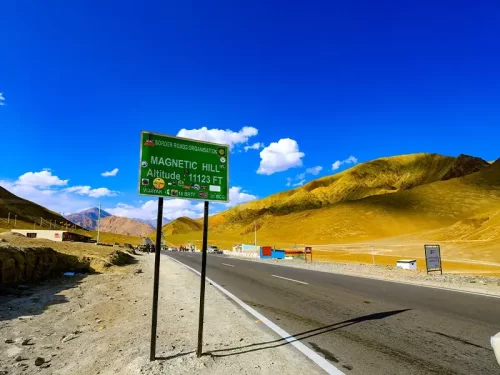
Magnetic Hill sign at Ladakh BRO during clear skies, featuring altitude 11312 ft board yellow mountains highway, perfect adventure Ladakh tour package.  Tourist Attraction

Magnetic Hill

Magnetic Hill is a gravity hill located at an elevation of approximately 3,350 meters (10,991 feet) on the Leh-Srinagar National Highway.
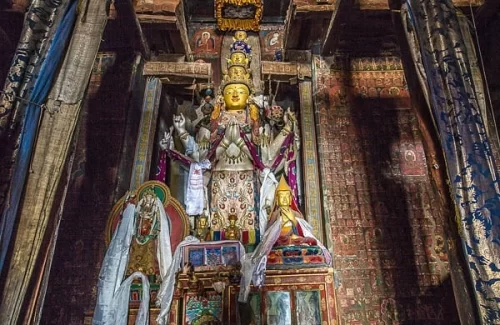
Buddha statue at Alchi Gompa Ladakh in dimly lit shrine during misty weather, featuring multiple arms prayer scarves and wall murals, perfect spiritual Ladakh tour package. Monastery

Alchi Monastery

Alchi Monastery is a historic Buddhist temple complex situated at an elevation of approximately 3,100 meters (10,170 feet) on the southern bank of the Indus River.
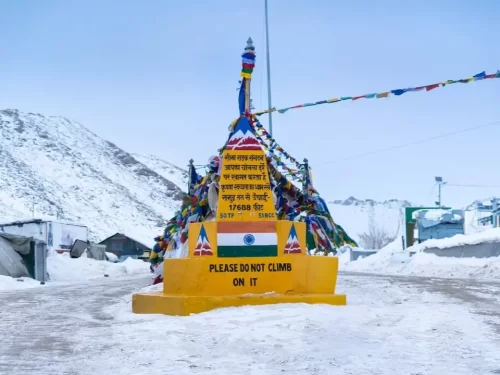
Memorial at Changla Pass 17688 ft during overcast skies, featuring prayer flags, Indian tricolor, snowy mountains, perfect spiritual adventure Ladakh tour pack Mountain Pass

Chang La Pass

Chang La is a high-altitude mountain pass situated at an elevation of approximately 5,360 meters (17,585 feet) on the road between Leh and Pangong Tso.

Frequently Asked Questions About Spituk Monastery

Spituk Monastery is located about 8 kilometers from Leh city in Ladakh, close to the Indus River and not far from Leh Airport. It sits on a hill overlooking the surrounding valley and is easily visible from the road.
Spituk Monastery can be reached within 15 to 20 minutes by car or taxi from Leh city center in Ladakh. The road is well connected and commonly used for short local sightseeing trips.
Spituk Monastery in Leh generally remains open during daytime hours, usually from morning until late afternoon. Visiting times may vary slightly depending on season and local religious activities in Ladakh.
Spituk Monastery has a small entry fee for visitors in Ladakh, which is collected at the entrance. Tickets are typically available on site without advance booking.
Around one to one and a half hours is sufficient to explore Spituk Monastery comfortably near Leh. This allows time to climb the steps, visit prayer halls, and enjoy views of the Indus Valley.
Morning hours are considered ideal to visit Spituk Monastery near Leh when the weather is clear and the monastery atmosphere is calm. Early visits also provide better light for photography of the surrounding landscape in Ladakh.
Spituk Monastery can be visited during winter months if road access from Leh city remains clear. Cold temperatures in Ladakh require warm clothing, and steps may be slippery after snowfall.
Spituk Monastery involves climbing stairs and walking on inclined paths, so visitors should be prepared for moderate effort at high altitude. Senior citizens can visit but should move slowly and rest as needed in Leh, Ladakh.
Inside Spituk Monastery near Leh, visitors can see traditional Buddhist statues, prayer halls, murals, and ceremonial objects. The upper levels offer panoramic views of Leh city and the Indus River in Ladakh.
Photography is generally allowed in outer areas of Spituk Monastery near Leh, while certain prayer halls may have restrictions. Visitors should respect signage and religious practices during their visit.
Parking space is available near the base of Spituk Monastery outside Leh city. From the parking area, visitors walk uphill to reach the main entrance of the monastery.
Spituk Monastery near Leh can easily be included in a half day sightseeing plan due to its proximity to Leh city and the airport. It is often combined with other nearby attractions along the Indus Valley in Ladakh.

Loved this place ? Let’s Plan Your Ladakh Trip

Get customized Ladakh tour planning designed around altitude comfort, acclimatization time, weather windows, and real Himalayan road conditions. Whether you are visiting for high mountain passes, monasteries, lakes, or remote valley experiences, our exper

⚡ Quick Response | 💰 Free consultation | 🕒 24×7 expert support

×

Plan Your Trip