Quick Facts About Magnetic Hill
| Entry Fee | Free |
| Timings | 00:00 - 23:59 |
| Altitude (m) | 3500 |
| Ideal Visit Duration (hrs) | 0.5 |
| Best Time of Day | Morning |
| Crowd Level | High |
| Distance from Leh (km) | 30 |
| Walking Difficulty | Easy |
| Parking Available | Yes |
| Last Mile Access | Road |
| Suitable for Kids | Yes |
| Suitable for Seniors | Yes |
| Wheelchair Friendly | Yes |
Why Visit Magnetic Hill in Ladakh
Magnetic Hill is a fascinating gravity-defying phenomenon located on the Srinagar-Leh highway, approximately 30 kilometers from Leh. Travelers visit this specific stretch of road to witness a rare optical illusion where the surrounding layout of the terrain creates the impression that vehicles, when left in neutral, are being pulled uphill by a powerful magnetic force.
The atmosphere on the ground is one of curiosity and experimentation, as visitors pause their journey to test the phenomenon for themselves against the backdrop of the stark, barren mountains. The site is characterized by the vastness of the Indus Valley and the proximity of the Sangam confluence, offering a wide-open landscape where the scale of the Trans-Himalayas makes the perspective-shifting illusion possible.
What makes Magnetic Hill distinct is its status as a unique natural anomaly that challenges a traveler’s sensory perception of the horizon. It serves as a popular and accessible stop for overlanders, providing a moment of lighthearted intrigue and a perfect vantage point to appreciate the desert-like geological formations of the region before continuing toward the historic Pathar Sahib Gurudwara or the Nimmu Valley.
Historical and Geographic Significance of Magnetic Hill
Magnetic Hill is a "gravity hill" located at an elevation of approximately 3,350 meters (11,000 feet) on the Leh-Srinagar National Highway, about 30 kilometers from Leh. It is a world-renowned geographic phenomenon where the layout of the surrounding land creates an optical illusion, making a slight downhill slope appear to be an uphill slope. Consequently, vehicles left in neutral appear to roll upward against gravity, and the waters of the Sindhu River are often perceived to flow uphill in this specific stretch.
Geographically, the hill is nestled in the Himalayan transition zone, flanked by the Indus River to the east and the stark, treeless peaks of the Ladakh Range. The "magnetic" effect is purely a result of a horizon-line obstruction, where the absence of a true horizon prevents the human eye from accurately perceiving the slope of the road. This unique topography has made the site a mandatory stop for researchers, geologists, and tourists exploring the Trans-Himalayan landscape.
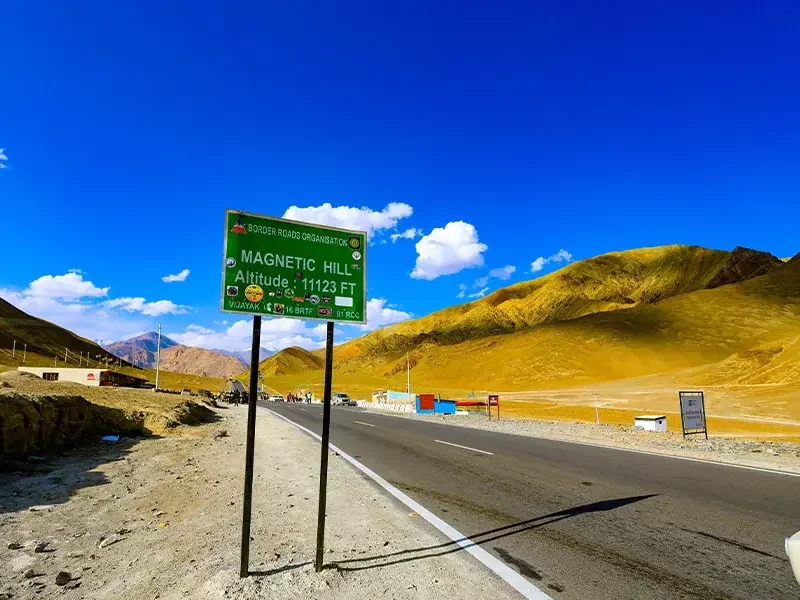
Historically, the site was shrouded in local folklore, with villagers believing the road once led directly to heaven; those who were "deserving" would be pulled upward, while the "undeserving" could never make progress. Today, the Border Roads Organization (BRO) has marked the area with prominent signage to assist travelers in experiencing the phenomenon safely. It serves as a significant landmark for those traveling toward the Nimmu Valley and the confluence of the Indus and Zanskar rivers.
Best Time to Visit Magnetic Hill
Magnetic Hill, located at an altitude of approximately 11,000 feet on the Leh-Srinagar Highway, is a gravity-defying phenomenon that is accessible for most of the year. However, the experience of testing the optical illusion is best during the months when the asphalt is dry and the main trans-Himalayan highways are open to regular traffic.
- Ideal months: May to October is the most favorable period, with June to September providing the best road conditions for vehicles to experience the uphill magnetic pull effect.
- Weather conditions: Summer daytime temperatures are pleasant, ranging from 15°C to 25°C, but the site is located in a completely barren valley with no shade, leading to intense heat and high UV exposure during midday.
- Periods to avoid: Avoid the deep winter months of December to February if you are uncomfortable with extreme cold, as temperatures often stay below freezing and heavy snow can temporarily hide the road markings necessary to identify the "magnetic" starting point; additionally, late July can bring sporadic rain that makes the dusty surrounding terrain muddy and less photogenic.
How to Reach Magnetic Hill
Magnetic Hill is a world-famous gravity hill located on the Srinagar-Leh Highway (NH1) at an altitude of approximately 3,350m (11,000 ft). It is a major tourist attraction where the surrounding layout creates an optical illusion, making stationary vehicles appear to roll uphill against gravity when placed in neutral.
- Nearest Airport: Kushok Bakula Rimpochee Airport (IXL) in Leh is the closest airport, situated about 25 km away. The drive from the airport to the hill takes approximately 30 to 45 minutes.
- Nearest Railway Station: Jammu Tawi is the nearest major railhead, located roughly 660 km away. Most visitors reach this site via road as part of their entry into Leh from Srinagar or during a local sightseeing circuit.
- Road Access via NH1: The site is located directly on the National Highway 1, connecting Leh to Kargil and Srinagar. It is easily accessible from Leh city by heading west toward Nimmu and Pathar Sahib Gurudwara.
- Last-Mile Connectivity: The highway is in excellent condition and is accessible by all vehicle types, including small hatchbacks, luxury sedans, and motorcycles. Many travelers visit the hill as part of a half-day trip that also includes the Hall of Fame, Sangam (Indus-Zanskar confluence), and Pathar Sahib Gurudwara.
- Traveler Logistics: The specific "magnetic" stretch is clearly marked with a yellow box painted on the road. There is a designated parking area and small cafes nearby for visitors to rest. No trekking or hiking is required to experience the phenomenon.
- Practical Amenities: Being a popular tourist spot, basic facilities like refreshments and restrooms are available at nearby transit points. The nearest reliable fuel station is in Leh or further down at Khalsi. Mobile connectivity for BSNL and Airtel postpaid users is generally strong in this area.
What to Expect When You Visit Magnetic Hill
- http://googleusercontent.com/map_location_reference/1
- Environment and Surroundings: [Magnetic Hill](http://googleusercontent.com/map_location_reference/0) is located at an altitude of approximately 3,350 meters (11,000 feet) on the Srinagar-Leh Highway (NH1). The landscape is a stark, high-altitude desert surrounded by barren, brown mountains, featuring a specific stretch of road where a "gravity-defying" optical illusion occurs, making stationary vehicles appear to roll uphill.
- Facilities and Amenities: Infrastructure at the immediate site is extremely limited. Aside from the marked road segment and a few information boards, there are no permanent shops or medical facilities. A few seasonal cafes and small eateries are located within a short drive along the highway toward Nimmu or Leh, but travelers should carry their own water and snacks.
- Accessibility and Movement: The site is highly accessible as it lies directly on the main NH1 highway, roughly 30 km from Leh. The road is well-paved and manageable for all vehicle types. Visitors usually park in the designated "Yellow Box" painted on the road to experience the magnetic effect, though caution is required as this is an active highway with fast-moving traffic and military convoys.
- Typical Visitor Behavior and Conditions: The site is a popular 15-to-20-minute photography and novelty stop for tourists traveling between Kargil and Leh. Visitors typically turn off their engines and put their vehicles in neutral to observe the illusion. While the altitude is lower than the major passes, the intense sun and lack of shade can lead to dehydration, and the area can become crowded with tour groups during midday.
Essential Visitor Information for Taglang La Pass
- Crowd and Weather: As one of the highest motorable passes on the Manali-Leh Highway (5,328 meters), expect moderate transit traffic; weather is notoriously volatile with sudden snow flurries and a perpetual, high-velocity wind that creates a severe wind-chill effect even in July.
- Peak and Quiet Visiting Hours: Peak transit occurs between 11:00 AM and 3:00 PM; for the quietest experience and the most stable light for photography, aim for a crossing between 8:00 AM and 10:00 AM, provided the road has been cleared of overnight frost.
- Dress Code: Technical cold-weather gear is essential; wear a windproof outer shell, heavy fleece or down mid-layers, and thermal leggings. A woolen cap that covers the ears and a neck buff are necessary to prevent windburn and headaches.
- Safety and Altitude Cautions: The rapid ascent from the Moore Plains often triggers acute altitude symptoms; limit your stay at the top to 10–15 minutes and avoid physical exertion. Descent toward Upshi is steep with numerous hairpins—ensure your vehicle’s brakes are in optimal condition.
- Logistics and Facilities: There are no permanent shops or medical facilities at the summit; the nearest basic amenities are located at the base in Moore Plains or further down in Rumtse. Mobile connectivity is non-existent at the pass.
Photography Strategy and Viewpoints for Magnetic Hill
[Magnetic Hill](http://googleusercontent.com/map_location_reference/0) is a world-famous "gravity hill" located on the Srinagar-Leh Highway, where the surrounding landscape creates an optical illusion that parked vehicles are moving uphill. Documenting this phenomenon requires specific angles to emphasize the perspective shift against the stark, arid mountains of the Indus Valley.
- The Optical Illusion Perspective: To capture the "uphill" movement effectively, position your camera at a low angle on the shoulder of the highway, looking toward the east. Use a mid-range lens (35mm-50mm) to maintain a natural perspective that highlights the road's alignment with the sloping ridgelines in the background.
- The "Yellow Box" Framing: The Border Roads Organization has marked a specific yellow box on the asphalt where the illusion is strongest. Photographing a vehicle positioned here from a distance of 20-30 meters provides a clear visual narrative of the gravity-defying claim, especially when framed with the official "Magnetic Hill" signage.
- Optimal Lighting and Contrast: Mid-morning (9:30 AM – 11:30 AM) is the superior time for photography. The sun is high enough to eliminate the deep shadows from the southern ridges that can obscure the road surface, yet low enough to provide texture to the weathered sedimentary rock faces.
- Wide-Angle Indus Valley Vistas: Beyond the illusion itself, the area offers expansive views of the Indus River valley. Walk 50 meters up the small embankment to the north for an elevated panoramic shot of the highway cutting through the desolate, multi-toned brown landscape.
- Traffic and Safety Factors: As a major tourist attraction on the NH1, the road is frequently busy with taxis and heavy trucks. Use a spotter if you are setting up a tripod near the road surface. Avoid standing in the center of the lane, as the optical illusion can make it difficult for drivers to judge their actual speed and braking distance.
- Technical Environmental Considerations: The area is exceptionally reflective and prone to heat haze during peak summer afternoons. A circular polarizer is recommended to maintain color saturation in the sky and to reduce the shimmering effect on the asphalt.