Quick Facts About Rezang La War Memorial
| Entry Fee | Free |
| Timings | 06:00 - 18:00 |
| Altitude (m) | 5000 |
| Ideal Visit Duration (hrs) | 1 |
| Best Time of Day | Morning |
| Crowd Level | Low |
| Distance from Leh (km) | 235 |
| Walking Difficulty | Easy |
| Parking Available | No |
| Last Mile Access | Road |
| Suitable for Kids | No |
| Suitable for Seniors | No |
| Wheelchair Friendly | No |
Why Visit Rezang La War Memorial
Rezang La War Memorial is visited not for scenery or leisure, but for its deep national and historical meaning. It is a place for reflection, remembrance, and understanding the realities of high-altitude warfare and sacrifice made by Indian soldiers during the 1962 conflict.
Atmosphere
The atmosphere at Rezang La is stark, silent, and solemn. The high-altitude plateau is harsh and exposed, with strong winds and thin air creating a sense of isolation. There are no crowds, commercial activity, or distractions, allowing visitors to experience the gravity of the place without interruption.
What Makes It Special
What makes Rezang La War Memorial special is the story it represents. In November 1962, a small unit of the 13 Kumaon Regiment defended this position against overwhelming enemy forces, fighting until the last man. The memorial stands at or near the actual battlefield, making it one of the few war memorials in India located in such extreme terrain. Its authenticity, location, and historical significance give it a powerful emotional impact that cannot be replicated by museums or plaques elsewhere.
Battle Background of Rezang La
Rezang La is the site of one of the most significant and documented battles of the 1962 India China war. In November 1962, troops of Charlie Company, 13 Kumaon Regiment, were deployed at Rezang La to defend India’s eastern Ladakh frontier. Despite being heavily outnumbered and facing severe weather, limited supplies, and extreme altitude, the soldiers held their position against repeated attacks.
The battle is remembered for the exceptional courage and discipline displayed by the Indian soldiers, many of whom fought until they exhausted ammunition and were killed at their posts. The terrain, altitude, and freezing conditions added to the intensity of the conflict, making survival itself a challenge even without combat.
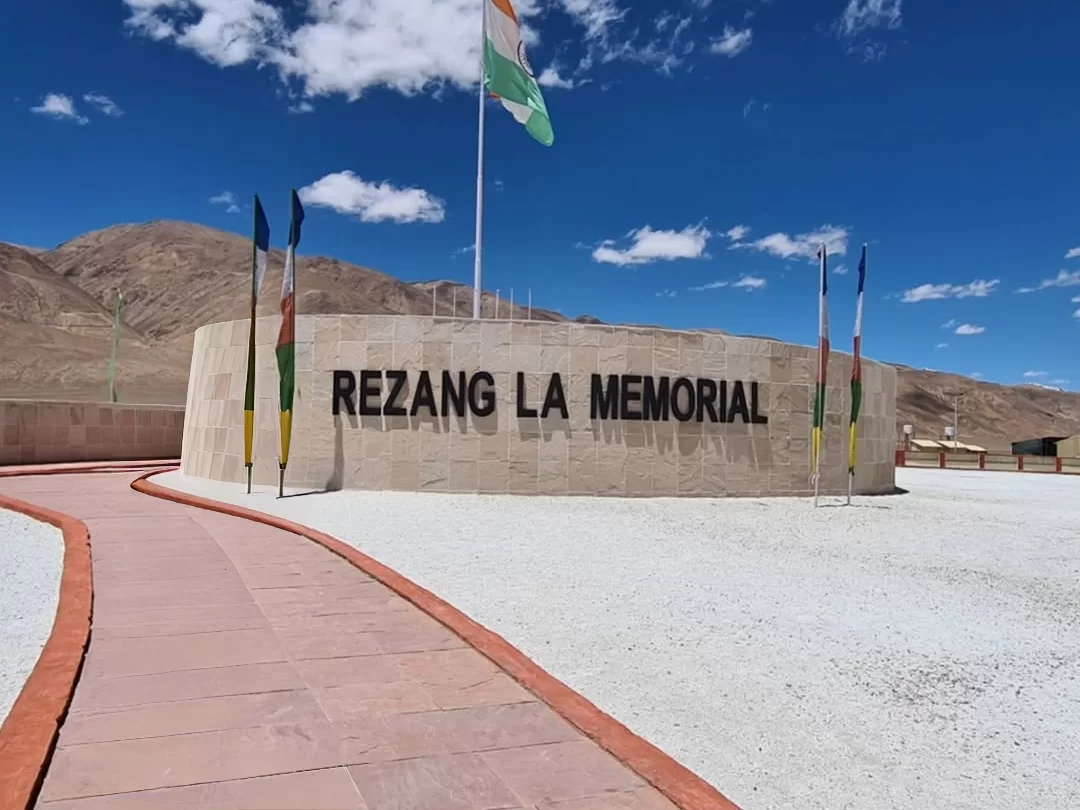
After the war, Rezang La became a symbol of sacrifice and military honor. The War Memorial was later established near the battlefield to commemorate the fallen soldiers and to preserve the memory of their stand. Unlike ceremonial memorials in urban settings, this site remains closely tied to the actual terrain and conditions under which the battle was fought.
Today, Rezang La is recognized as a place of national remembrance rather than a conventional heritage site. Its importance lies in historical record, military legacy, and the continued respect shown by the armed forces and visitors who reach this remote location.
Best Time to Visit Rezang La War Memorial
The best time to visit Rezang La War Memorial is from late May to early October, when roads in the Changthang region are generally open and weather conditions allow safe travel. Even during this window, temperatures remain low due to the extreme altitude, and strong winds are common.
June to September offers the most reliable access. Snow has cleared from approach roads, and daylight hours are longer, which is important because visits are only advisable during daylight. Weather can still change quickly, so flexibility in travel plans is necessary.
From October onward, temperatures drop sharply and snowfall can block routes without warning. Between November and April, the area is largely inaccessible due to heavy snow, extreme cold, and security-related restrictions, making visits impractical and unsafe.
- Late May and June provide quieter conditions but colder mornings and evenings
- July and August offer the safest road access with relatively stable weather
- September has clear skies and fewer vehicles but shorter daylight hours
- Winter months are not suitable due to road closures and severe cold
How to Reach Rezang La War Memorial
- Rezang La War Memorial is reached by road from Leh, covering a distance of approximately 230 to 235 km through the Changthang region of eastern Ladakh
- The commonly followed route is Leh to Karu to Upshi to Chumathang to Nyoma to Loma to Chushul and onward toward Rezang La, subject to security permissions
- A mandatory army check post is located at Loma Bridge, where all visitors must present valid government-issued identity proof
- Inner Line Permit is compulsory for Indian nationals, as Rezang La lies in a highly sensitive border area
- Foreign nationals are not permitted to visit Rezang La due to proximity to the India China border
- There is no public transport to Rezang La; access is only possible via private vehicles or authorized tour operators
- Road conditions are rough and exposed, with long isolated stretches, strong winds, and occasional water crossings during summer
- No fuel stations or repair facilities are available beyond Karu or Upshi, so vehicles must be fully fueled and checked before departure
What to Expect When You Visit Rezang La War Memorial
- A simple and solemn war memorial set in an open high-altitude plateau with no surrounding development
- Harsh weather conditions, including strong winds and low temperatures, even during summer months
- Very thin air due to extreme altitude, making physical movement slower and more tiring
- No tourist facilities such as restrooms, food stalls, or shelters near the memorial
- Minimal crowd presence, with only a few permitted visitors reaching the site
- A quiet environment that encourages reflection rather than sightseeing
- Restricted movement beyond designated areas due to security considerations
- Long travel time from Leh, requiring careful planning and acclimatization
Important Visitor Information for Rezang La War Memorial
- Crowd and weather notes: Rezang La sees extremely low visitor numbers, but weather conditions are harsh with strong winds, sudden cloud cover, and rapid temperature drops even in summer
- Peak hours: Late morning to early afternoon, when permitted vehicles usually pass through the area
- Quiet hours: Early mornings and late afternoons are generally empty but much colder and windier
- Dress code: Heavy winter clothing is essential, including insulated jackets, windproof layers, gloves, woollen caps, and sturdy boots
- Safety notes: Extreme altitude poses a serious risk of altitude sickness; visitors should only attempt the visit after proper acclimatization in Leh
- Visitors should remain within permitted areas and follow instructions from security personnel at all times
- There are no medical facilities, shelters, or emergency services nearby, so self-preparedness is critical
- Photography may be restricted in certain directions due to border sensitivity
Photography and Viewpoints at Rezang La War Memorial
- The memorial itself is the primary viewpoint, set against a vast high-altitude plateau with unobstructed views of surrounding hills and open terrain
- Late morning to early afternoon offers the safest and clearest light conditions, reducing deep shadows caused by low-angle sunlight
- The stark landscape, minimal structures, and wide horizons make this location suitable for wide-angle and documentary-style photography
- Weather changes rapidly, so visibility can shift within minutes due to cloud movement and wind-driven dust
- Close-up photography of the memorial is generally permitted, but shooting toward border-facing directions may be restricted
- Tripods can be used, but strong winds require firm stabilization
- There are no elevated platforms or marked viewpoints; all photography is done from ground level around the memorial
- Drone photography is strictly prohibited due to the sensitive military location