Quick Facts About Nakee La Pass
| Entry Fee | Free |
| Timings | 06:00 - 18:00 |
| Altitude (m) | 4739 |
| Ideal Visit Duration (hrs) | 0.25 |
| Best Time of Day | Morning |
| Crowd Level | Moderate |
| Distance from Sarchu (km) | 85 |
| Walking Difficulty | Easy |
| Parking Available | Yes |
| Last Mile Access | Road |
| Suitable for Kids | Yes |
| Suitable for Seniors | Yes |
| Wheelchair Friendly | No |
Why Visit Nakee La Pass on the Manali-Leh Highway
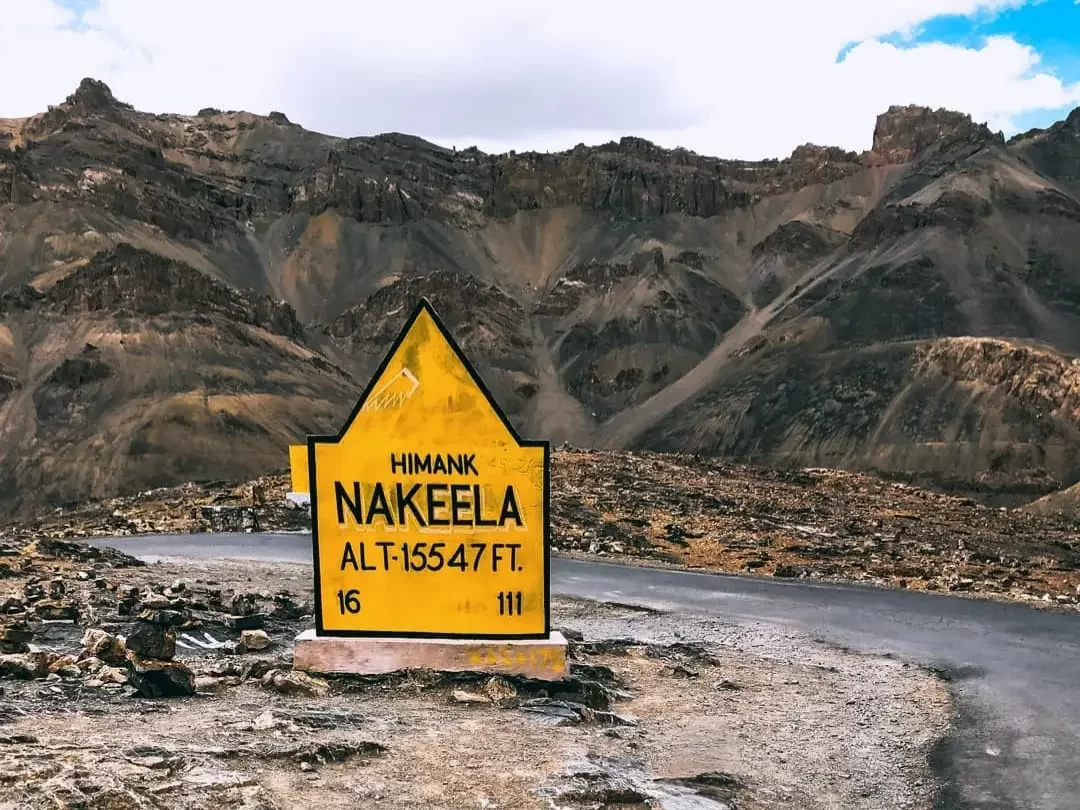
Travelers ascend Nakee La Pass primarily as a critical milestone on the legendary Manali-Leh Highway, situated at an elevation of 15,547 feet. It is most famous for being the site of the 21 Gata Loops, a series of hairpin bends that challenge drivers and cyclists while providing a necessary transition between the lower valleys of Lahaul and the high-altitude plateaus of Ladakh.
The atmosphere at Nakee La is dominated by the sheer scale of the surrounding limestone mountains and the rhythmic, dizzying perspective of the loops below. The air is notably crisp and thin, creating a sense of stark isolation where the only sounds are the whistling wind and the occasional hum of heavy BRO convoys traversing the dusty, sun-bleached terrain.
This pass is distinct for its dramatic topographical shift and the local lore surrounding the "Ghost of Gata Loops," where travelers often leave water bottles at a roadside shrine. It offers a unique vantage point to witness the geological transition of the Zanskar Range, making it a pivotal site for those documenting the raw, engineering-defying transit of the Indian Himalayas.
Historical and Geographic Significance of Nakee La Pass
Nakee La Pass is a high-altitude mountain pass situated at an elevation of 4,739 meters (15,547 feet) along the Leh-Manali Highway in the Ladakh region. It represents the third of five major passes encountered when traveling from Manali to Leh, positioned between Sarchu and Pang.
The pass is defined by the 21 Gata Loops, a series of twenty-one hairpin bends that ascend the mountainside, showcasing the engineering required to navigate the Trans-Himalayan terrain. This stretch is a vital logistical link for the Border Roads Organization (BRO), ensuring the movement of supplies and travelers through the rugged Lahaul and Ladakh mountain ranges.
Local significance is marked by the presence of a roadside shrine dedicated to a ghost story involving a stranded truck driver, which has become a modern cultural fixture where travelers leave water bottles as a gesture of safe passage. Geographically, Nakee La serves as a critical transition point into the high-altitude arid desert, characterized by its lack of vegetation and oxygen-thin atmosphere.
Best Time to Visit Nakee La Pass
Nakee La, situated at 15,547 feet on the Manali-Leh Highway, is a transit-critical mountain pass that is only navigable when the Border Roads Organization clears the winter snowpack. Its accessibility is strictly dictated by the seasonal opening of the highway, typically offering a narrow window for travelers to traverse its famous 21 Gata Loops.
- Ideal months: June to September represent the only viable window, with June being the most dramatic for snow walls and September offering the most stable road conditions and crisp, clear vistas.
- Weather conditions: Expect extreme temperature fluctuations where intense high-altitude radiation provides warmth in direct sunlight, while blistering cold winds across the pass can drop the effective temperature to near freezing even at midday.
- Periods to avoid: October to May must be avoided as the pass is buried under heavy snow and officially closed to civilian traffic; additionally, the peak monsoon weeks of late July and August are hazardous due to frequent landslides and water crossings (nullahs) becoming turbulent on the ascent from Sarchu.
How to Reach Nakee La Pass
Nakee La Pass, situated at an elevation of approximately 4,740m (15,551 ft), is a vital high-altitude transit point on the Leh-Manali Highway. It is famous for being the third of the five passes encountered while traveling from Manali to Leh and is located between Sarchu and Pang.
- Nearest Airport: Kushok Bakula Rimpochee Airport (IXL) in Leh is the closest domestic airport, approximately 190 km away. Alternatively, Kullu-Manali Airport (KUU) in Bhuntar is roughly 285 km from the pass.
- Nearest Railway Station: Joginder Nagar Railway Station (narrow gauge) is about 410 km away, while Chandigarh Railway Station (broad gauge) is approximately 580 km away, making road travel the only practical entry method.
- Road Access and Gata Loops: The pass is accessible via the NH3 (Leh-Manali Highway). Travelers approaching from the Manali side must negotiate the "Gata Loops"—a series of 21 hair-raising hairpin bends that climb steeply from the Sarchu plains to the approach of Nakee La.
- Last-Mile Connectivity: There is no public transport directly to the pass. Travel is conducted via private taxis, self-drive SUVs, or expedition-grade motorcycles. The road is maintained by the Border Roads Organization (BRO), but the surface often features loose gravel and potholes due to heavy winter snow melt.
- Travel Limitations: The pass is seasonally restricted and typically remains open only from June to October. Even in summer, the pass can experience sudden snowfall. Due to the rapid altitude gain via the Gata Loops, travelers are at high risk of Acute Mountain Sickness (AMS); it is advised to transit quickly and avoid long halts at the summit.
- Infrastructure Constraints: There are no fuel stations, mechanical workshops, or medical facilities within a 70 km radius of Nakee La. Travelers must ensure they have sufficient fuel from Tandi or Karu and carry emergency oxygen and basic repair kits.
What to Expect When You Visit Nakee La Pass
- Environment and Surroundings: Located at an altitude of 4,739 meters (15,547 feet) on the Manali-Leh Highway, the pass is defined by a stark, high-altitude alpine desert environment. It is the third of five high passes on the route and is characterized by the 21 Gata Loops, a series of hairpin bends leading up to the summit where strong crosswinds and dusty conditions are frequent.
- Facilities and Amenities: There are no permanent structures, electricity, or running water at the pass. While occasional temporary seasonal stalls (Dhabas) may be found at the base of the Gata Loops or in nearby Sarchu, the summit itself lacks any medical, mechanical, or sanitary facilities.
- Accessibility and Movement: The road is paved but subject to heavy degradation from winter snow and heavy truck traffic. Movement is often slow due to the steep gradient of the Gata Loops and the presence of heavy freight convoys; the pass is typically only accessible between June and October, depending on snow clearance.
- Typical Visitor Behavior and Conditions: Most travelers experience the pass as a transit point rather than a long-stay destination. Rapid ascent via the loops often triggers symptoms of altitude sickness, so visitors generally stop briefly for photography and acclimatization before descending toward Sarchu or Whiskey Nala to minimize time spent at peak elevation.
Essential Visitor Information for Nakee La Pass
- Crowd and Weather: Located at 4,739 meters (15,547 feet), Nakee La is a high-transit but less-celebrated pass on the Manali-Leh Highway; expect raw, lunar-like landscapes with intense, biting winds and highly unpredictable weather that can shift from bright sunshine to moderate snowfall within minutes.
- Peak and Quiet Visiting Hours: Most travelers cross between 9:00 AM and 3:00 PM as part of the Day 2 transit between Sarchu and Leh; early morning crossings (before 8:00 AM) are the quietest but coldest, while late afternoon transits are discouraged due to dropping temperatures and lack of nearby facilities.
- Dress Code: Wind-blocking layers are essential; wear a heavy windcheater or down jacket over thermals, and ensure you have a woolen cap (balaclava), polarized sunglasses to prevent snow/sun blindness, and insulated gloves.
- Safety and Practical Cautions: Limit your stay at the summit to 5–10 minutes to avoid Acute Mountain Sickness (AMS); the pass is situated immediately above the 21 hairpin bends of the Gata Loops, where the rapid altitude gain (from 4,250m to 4,739m) frequently triggers nausea and headaches.
- Logistics and Infrastructure: There are no shops, settlements, or mobile connectivity at the pass; the nearest emergency transit camps and basic food stalls are located at Sarchu (40 km south) or Pang (40 km north).
Best Viewpoints and Photography Guide for Nakee La Pass
Situated at an altitude of 4,739 meters (15,547 feet) on the Leh-Manali Highway, Nakee La is defined by its dramatic limestone terrain and the legendary 21 Gata Loops that precede it. Capturing the essence of this pass requires planning for its unique geography and high-contrast environment.
- The Gata Loops Perspective: The most iconic shot is not at the summit itself but from the ascent. Stop at the pull-offs between loops 18 and 21 to capture the serpentine road below, which provides a powerful visual narrative of the climb's scale.
- Summit Panoramas: From the Nakee La marker, face westward to photograph the stark, jagged peaks of the Zanskar Range. The landscape here is almost entirely devoid of vegetation, offering a "moonscape" aesthetic that benefits from wide-angle lenses.
- Lighting Strategy: Early morning (7:00 AM – 9:00 AM) is the most favorable time for photography. The sun rises behind the pass, illuminating the valley walls and deep canyons with a soft glow while avoiding the harsh, vertical shadows that flatten the landscape by noon.
- Environmental Constraints: High-altitude dust and wind are constant factors. It is vital to avoid lens changes in the open air to prevent sensor contamination. Use a fast shutter speed to compensate for wind-induced camera vibration if using a tripod.
- Access and Drone Regulations: While standard photography is unrestricted, the pass is a critical transit point for Indian Army convoys. Drone usage is strictly prohibited without prior military and civil authorization due to the proximity to sensitive border regions.