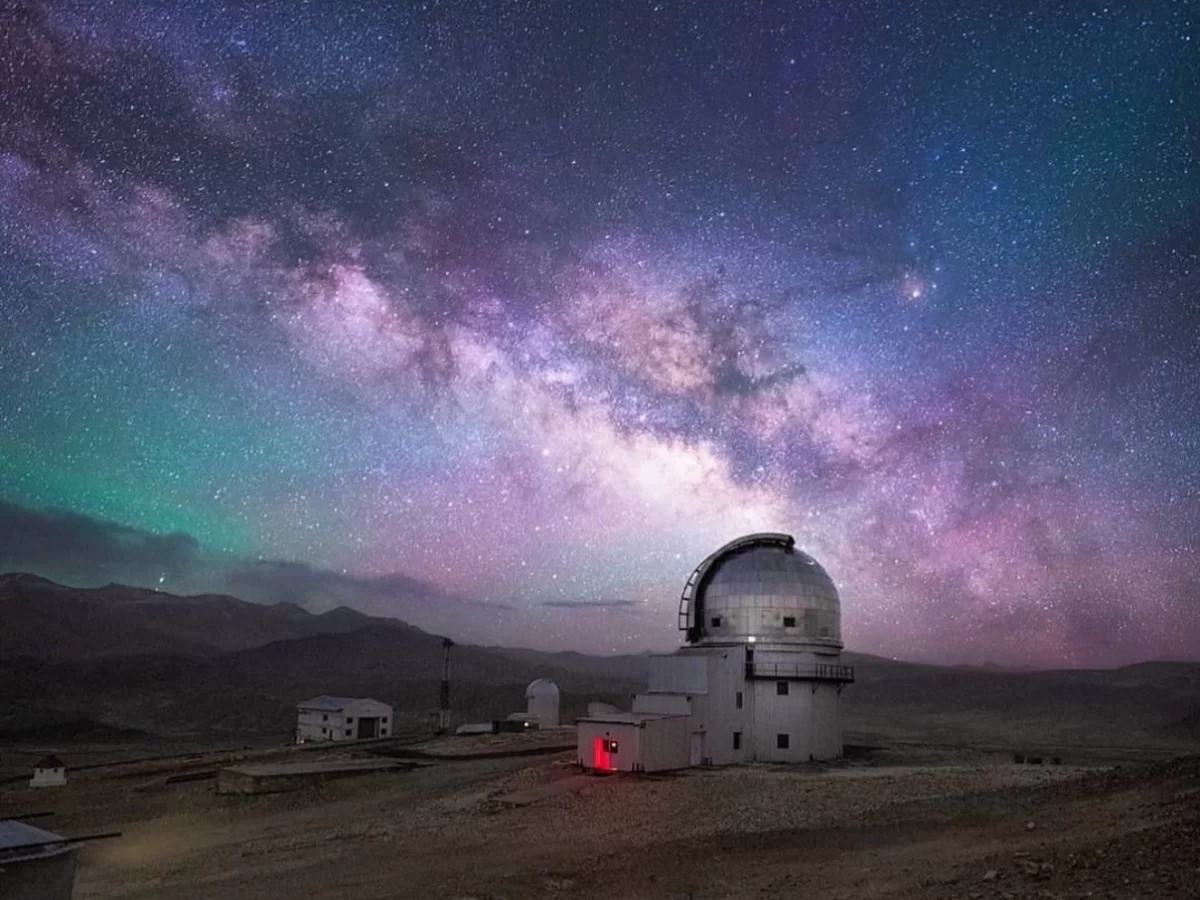
Hanle Observatory Ladakh | Indian Astronomical Observatory Travel Guide

Hanle Observatory , Hunder
Hanle Observatory, officially known as the Indian Astronomical Observatory, is located near Hanle village in eastern Ladakh at very high altitude. It was established by the Indian Institute of Astrophysics for astronomical and astrophysical observations due to the region’s dry climate, minimal light pollution, and exceptionally clear night skies. The observatory houses powerful optical telescopes and functions primarily as a scientific research facility, not a tourist attraction. Visitor access is limited, and most travelers view it only from outside while exploring the remote Changthang region.

Quick Facts About Hanle Observatory

Entry Fee Free
Timings 06:00 - 18:00
Altitude (m) 4500
Ideal Visit Duration (hrs) 1
Best Time of Day Morning
Crowd Level Low
Distance from Leh (km) 255
Walking Difficulty Easy
Parking Available Yes
Last Mile Access Road
Suitable for Kids No
Suitable for Seniors No
Wheelchair Friendly No

Why Visit Hanle Observatory

Hanle Observatory is worth visiting for travelers interested in science, extreme landscapes, and the realities of high-altitude research rather than conventional sightseeing. It offers a rare chance to see where frontline astronomical work is conducted in one of the most remote and least light-polluted regions of India.

Atmosphere

The atmosphere around Hanle Observatory is quiet, isolated, and stark. The surrounding Changthang plateau feels vast and almost empty, with strong winds, thin air, and minimal human activity. Nights are exceptionally dark and silent, reinforcing why this location was chosen for astronomical observation.

What Makes It Special

What makes Hanle Observatory special is its combination of altitude, climate, and darkness. Situated at around 4500 meters, it is among the highest optical observatories in the world. The dry air, low atmospheric disturbance, and near-zero light pollution create ideal conditions for deep-space observation, making the site scientifically important even though public access is limited.

Scientific Background of Hanle Observatory

Hanle Observatory, officially known as the Indian Astronomical Observatory, was established in the late 1990s by the Indian Institute of Astrophysics to support advanced astronomical research. The site was selected after extensive scientific surveys identified the Hanle region as one of the best locations in India for optical and infrared astronomy due to its high altitude, extremely low atmospheric moisture, and minimal light pollution.

The observatory became operational in 2001 with the installation of the Himalayan Chandra Telescope, a 2-meter optical infrared telescope used for deep-space observations. Since then, Hanle has played a key role in Indian and international astronomical studies, contributing to research on stars, galaxies, quasars, and solar system objects.

Unlike heritage or cultural sites, Hanle Observatory functions as an active scientific facility rather than a public monument. Its development reflects India’s growing investment in space science and ground-based astronomy, and its continued operation depends on maintaining strict controls over light, access, and surrounding activity.

The observatory’s presence has also influenced regional policies, including dark-sky protection measures around Hanle village, ensuring that scientific research can continue without interference from artificial lighting or unregulated development.

Best Time to Visit Hanle Observatory

The best time to visit Hanle Observatory is from late May to early October, when high-altitude roads in eastern Ladakh are accessible and weather conditions are comparatively stable. During this period, travelers can reach Hanle village safely and view the observatory complex from outside during daylight hours.

June to September offers the most reliable travel window, with minimal snow on approach roads and manageable daytime temperatures. Despite summer conditions, temperatures remain low due to the altitude, and strong winds are common throughout the day.

From October onward, temperatures drop sharply, and early snowfall can make the route unreliable. Between November and April, Hanle is largely inaccessible due to snowbound roads, extreme cold, and limited local support facilities.
  • Late May and June provide clearer skies with fewer travelers but colder mornings
  • July and August offer the safest road access and stable daytime travel conditions
  • September brings crisp weather and excellent visibility with shorter daylight hours
  • Winter months are not suitable due to road closures and severe cold

How to Reach Hanle Observatory

  • Hanle Observatory is accessed by road from Leh, covering a distance of approximately 255 km through the Changthang region of eastern Ladakh
  • The most common route is Leh to Karu to Upshi to Chumathang to Nyoma to Loma to Hanle village
  • A security check post is present at Loma Bridge, where valid identity proof is mandatory for all travelers
  • Inner Line Permit is required for Indian nationals as Hanle lies close to the India China border
  • Foreign nationals are not permitted beyond certain points on the Hanle route and cannot visit the observatory area
  • Public transport options are extremely limited, making private taxis or pre-arranged vehicles necessary
  • Road conditions vary by season, with broken stretches and water crossings during summer
  • No fuel stations are available after Karu or Upshi, so vehicles must be refueled before departure

What to Expect When You Visit Hanle Observatory

  • A remote high-altitude research facility located in an open, windswept plateau with minimal surrounding development
  • No public entry inside the observatory buildings, as the site functions as an active scientific research center
  • Clear views of the observatory domes from outside the perimeter during daylight hours
  • Extremely thin air due to altitude, which can cause breathlessness or fatigue without proper acclimatization
  • Cold temperatures even in summer, with strong winds common throughout the day
  • Very limited facilities, with no restrooms, cafes, or information centers near the observatory
  • Low tourist presence, with only a few vehicles stopping briefly while crossing the Hanle route
  • Long travel time from Leh, making the visit suitable only as part of a planned multi-day Changthang itinerary

Important Visitor Information for Hanle Observatory

  • Crowd and weather notes: Hanle Observatory experiences extremely low visitor traffic, but weather conditions can change quickly with strong winds, sudden cloud cover, and sharp temperature drops even in summer
  • Peak hours: Late morning to early afternoon when travelers pass through Hanle village and briefly stop near the observatory perimeter
  • Quiet hours: Early mornings and late afternoons are usually empty but colder and windier
  • Dress code: Heavy layered clothing is essential, including insulated jackets, windproof outerwear, gloves, and warm footwear throughout the year
  • Safety notes: High altitude poses a real risk of altitude sickness; visitors should only attempt this route after proper acclimatization in Leh
  • There are no medical facilities near the observatory, and emergency assistance can take several hours to reach the area
  • Mobile network connectivity is very limited or completely unavailable around the observatory
  • Visitors should respect restricted zones and avoid approaching observatory buildings without permission

Photography and Viewpoints at Hanle Observatory

  • The best viewpoints are from the public road and open ground outside the observatory boundary, where the telescope domes can be photographed against the vast Changthang plateau
  • Clear daytime conditions allow wide-angle landscape shots combining the observatory, barren hills, and expansive high-altitude sky
  • Late morning to afternoon offers stable light and safer conditions, as early mornings and evenings are colder and windier
  • Night photography of the sky is exceptional in the Hanle region due to minimal light pollution, but the observatory complex itself should not be photographed at night or with artificial lighting
  • Tripods are useful for landscape and low-light shots, but strong winds require firm stabilization
  • Close-up photography of equipment or buildings is restricted, and visitors should follow local guidance and posted rules
  • The surrounding plateau offers clean horizons, making it suitable for panoramic shots rather than detailed foreground compositions
  • Drone photography is not permitted due to proximity to sensitive border areas and the operational nature of the observatory

Near By Attraction

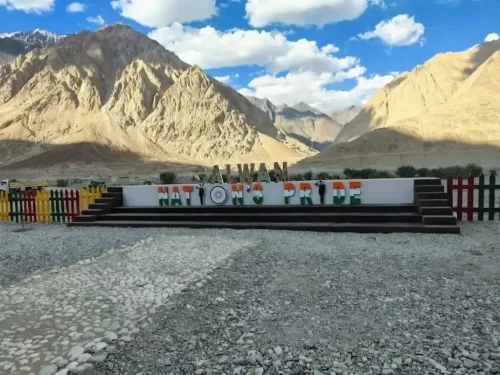
Galwan War Memorial, solemn tribute in Ladakh honoring the brave Indian soldiers who sacrificed their lives in the Galwan Valley clash. Memorial

Galwan War Memorial

Galwan War Memorial is a national war memorial in eastern Ladakh built in memory of the Indian Army soldiers who lost their lives in the Galwan Valley clash.

Colorful prayer flags and signposts pointing to Turtuk, Leh, Hundar, Kargil and Khalsar at snow-covered Khardungla Pass, capturing high-altitude Himalayan adventure vibes. Mountain Pass

Khardung La

Khardung La is a legendary high-altitude mountain pass in Ladakh, famous for its extreme elevation, dramatic views, and gateway access to Nubra Valley.
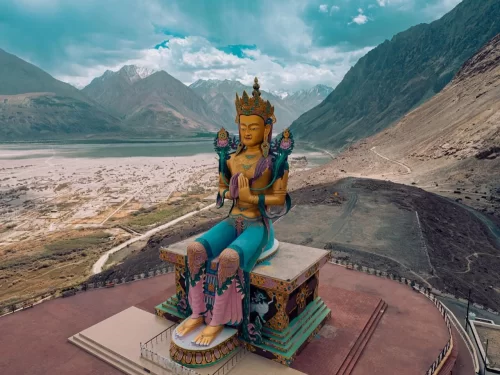
Diskit Gompa Ladakh aerial golden Maitreya Buddha statue snowy peaks Shyok River Nubra Valley desert backdrop, perfect Leh Ladakh spiritual adventure package. Monastery

Diskit Monastery

Diskit Monastery, also known as Deskit Gompa, is the oldest and largest Buddhist monastery in Nubra Valley, renowned for its giant Maitreya Buddha statue and panoramic valley views.

Frequently Asked Questions About Hanle Observatory

Hanle Observatory is located in the remote Changthang region of eastern Ladakh near Hanle village at high altitude. It is one of the highest astronomical observatories in the world.
Hanle Observatory is approximately 250 to 270 kilometers from Leh and the drive usually takes 7 to 9 hours depending on road and weather conditions.
Travelers reach Hanle Observatory by driving from Leh toward Upshi and Nyoma and then continuing through remote high altitude terrain toward Hanle village.
Visitors require an Inner Line Permit to travel to Hanle because it lies in a restricted border region of eastern Ladakh. Permits are arranged in Leh before departure.
Tourists are generally not allowed inside the main telescope facility of Hanle Observatory as it is an operational research center. Visitors can view the structure from designated external areas.
The best time to visit Hanle Observatory is between June and September when roads are accessible and skies are clear for mountain and night sky views.
Hanle Observatory is usually not accessible during peak winter months because snowfall and extreme temperatures affect road connectivity in the Changthang region.
Travelers typically spend 30 to 60 minutes near Hanle Observatory viewing the facility from outside and exploring nearby viewpoints.
Hanle Observatory is located at very high altitude so proper acclimatization is important. Senior citizens can visit if medically fit and comfortable with long remote drives.
There are no food facilities at Hanle Observatory itself though small guesthouses and homestays are available in Hanle village. Travelers should plan meals in advance.
Road conditions toward Hanle Observatory include paved stretches mixed with rough gravel sections especially beyond Nyoma where terrain becomes more isolated.
Hanle Observatory is often combined with visits to Tso Moriri Puga Valley or Umling La as part of an extended eastern Ladakh circuit from Leh.

Loved this place ? Let’s Plan Your Ladakh Trip

Get customized Ladakh tour planning designed around altitude comfort, acclimatization time, weather windows, and real Himalayan road conditions. Whether you are visiting for high mountain passes, monasteries, lakes, or remote valley experiences, our exper

⚡ Quick Response | 💰 Free consultation | 🕒 24×7 expert support

×

Plan Your Trip