


Uttarakhand in January – Weather, Snowfall & Travel Guide
Plan a January trip to Uttarakhand with practical information on weather, snowfall, temperatures, road conditions, places to visit and winter activities.
+91 9910402252
admin@chalbanjare.com


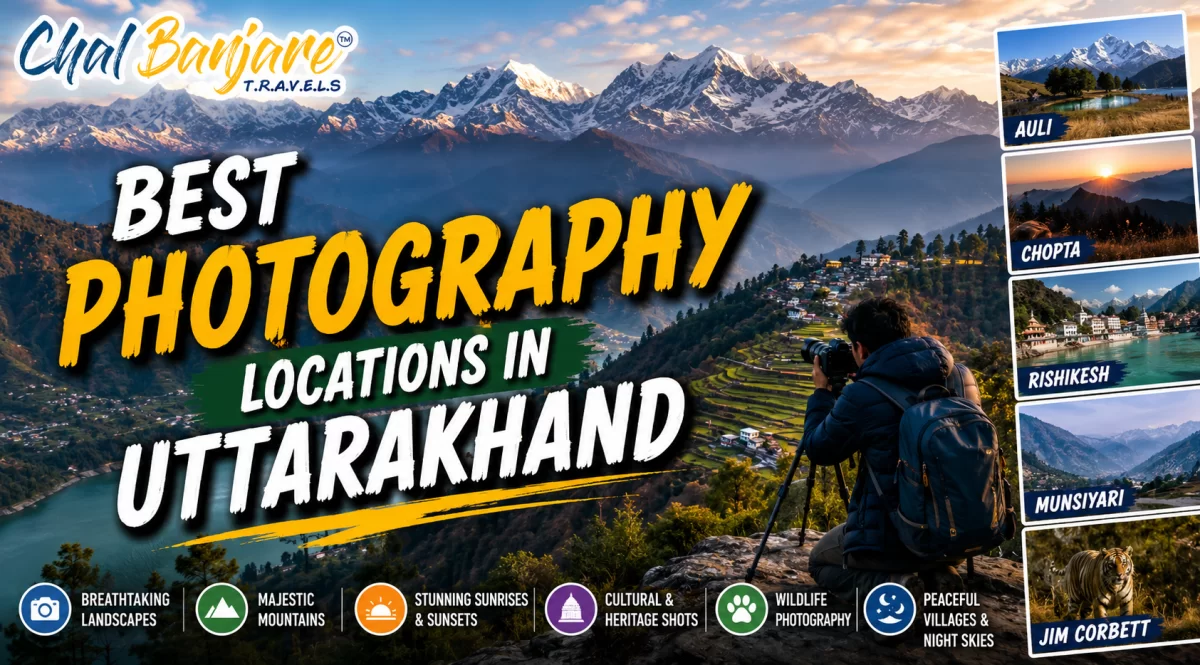
Uttarakhand offers breathtaking photography opportunities ranging from Himalayan peaks and alpine meadows to lakes, waterfalls, wildlife habitats, villages, and spiritual destinations.
Uttarakhand offers some of the finest Himalayan photography opportunities in India, with destinations such as Auli, Munsiyari, Chopta, Kausani, Binsar, Dayara Bugyal, and the higher reaches of the Garhwal and Kumaon Himalayas providing remarkable mountain landscapes. Each location offers a unique perspective of the Himalayan range, from snow-covered summits and alpine meadows to deep valleys and dense conifer forests. The constantly changing weather, shifting light, and dramatic terrain allow photographers to capture different moods throughout the year.
Auli is well known for panoramic views of Nanda Devi, Kamet, Mana Parvat, Dunagiri, and surrounding peaks, while Munsiyari offers spectacular views of the Panchachuli range rising above traditional Himalayan villages. Chopta combines alpine meadows, forests, and trekking routes leading towards Tungnath and Chandrashila, making it one of Uttarakhand's most photogenic mountain destinations. Binsar Wildlife Sanctuary and Kausani provide excellent elevated viewpoints where photographers can capture long Himalayan panoramas without undertaking demanding treks.
Each mountain destination presents its own photographic style, allowing visitors to capture everything from dramatic snow-covered peaks to peaceful high-altitude meadows. Exploring several regions during one journey offers a comprehensive visual experience of Uttarakhand's remarkable Himalayan landscapes.
The diversity of Uttarakhand's mountain terrain provides endless opportunities for landscape photography. High-altitude ridges overlook glacier-fed valleys, dense forests gradually transition into alpine grasslands, and distant snow peaks dominate the horizon during clear weather. Photographers can create wide-angle compositions featuring rivers, forests, villages, and towering mountain ranges within a single frame, particularly from elevated viewpoints reached by road or trekking routes.
Valleys such as Johar Valley, Pindar Valley, Mandakini Valley, and the regions surrounding Kedarnath, Badrinath, and Gangotri offer striking combinations of rugged mountain terrain and traditional Himalayan settlements. Seasonal vegetation adds further variety, with spring flowers, lush summer greenery, autumn colours, and winter snow each creating distinct photographic conditions. Careful observation of weather patterns often rewards photographers with dramatic cloud formations and changing mountain light.
Photographing Uttarakhand's mountain landscapes requires patience because weather and lighting change continuously throughout the day. Waiting for clouds to shift or sunlight to reach distant peaks often produces more rewarding images than photographing immediately after arriving at a viewpoint.
Seasonal variation plays an important role in Himalayan photography. Winter transforms destinations such as Auli and Chopta into snow-covered landscapes, while spring introduces colourful rhododendron forests and clear mountain skies. Summer provides access to high-altitude trekking routes that remain inaccessible during winter, and autumn is widely regarded as one of the best seasons because of stable weather and exceptional visibility across the Himalayan ranges.
Sunrise is particularly rewarding because the first light gradually illuminates snow-covered peaks while valleys remain filled with soft morning mist. During sunset, warm golden light creates beautiful contrast against distant mountains before gradually fading into cooler twilight tones. Photographers should monitor local weather forecasts because mountain conditions change rapidly and dramatically influence visibility.
Successful Himalayan photography depends on matching destinations with the most suitable season and natural lighting. Travellers who remain flexible and plan around sunrise, sunset, and weather conditions can capture Uttarakhand's mountains in their most spectacular form while experiencing the constantly changing beauty of the Himalayas.
The Chopta region is one of Uttarakhand's most photogenic high-altitude destinations, offering exceptional views of Himalayan peaks, alpine meadows, forests, and ancient pilgrimage routes. The trek to Tungnath Temple and Chandrashila Summit provides photographers with constantly changing landscapes, beginning with rolling grasslands before climbing towards rocky ridges that reveal sweeping panoramas of Chaukhamba, Nanda Devi, Kedarnath, Trishul, and numerous surrounding peaks.
Tungnath Temple, recognised as the world's highest Shiva temple, creates a unique combination of spiritual architecture and dramatic mountain scenery. Continuing beyond the temple to Chandrashila Summit rewards photographers with one of the widest Himalayan viewpoints in Uttarakhand. Every season transforms the landscape, making the same route appear completely different throughout the year.
Chopta rewards photographers who take their time during the trek rather than focusing only on the destination. Every section of the trail offers new compositions, ensuring memorable photographs long before reaching Chandrashila Summit.
The trekking routes around Chopta pass through dense oak, pine, deodar, and rhododendron forests before opening into expansive alpine meadows. These transitions create remarkable opportunities to capture changing ecosystems within a relatively short distance. Seasonal wildflowers, forest trails, wooden signposts, grazing animals, and distant mountain views provide countless landscape and nature photography opportunities throughout the journey.
Photographers will find numerous viewpoints where forest clearings reveal distant Himalayan peaks framed by trees. During spring, blooming rhododendrons introduce vibrant colours, while autumn provides warm golden foliage. Even during misty weather, the forests develop a unique atmosphere that creates dramatic and moody compositions unavailable under clear skies.
Photographing the forests and meadows around Chopta highlights the remarkable ecological diversity of the Himalayas. Careful observation along the trekking route often reveals smaller natural details that complement the dramatic mountain scenery.
Sunrise is widely regarded as the finest time for photography in the Chopta region because the first rays of sunlight gradually illuminate the surrounding Himalayan peaks while valleys remain filled with soft morning mist. Chandrashila Summit becomes one of the most sought-after sunrise locations in Uttarakhand, offering breathtaking views across multiple Himalayan ranges as daylight spreads across the mountains.
Visitors planning sunrise photography should begin their trek well before dawn, allowing enough time to reach safe viewpoints before first light. Weather conditions strongly influence visibility, and clear autumn or winter mornings generally provide the sharpest mountain views. Carrying warm clothing and allowing extra time for changing light conditions greatly improves the overall photography experience.
Sunrise photography around Chopta combines dramatic Himalayan scenery with peaceful mountain silence. Careful preparation, patience, and favourable weather allow photographers to capture some of Uttarakhand's most iconic high-altitude landscapes in their finest natural light.
Uttarakhand's lake region, particularly around Nainital and Kumaon, provides outstanding opportunities for landscape photography throughout the year. Lakes such as Naini Lake, Bhimtal, Sattal, Naukuchiatal, Khurpatal, and Dodital combine calm water surfaces with forested hills, mountain skylines, and traditional hill town surroundings. Each lake has its own visual character, allowing photographers to capture reflections, changing light, lakeside architecture, and natural landscapes from a variety of viewpoints.
Naini Lake forms the centrepiece of Nainital and is surrounded by hills, promenades, temples, and colonial-era buildings that create attractive compositions throughout the day. Bhimtal offers a quieter atmosphere with broader views of the surrounding mountains, while Sattal's interconnected lakes are enclosed by dense forests, making them particularly rewarding for nature photography. Naukuchiatal, known for its nine-cornered shape, presents expansive water views with comparatively fewer visitors.
Each lake offers a different photographic atmosphere, from lively urban waterfronts to quiet forest settings. Exploring several lakes within the Kumaon region provides a varied portfolio of water landscapes that showcase the remarkable natural diversity of Uttarakhand.
Lake photography in Uttarakhand is strongly influenced by weather, natural light, and wind conditions. Calm mornings often produce near-perfect reflections of surrounding hills, forests, boats, and lakeside buildings, while gentle evening light creates warm colours across the water. Elevated viewpoints overlooking the lakes allow photographers to capture the relationship between water, mountains, and nearby settlements within a single composition.
Walking around the lakes reveals numerous changing perspectives. Forest edges, small jetties, boating areas, gardens, temples, and hillside roads all contribute additional foreground elements that enhance landscape photography. During monsoon and post-monsoon months, lush vegetation increases colour saturation, while winter mornings frequently offer crisp visibility and atmospheric mist above the water surface.
The finest lake photographs often result from exploring the shoreline patiently rather than remaining at a single viewpoint. Small changes in elevation, light, and angle frequently create entirely different compositions while highlighting the natural harmony between water and mountains.
Beyond the popular lakes of Nainital, Uttarakhand offers several quieter destinations where photographers can work without large crowds. Sattal, Khurpatal, and remote Himalayan lakes such as Dodital provide peaceful environments where birdlife, forests, and reflections become the primary photographic subjects. These locations are especially attractive for visitors seeking slow nature photography rather than busy tourist viewpoints.
Early mornings remain the most rewarding period because visitor activity is minimal and natural lighting is soft. Many lakes also attract migratory and resident birds, adding opportunities for wildlife photography alongside landscapes. Carrying lightweight equipment makes it easier to explore lakeside trails and forest paths while allowing flexibility to respond to changing weather and light.
Peaceful lake destinations reveal a quieter side of Uttarakhand that rewards patience and observation. Spending time beside these scenic water bodies allows photographers to capture the changing relationship between mountains, forests, reflections, and natural light throughout the day.
Uttarakhand is home to numerous waterfalls that flow through forests, rocky valleys, and mountain landscapes, creating excellent opportunities for nature photography. Kempty Falls near Mussoorie remains the state's most famous waterfall, attracting visitors with its multi-tiered cascade and scenic surroundings. Other impressive waterfalls such as Bhatta Falls, Mossy Falls, Tiger Falls, Birthi Falls, Corbett Falls, Vasudhara Falls, and Sahastradhara each offer distinct photographic settings ranging from easily accessible viewpoints to more adventurous trekking routes.
Every waterfall differs in character depending on its height, surrounding vegetation, seasonal water flow, and accessibility. Some waterfalls are located close to popular hill stations, while others remain hidden within forests or mountain valleys. Exploring several waterfall destinations allows photographers to capture a wide variety of landscapes while experiencing different regions of Uttarakhand.
Photographing waterfalls across Uttarakhand offers an opportunity to combine moving water with mountain scenery, forests, and seasonal vegetation. Every location provides a different visual experience, making waterfall photography an important part of exploring the state's natural landscapes.
Successful waterfall photography depends on observing the relationship between flowing water and its surrounding landscape rather than focusing only on the cascade itself. Forests, moss-covered rocks, mountain cliffs, streams, and natural pools all contribute to balanced compositions. Walking around designated viewing areas often reveals alternative perspectives where waterfalls can be framed naturally by trees or rocky formations.
Lighting conditions strongly influence waterfall photography. Overcast weather generally produces softer light that reduces harsh reflections on water, while early morning provides calmer conditions before visitor numbers increase. During the monsoon, waterfalls become more powerful, but photographers should remain cautious because rocks and trails often become slippery.
Taking time to explore multiple viewpoints around each waterfall often produces more creative results than photographing from the main viewing platform alone. Small changes in position reveal new perspectives while highlighting the relationship between water and the surrounding Himalayan landscape.
Seasonal changes dramatically influence the appearance of Uttarakhand's waterfalls. During the monsoon and immediately afterwards, waterfalls reach their maximum volume, creating spectacular displays of flowing water surrounded by lush green forests. Winter often reduces water flow at lower elevations but introduces clearer visibility, while spring and early summer provide pleasant weather and comfortable access to most waterfall destinations.
Visitors planning waterfall photography should consider weather forecasts and local road conditions, especially during periods of heavy rainfall. Certain high-altitude waterfalls remain more accessible during the warmer months, whereas lower-elevation waterfalls near Mussoorie and Dehradun can generally be visited throughout much of the year. Choosing the appropriate season helps photographers balance accessibility, safety, and visual impact.
Seasonal planning is essential for successful waterfall photography in Uttarakhand. Matching destinations with favourable weather and safe travel conditions allows photographers to capture powerful natural landscapes while fully appreciating the diversity of the state's rivers, forests, and mountain environments.
Uttarakhand offers numerous sunrise and sunset viewpoints where changing light transforms the Himalayan landscape into one of India's most spectacular photography experiences. Destinations such as Kausani, Nainital, Mussoorie, Auli, Munsiyari, Chopta, Binsar, and Lansdowne provide elevated viewpoints overlooking snow-covered peaks, valleys, forests, and hill towns. Each location presents a different perspective depending on altitude, surrounding terrain, and seasonal weather conditions.
Kausani is widely regarded as one of the finest sunrise destinations because of its uninterrupted views of Himalayan peaks including Nanda Devi, Trishul, and Panchachuli on exceptionally clear days. Mussoorie offers elevated viewpoints such as Lal Tibba and George Everest Peak where sunset colours spread across the Doon Valley and surrounding hills. Nainital combines lake reflections with mountain silhouettes, creating beautiful compositions during both sunrise and sunset.
Visiting multiple viewpoints across Uttarakhand allows photographers to experience a wide variety of lighting conditions and mountain landscapes. Every destination offers its own combination of valleys, forests, snow peaks, and changing skies, making sunrise and sunset among the most rewarding times for landscape photography.
The golden hour immediately after sunrise and before sunset creates the most balanced natural lighting for mountain photography. During these periods, soft sunlight gently illuminates snow-covered peaks, forests, valleys, and hill towns without the harsh contrast often seen during midday. Long shadows add depth to mountain ridges, while warm colours gradually spread across the Himalayan landscape.
Valleys frequently remain filled with morning mist while higher peaks receive the first sunlight, creating dramatic layers within the landscape. During sunset, the mountains gradually transition from warm golden tones to soft blue twilight. Wide-angle viewpoints overlooking valleys, rivers, forests, and villages allow photographers to capture the relationship between natural terrain and human settlements within a single frame.
Golden-hour photography rewards patience because lighting changes rapidly within a short period. Remaining at a chosen viewpoint throughout sunrise or sunset often produces a sequence of unique images that cannot be captured during any other part of the day.
Many of Uttarakhand's most rewarding photography locations are found away from crowded viewpoints. Forest trails, lakeside promenades, mountain meadows, temple surroundings, and lesser-known hilltop roads provide peaceful environments where photographers can work without distractions. Early mornings are especially quiet because visitor numbers remain low, while evening offers comfortable temperatures and softer natural light.
Planning additional time before sunrise or after sunset allows photographers to appreciate changing atmospheric conditions rather than focusing only on the moment the sun appears or disappears. Carrying warm clothing during winter, monitoring mountain weather, and arriving before daylight help ensure a comfortable and productive photography session throughout the year.
Peaceful sunrise and sunset photography allows visitors to experience Uttarakhand beyond busy tourist hours. Careful planning, patience, and an appreciation of natural light combine to produce memorable images while revealing the quiet beauty of the Himalayan landscape.
Uttarakhand is one of India's premier destinations for wildlife photography, with Jim Corbett National Park leading the way as the country's oldest national park. Spread across forests, river valleys, grasslands, and foothills, Corbett offers photographers opportunities to capture Bengal tigers, Asian elephants, deer, crocodiles, birds, and diverse forest landscapes. Different safari zones present varying habitats, ensuring that each visit offers a unique wildlife experience.
Beyond Corbett, protected areas such as Rajaji National Park, Nanda Devi National Park, Govind Pashu Vihar National Park, Binsar Wildlife Sanctuary, Kedarnath Wildlife Sanctuary, and Askot Wildlife Sanctuary provide additional opportunities to photograph Himalayan wildlife within diverse ecosystems. Every sanctuary differs in altitude, vegetation, and species, allowing photographers to explore a wide range of natural habitats across Uttarakhand.
Exploring multiple protected areas provides photographers with opportunities to capture both iconic wildlife and the remarkable landscapes that support Uttarakhand's rich biodiversity. Every sanctuary contributes its own unique visual character to a wildlife photography journey.
Successful wildlife photography requires patience, quiet observation, and respect for natural habitats. Rather than focusing solely on large mammals, Uttarakhand offers excellent opportunities to photograph birds, butterflies, reptiles, river ecosystems, and forest landscapes. Dense sal forests, Himalayan oak woodlands, alpine meadows, wetlands, and riverbanks create varied backgrounds that enrich wildlife images while highlighting the diversity of each protected area.
Birdwatchers will find exceptional opportunities throughout Corbett, Rajaji, Sattal, Pangot, and Binsar, where hundreds of resident and migratory bird species can be observed depending on the season. Early morning safaris generally provide the highest levels of wildlife activity, as animals are more active before daytime temperatures increase.
Wildlife photography becomes more rewarding when photographers focus on the complete ecosystem rather than individual animals alone. Including forests, rivers, and natural surroundings creates stronger visual stories while reflecting the ecological richness of Uttarakhand's protected landscapes.
Each protected area in Uttarakhand offers different photographic possibilities depending on altitude, habitat, and season. Lower-elevation parks such as Corbett and Rajaji are accessible for much of the year, while higher-altitude sanctuaries provide opportunities to photograph alpine forests, mountain landscapes, and Himalayan wildlife during suitable weather conditions. Seasonal migration patterns, flowering vegetation, and changing landscapes continually transform the photographic experience.
Visitors should always follow park regulations regarding safari timings, designated routes, and responsible behaviour. Respecting wildlife habitats, avoiding loud noise, and remaining within authorised vehicles or trails helps protect both visitors and the fragile ecosystems that support Uttarakhand's remarkable biodiversity.
Uttarakhand's protected areas offer far more than opportunities to photograph individual animals. Together they provide an immersive experience of Himalayan ecosystems where forests, rivers, mountains, birds, and wildlife combine to create some of India's most rewarding destinations for nature photography.
The mountain villages of Uttarakhand offer photographers an opportunity to document everyday life alongside the dramatic Himalayan landscape. Across the Kumaon and Garhwal regions, traditional settlements are surrounded by terraced farms, forests, rivers, and snow-capped peaks, creating scenes that combine culture with nature. Villages such as Mana, Khirsu, Munsiyari, Sarmoli, Khati, Kanatal, and several settlements around Chopta and Kausani preserve a slower pace of life where agriculture, local traditions, and mountain architecture remain closely connected.
Walking through these villages allows photographers to observe stone houses, slate roofs, wooden balconies, narrow pathways, village temples, and seasonal farming activities. Morning and evening are particularly rewarding because residents begin or finish their daily routines while soft natural light enhances the surrounding mountain scenery. Respectful interaction with local communities is important, and asking permission before photographing people helps create a positive experience for both visitors and residents.
Village photography in Uttarakhand is most meaningful when it captures the relationship between people, traditional architecture, agriculture, and the Himalayan environment. Taking time to explore on foot reveals authentic moments that reflect the daily rhythm of mountain life.
The Kumaon and Garhwal regions each possess distinctive cultural identities expressed through architecture, farming methods, temples, clothing, festivals, and settlement patterns. Photographers travelling across these regions encounter changing landscapes where villages are positioned along mountain ridges, beside rivers, or beneath snow-covered peaks. Traditional wooden temples, ancient pathways, suspension bridges, and stone houses blend naturally with forests and terraced fields, creating visually rich compositions throughout the journey.
Road trips through Almora, Pithoragarh, Chamoli, Rudraprayag, Uttarkashi, Tehri Garhwal, and Pauri Garhwal reveal continuous transitions between natural scenery and cultural heritage. Each district offers opportunities to document both large landscapes and small architectural details while observing how mountain communities have adapted to the Himalayan environment over centuries.
Photographing Kumaon and Garhwal allows visitors to capture not only impressive Himalayan scenery but also the rich cultural traditions that continue to define mountain life. Combining landscape and documentary photography creates a more complete visual story of Uttarakhand.
Beyond landscapes, Uttarakhand offers numerous opportunities to photograph festivals, local markets, village celebrations, traditional crafts, and everyday mountain life. Seasonal festivals bring colourful clothing, folk music, dance performances, temple decorations, and community gatherings that reflect the state's rich cultural heritage. Local bazaars, pilgrimage towns, and village squares also provide opportunities to document interactions between residents, visitors, and traditional occupations.
Architectural photography is equally rewarding because many villages preserve historic temples, wooden homes, stone walls, carved entrances, and slate-roofed buildings that have remained largely unchanged for generations. Visitors should always photograph cultural events respectfully and avoid interrupting religious ceremonies or private community activities.
Cultural photography in Uttarakhand extends far beyond monuments by highlighting the people, traditions, and architecture that continue to shape mountain communities. Respectful observation and thoughtful composition allow photographers to document these living traditions while preserving the authenticity of each experience.
Uttarakhand's forests and alpine meadows provide remarkable opportunities for nature photography throughout the year. Dense oak, deodar, pine, cedar, rhododendron, and mixed Himalayan forests stretch across destinations such as Chopta, Binsar Wildlife Sanctuary, Kedarnath Wildlife Sanctuary, Valley of Flowers National Park, Dayara Bugyal, Bedni Bugyal, and Munsiyari. These landscapes continually change with altitude and season, creating an extraordinary range of natural subjects for photographers.
Spring introduces colourful rhododendron blossoms, summer reveals lush green forests and flowering meadows, autumn offers golden vegetation with exceptionally clear mountain views, and winter transforms many high-altitude destinations beneath fresh snowfall. Every season produces unique colours, textures, and lighting conditions that encourage photographers to revisit familiar locations throughout the year.
Nature photography in Uttarakhand is enriched by the remarkable transition between forests, grasslands, rivers, and mountains. Exploring these diverse ecosystems allows photographers to capture landscapes that continually evolve with changing altitude, weather, and season.
Many of Uttarakhand's most scenic forest destinations are crossed by rivers, mountain streams, wooden bridges, and trekking trails that naturally guide photographers through changing landscapes. Forest paths winding beneath tall trees, clear streams flowing over rocks, and quiet woodland clearings provide countless opportunities to create balanced nature compositions that extend beyond distant mountain views.
Photographers walking through these forests frequently encounter moss-covered stones, fallen logs, flowering plants, butterflies, birds, and small woodland streams that add visual interest to wider landscape photographs. Gentle morning light filtering through trees creates especially attractive woodland scenes, while misty conditions introduce atmosphere and depth within dense forests.
Photographing rivers and forests encourages slower exploration because the finest compositions often appear unexpectedly along walking trails. Careful observation of light, water, and vegetation reveals the intricate beauty of Uttarakhand's woodland ecosystems.
Beyond the state's well-known tourist destinations, Uttarakhand contains countless peaceful natural locations where photographers can work without large crowds. Quiet forest clearings, alpine meadows, remote valleys, protected sanctuaries, riverside trails, and high-altitude grasslands provide calm environments that encourage patient observation and creative composition. These locations are particularly valuable for visitors seeking immersive landscape and nature photography experiences.
Early mornings remain the most productive time because wildlife activity increases, light remains soft, and forests are often filled with birdsong and mist. Carrying lightweight equipment, checking weather forecasts, and allowing enough time to explore on foot greatly improve opportunities to discover hidden viewpoints and natural details throughout the journey.
Peaceful nature photography across Uttarakhand rewards visitors who move beyond popular viewpoints and spend time exploring the state's forests and mountain ecosystems. Patience, careful observation, and respect for the natural environment allow photographers to capture the remarkable diversity that makes Uttarakhand one of India's finest destinations for landscape photography.
Road trips across Uttarakhand provide photographers with constantly changing landscapes where every bend in the mountain road introduces a new viewpoint. The state's highways pass through dense forests, river valleys, alpine meadows, traditional villages, waterfalls, high mountain passes, and popular hill stations, making the journey itself as rewarding as the destinations. Routes linking Dehradun, Mussoorie, Dhanaulti, Chopta, Auli, Munsiyari, Kausani, Almora, Nainital, Bageshwar, Joshimath, Badrinath, Kedarnath, and Pithoragarh offer exceptional opportunities for landscape photography throughout the year.
Unlike stationary viewpoints, road journeys allow photographers to document the gradual transition between different ecosystems and elevations. Pine forests give way to alpine landscapes, deep river gorges open into broad valleys, and distant Himalayan peaks appear unexpectedly after winding mountain sections. Planning regular stops at designated viewpoints allows travellers to photograph these changing environments safely while appreciating the diversity of Uttarakhand's terrain.
Road photography in Uttarakhand is most rewarding when travellers allow flexibility within their itinerary. Rather than driving continuously, stopping regularly at safe viewpoints reveals the remarkable diversity of mountain landscapes that make the state one of India's finest road trip destinations.
One of the greatest advantages of travelling by road is the opportunity to document the continuous transformation of the landscape. Rivers emerge beside highways, forests gradually change with altitude, distant Himalayan peaks appear beyond valleys, and traditional villages blend naturally into mountain scenery. Every stage of the journey presents different lighting conditions, weather patterns, and seasonal colours that contribute to a varied photography collection.
Morning drives frequently offer clear mountain visibility before clouds develop later in the day, while evening journeys often produce warm golden light across valleys and ridges. During spring, flowering rhododendrons brighten roadside forests, whereas autumn provides exceptionally clear skies. Winter introduces snow-covered roads in higher regions, creating completely different photographic opportunities compared to the warmer months.
Capturing changing landscapes throughout a road journey creates a visual story rather than a collection of isolated photographs. Observing the gradual transition between forests, rivers, villages, and Himalayan peaks allows photographers to document the remarkable geographical diversity of Uttarakhand.
Many of Uttarakhand's highways include designated viewpoints, roadside cafés, forest clearings, bridges, and scenic bends where travellers can safely stop to photograph the surrounding landscape. These locations frequently overlook river valleys, snow-covered mountains, alpine meadows, lakes, or traditional villages, providing ideal opportunities to capture wide panoramas without requiring lengthy treks. Planning regular photography breaks also reduces travel fatigue during longer mountain journeys.
Safety should always remain the highest priority while photographing along mountain roads. Vehicles should be parked only in designated areas, and photographers should avoid standing on narrow bends or busy highways. Carrying lightweight equipment, checking weather forecasts, and allowing additional travel time for photography stops ensures a more comfortable and productive road trip experience.
The finest road trip photographs often come from unexpected stops rather than famous destinations alone. Travellers who combine careful planning with a flexible itinerary can capture the changing landscapes, peaceful villages, dramatic valleys, and Himalayan panoramas that define Uttarakhand's unforgettable mountain roads.
Uttarakhand offers extraordinary photographic diversity, allowing travellers to select destinations according to their preferred subjects. Mountain enthusiasts may focus on Auli, Munsiyari, Chopta, and Kausani, while lake photographers will find rewarding opportunities around Nainital, Bhimtal, Sattal, and Naukuchiatal. Wildlife photographers can concentrate on Jim Corbett National Park, Rajaji National Park, and Binsar Wildlife Sanctuary, whereas cultural photographers may prefer traditional villages throughout Kumaon and Garhwal. Matching destinations with personal interests ensures a more organised and rewarding photography journey.
Seasonal planning is equally important because landscapes change dramatically throughout the year. Spring introduces colourful rhododendrons and flowering meadows, summer opens high-altitude trekking routes, monsoon transforms forests and waterfalls into lush green environments, autumn offers exceptional Himalayan visibility, and winter covers higher elevations with snow. Understanding these seasonal variations helps photographers choose destinations that best match their creative goals.
Selecting destinations according to both photography interests and seasonal conditions allows travellers to experience the full visual diversity of Uttarakhand. Careful planning increases opportunities to capture memorable landscapes while reducing unnecessary travel between distant locations.
Efficient planning significantly improves photography opportunities throughout Uttarakhand. Early morning departures maximise soft natural light, clear mountain visibility, and active wildlife conditions, while evening allows photographers to capture warm sunset colours across valleys and snow-covered peaks. Organising routes in advance reduces travel time and allows more opportunities for exploring viewpoints, forest trails, lakes, and mountain villages without rushing between destinations.
Equipment should be selected according to the planned locations rather than carrying unnecessary weight. Comfortable backpacks, weather protection for cameras, spare batteries, memory cards, and appropriate clothing for changing mountain temperatures improve both safety and convenience. Photographers travelling to higher altitudes should also allow sufficient time for acclimatisation and monitor local weather conditions before beginning longer excursions.
Well-organised photography planning allows visitors to spend more time exploring landscapes and less time managing logistics. Careful preparation creates greater flexibility while ensuring equipment, travel schedules, and weather conditions support successful photography throughout the journey.
Successful landscape photography in Uttarakhand depends on preparation, patience, and respect for the natural environment. Travellers should begin each day early, remain flexible when weather changes unexpectedly, and allow enough time at each viewpoint to observe evolving light conditions. Protecting equipment from dust, rain, and cold temperatures is especially important during extended mountain journeys where weather can change rapidly within a few hours.
Responsible photography also involves protecting Uttarakhand's fragile ecosystems by remaining on designated trails, avoiding disturbance to wildlife, and leaving natural locations clean. Respecting local communities, seeking permission before photographing people, and following park regulations contribute to a more meaningful travel experience while helping preserve the state's remarkable landscapes for future visitors.
Uttarakhand rewards photographers who combine thoughtful planning with patience and environmental responsibility. From snow-covered Himalayan peaks and alpine meadows to peaceful lakes, forests, waterfalls, wildlife reserves, and traditional mountain villages, every region offers remarkable opportunities to create memorable images while experiencing one of India's most diverse natural landscapes.


Get customized Uttarakhand tour planning designed around seasonal weather changes, hill road travel timing, pilgrimage flow, and comfort-based pacing. Whether you are visiting for spiritual journeys, Himalayan views, wildlife reserves, river valleys, or p
⚡ Quick Response | 💰 Free consultation | 🕒 24×7 expert support