Quick Facts About Shore Temple
Quick Facts About Shore Temple
| Entry Fee | INR 50 per person (ASI ticket) |
|---|---|
| Timings | 6:00 AM – 6:00 PM |
| Altitude (m) | 5 |
| Ideal Visit Duration | 30–60 minutes |
| Best Time of Day | Morning or late afternoon for soft lighting and ocean views |
| Crowd Level | Moderate, higher during weekends and holidays |
| Distance from City Centre (km) | 58 km from Chennai city center |
| Walking Difficulty | Low, flat stone pathways around the temple complex |
| Parking Available | Yes, near the temple entrance |
| Last Mile Access | Auto-rickshaws, taxis, and guided tours from Mahabalipuram town |
| Suitable for Kids | Yes |
| Suitable for Seniors | Yes, easy walking paths with minimal steps |
| Wheelchair Friendly | Partial accessibility; some uneven stone surfaces |
Why Visit Shore Temple
Visitors come to Shore Temple to see one of the earliest structural temples in South India, situated on the coast with panoramic views of the Bay of Bengal.
The atmosphere is serene, with the sound of waves, the gentle sea breeze, and the open-air setting providing a peaceful environment for exploration and photography.
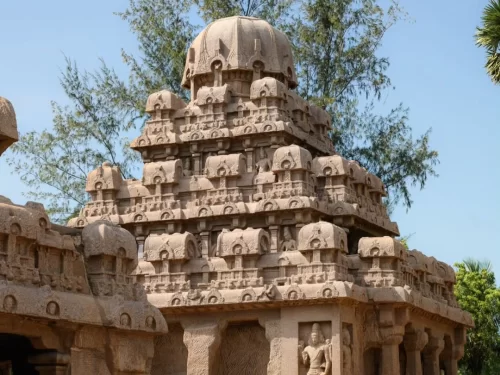
What makes Shore Temple distinct is its coastal location, Dravidian architectural style, and intricately carved shrines, making it both a historical landmark and a visually striking seaside attraction.
History of Shore Temple
Shore Temple was built in the 8th century during the Pallava dynasty and is one of the earliest structural stone temples in South India.
The temple complex holds religious significance, dedicated primarily to Lord Shiva and Lord Vishnu, and has been a site of worship for centuries.
Best Time to Visit Shore Temple
The temple is best visited during the cooler months when walking around the coastal site is comfortable and visibility is optimal for photography.
- Ideal months: November to February
- Weather conditions: Mild temperatures, low humidity, and clear skies for exploring the temple and coastal views
- Periods to avoid: April to June due to high heat, and October during monsoon showers which can make pathways slippery
How to Reach Shore Temple
- Nearest airport: Chennai International Airport, approximately 60 km from Mahabalipuram, with taxis and rental cars available for the onward journey.
- Nearest railway station: Chengalpattu Railway Station, about 25 km from Mahabalipuram, with taxis and local buses connecting to the temple.
- Road access: Accessible via East Coast Road (ECR); private vehicles, taxis, and buses from Chennai and nearby towns provide direct access to the Shore Temple.
What to Expect When You Visit Shore Temple
- The temple is situated on the coast, providing open-air views of the Bay of Bengal and a scenic backdrop of the shoreline and rock formations.
- Facilities include seating areas, interpretive signage, and nearby restrooms; additional food and refreshment options are available in Mahabalipuram town.
- Movement around the temple is easy on mostly flat stone pathways; caution is required near uneven or eroded rock surfaces close to the sea.
- Visitors generally walk slowly to observe carvings and take photographs; weekends and holidays are busier, while weekdays offer quieter experiences.
Important Visitor Information for Shore Temple
- Crowd and weather notes: Moderate crowds on weekdays; weekends and holidays see higher visitor numbers. Coastal winds and sun exposure can be strong, especially from April to June.
- Peak and quiet visiting hours: Peak hours are 10:00 AM – 4:00 PM; early mornings offer quieter conditions and better lighting for photography.
- Dress code: Comfortable clothing and footwear recommended for walking on stone pathways and near uneven surfaces.
- Safety notes: Avoid climbing on temple structures; supervise children closely; be cautious near edges and slippery rocks by the shoreline.
Photography and Viewpoints at Shore Temple
- Best viewpoints are from the front and side pathways that provide unobstructed views of the temple against the backdrop of the Bay of Bengal.
- Early morning and late afternoon offer soft natural light, highlighting the temple carvings and coastal scenery.
- Photography is allowed throughout the temple complex; climbing on the structures is strictly prohibited.
- Crowds during weekends and holidays may limit clear shots; visiting on weekdays ensures quieter conditions for photography.