Quick Facts About Sherabling Monastery
Sherabling Monastery Quick Facts
| Entry Fee | No entry fee |
| Timings | Generally open during daylight hours; visitor access may be restricted during religious ceremonies and monastic activities. |
| Altitude (m) | Approximately 1,350 m above sea level |
| Ideal Visit Duration | 1–2 hours |
| Best Time of Day | Morning for a quieter atmosphere and monastery activities |
| Crowd Level | Low to moderate; generally peaceful except during major Buddhist events |
| Distance from City Centre (km) | Approximately 18 km from Palampur town centre |
| Walking Difficulty | Easy; short walks within the monastery complex |
| Parking Available | Yes, limited parking is available near the monastery entrance |
| Last Mile Access | Accessible by paved road via Bhattu Samula village; short walk from the parking area |
| Suitable for Kids | Yes |
| Suitable for Seniors | Yes |
| Wheelchair Friendly | Partially; some sections are accessible, but stairs and uneven surfaces may limit movement |
Why Visit Sherabling Monastery
Visitors come to Sherabling Monastery to experience Tibetan Buddhist culture, observe monastic life, and explore one of the prominent Buddhist learning centres in the Kangra Valley.
The atmosphere is calm and contemplative, with prayer halls, monks engaged in daily routines, and forested surroundings that create a peaceful environment away from busy tourist areas.
What makes Sherabling Monastery distinct is its blend of traditional Tibetan architecture, active Buddhist education, and its secluded setting near Bhattu Samula, offering visitors an authentic monastic experience.
History of Sherabling Monastery
Sherabling Monastery was established in 1975 by the 12th Kenting Tai Situpa, Pema Tönyö Nyinje, a senior teacher of the Karma Kagyu lineage of Tibetan Buddhism. Located in the forested hills of the Kangra district, the monastery was developed as a center for Buddhist learning, meditation, and monastic training.
The monastery serves as an important seat of the Palpung tradition outside Tibet and attracts monks, scholars, and practitioners from around the world. Its educational institutions, retreat facilities, and traditional Tibetan architecture have made Sherabling Monastery a significant center of Tibetan Buddhist culture in India.
Best Time to Visit Sherabling Monastery
Sherabling Monastery is most pleasant to visit from March to June and September to November, when the weather in the Bhattu region of Kangra district is comfortable for exploring the monastery grounds and enjoying the surrounding Himalayan scenery.
- Ideal months: March to June and September to November offer the most favorable conditions for monastery visits, meditation retreats, and sightseeing in the surrounding valley.
- Weather conditions during the best season: Temperatures are generally mild, skies are often clear, and the forested mountain surroundings remain accessible for peaceful walks and photography.
- Periods to avoid: July to August can bring heavy monsoon rainfall, resulting in wet trails and reduced mountain visibility. Winter months from December to February are colder, particularly during early mornings and evenings, though the monastery remains open to visitors.
How to Reach Sherabling Monastery
- Nearest Airport: Kangra Airport (Gaggal Airport), approximately 65 km away, is the nearest airport. Visitors can hire taxis from the airport for the onward journey to the monastery.
- Nearest Railway Station: Baijnath Paprola Railway Station, about 12 km from Sherabling Monastery, is the nearest railway station on the Pathankot–Joginder Nagar narrow-gauge line. Pathankot Junction is the nearest major railhead with broader rail connectivity.
- Road Access and Last-Mile Connectivity: Sherabling Monastery is located in the Bhattu area of the Kangra Valley near Baijnath and Bir. It is accessible by road from Dharamshala, Palampur, Baijnath, and Bir through well-connected mountain roads. The final stretch is fully motorable, though some sections pass through narrow rural roads. Private taxis are the most convenient option for reaching the monastery.
What to Expect When You Visit Sherabling Monastery
- Environment and Surroundings: Sherabling Monastery is located in a quiet forested valley near Bir in Kangra district, surrounded by pine-covered hills and Himalayan landscapes. The setting is peaceful and focused on spiritual practice rather than tourism.
- Facilities and Amenities: Basic visitor facilities are available within the monastery grounds, while most restaurants, shops, and accommodation options are located in Bir and nearby villages rather than at the monastery itself.
- Accessibility and Movement: The monastery is accessible by road, followed by a short walk through the campus. Internal pathways are generally easy to navigate, though some areas may involve gentle slopes and outdoor walking.
- Visitor Conditions: Visitors are expected to maintain silence and respect ongoing prayers, teachings, and monastic activities. Photography may be restricted in certain prayer halls, and access to some sections may be limited during religious ceremonies or retreats.
Important Visitor Information for Sherabling Monastery
- Sherabling Monastery is generally peaceful throughout the year, though visitor numbers increase during Buddhist teachings, special ceremonies, and festival periods.
- Morning hours typically offer the quietest atmosphere for observing prayers and exploring the monastery grounds, while activity may increase during scheduled religious events.
- The monastery is located in a forested valley near Bir and experiences pleasant weather in spring and autumn, while monsoon months can bring rain and occasional travel delays on approach roads.
- Visitors are expected to dress modestly, covering shoulders and knees, and maintain respectful behavior inside prayer halls and meditation areas.
- Photography may be restricted inside certain religious spaces, and visitors should follow monastery guidelines, remain quiet during prayers, and avoid disturbing monks or ongoing ceremonies.
Photography and Viewpoints at Sherabling Monastery
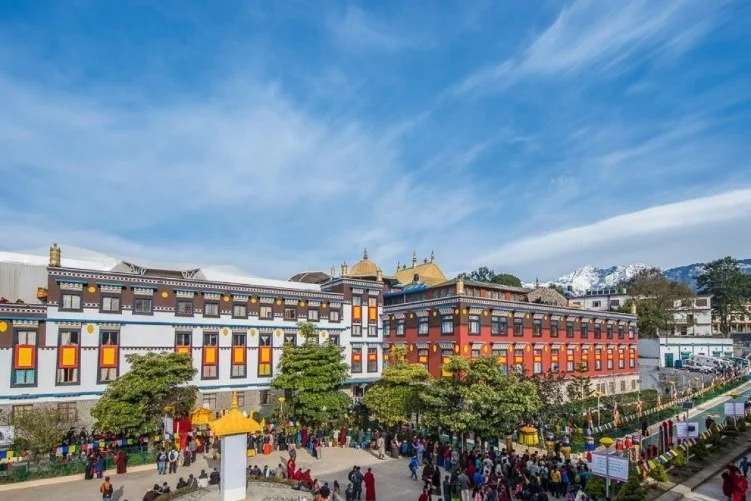
- The best photography locations are within the monastery grounds, where visitors can capture the traditional Tibetan architecture, prayer halls, landscaped courtyards, and surrounding pine-covered hills of the Kangra Valley.
- Early morning provides soft light and a peaceful atmosphere, making it ideal for photographing the monastery buildings before visitor activity increases.
- Several open areas around the complex offer scenic views of the surrounding mountains and forested slopes, creating attractive backdrops for landscape photography.
- Photography inside prayer halls, meditation areas, and during religious ceremonies may be restricted or prohibited. Visitors should always follow monastery guidelines and seek permission where required.
- The monastery’s colorful murals, prayer wheels, statues, and Tibetan design elements are best photographed in natural daylight when details are clearly visible.
- Large gatherings during teachings, festivals, and special events can limit access to certain areas and affect photography opportunities within the complex.
- Drone photography is generally not permitted without prior authorization due to the religious nature of the site and the need to maintain a peaceful environment.