
What is Meghalaya Famous For?
Meghalaya is famous for its living root bridges, waterfalls, caves, hills, tribal culture, clean villages, crystal clear rivers, and unique natural landscapes that attract travellers throughout the year.
+91 9910402252
admin@chalbanjare.com


Nongriat is one of Meghalaya’s most unique destinations, famous for the Double Decker Living Root Bridge, jungle trekking trails, crystal-clear pools, waterfalls, and immersive Khasi village experiences.
Nongriat is a remote village located deep in the East Khasi Hills of Meghalaya, best known for its dramatic trekking route and the iconic Double Decker Living Root Bridge. The village is accessible only by foot after a long descent from Tyrna, which gives it a distinctly secluded and untouched character compared to other tourist destinations in the region.
The atmosphere here is defined by dense rainforest, stone pathways, and a slow rural lifestyle where modern infrastructure is minimal. Life in Nongriat is closely connected to nature, and the absence of road access preserves its peaceful and isolated environment.
It is one of the most immersive trekking destinations in Meghalaya.
The combination of physical effort and natural beauty makes arriving in Nongriat feel like entering a completely different world away from urban surroundings.
Nongriat offers a rare sense of isolation and deep nature immersion.
First-time visitors to Nongriat typically require at least two days to complete the experience comfortably, as the trek itself involves a steep descent and equally demanding return climb. Many travelers choose to stay overnight in the village to fully experience the environment without rushing.
A two-day plan allows time to explore the Double Decker Living Root Bridge on arrival, rest in the village, and optionally visit nearby attractions like Rainbow Falls the following day. This structure also helps manage physical fatigue from the long staircase trek.
It is one of the most physically demanding but rewarding short trips in Meghalaya.
Proper pacing is essential, especially for travelers who are not accustomed to steep trekking routes and humid forest conditions.
A relaxed timeline ensures a safer and more enjoyable Nongriat experience.
A comfortable Nongriat itinerary focuses on balancing trekking effort with rest periods and nearby exploration points. The route from Tyrna to Nongriat is physically demanding, so planning stops and pacing the descent is important for energy management.
Once in Nongriat, travelers can explore the Double Decker Living Root Bridge and nearby natural pools before deciding whether to continue toward Rainbow Falls or rest in the village. Weather conditions and fitness levels should guide how much additional trekking is included.
It is one of the most rewarding yet challenging nature experiences in Meghalaya.
Proper planning ensures that the trek remains enjoyable rather than exhausting, especially for first-time visitors.
Good planning helps turn the Nongriat trek into a memorable and manageable journey.
The trek to Nongriat begins from Tyrna village, located a short drive from Cherrapunji. From this point, the journey continues entirely on foot through a long series of stone steps descending into the forested valleys of the East Khasi Hills. The trail is well-defined but physically demanding due to its continuous downward slope.
The descent passes through dense rainforest, small bridges, and occasional rest points where travelers can pause and adjust their pace. The environment becomes increasingly remote as you move deeper into the valley, with limited mobile connectivity and natural surroundings dominating the landscape.
It is one of the most iconic trekking routes in Meghalaya.
While the descent is easier than the return climb, it still requires steady pacing and hydration due to the length and humidity of the route.
The journey into Nongriat is defined by endurance and gradual immersion into nature.
The Tyrna to Nongriat trek is known for its steep and continuous staircase route, which consists of thousands of stone steps carved into the hillside. The difficulty lies not only in the descent but also in the return ascent, which can be physically exhausting for many travelers.
The path includes uneven steps, natural slopes, and occasional slippery sections during or after rain. Despite its challenges, the route is well-trodden and manageable for reasonably fit travelers who maintain a steady pace.
It is one of the most physically demanding treks in Meghalaya.
Proper footwear, rest intervals, and hydration play a crucial role in completing the trek safely and comfortably.
The trek tests endurance more than technical climbing skills.
Rest stops are an essential part of the Nongriat trek due to its steep and continuous nature. Along the route, small resting points, local shops, and shaded areas provide opportunities to recover energy and hydrate before continuing the journey downward or upward.
Many travelers also plan longer breaks at midway points to manage fatigue and avoid overexertion, especially during the return climb. The availability of natural shade and village rest spots helps make the trek more manageable when paced correctly.
It is one of the most endurance-focused trekking routes in Northeast India.
Proper use of rest stops significantly improves comfort and reduces strain during both descent and ascent.
Strategic rest planning makes the trek more comfortable and safe.
The journey to Nongriat begins with a road trip from Shillong to Tyrna village, which serves as the final motorable point before the trek starts. The drive passes through the East Khasi Hills region, moving across winding roads, small settlements, and scenic viewpoints along the way.
The route typically takes several hours depending on weather and traffic conditions, with Cherrapunji often acting as a midway stop for travelers who want to break the journey. Road conditions are generally manageable but can be affected by rain, fog, or landslides during monsoon season.
It is one of the most scenic pre-trek drives in Meghalaya.
Reaching Tyrna early in the day is important to ensure sufficient daylight for the long descent to Nongriat village.
The road journey sets the stage for the challenging trek ahead.
The trek officially begins at Tyrna village, where the road ends and a long stone staircase leads down into the forested valley below. This point marks the transition from motorable travel to full trekking through dense natural terrain.
From here, travelers descend through thousands of steps that cut through thick greenery, small water streams, and shaded forest areas. The path is well-established but requires careful movement due to its steep gradient and continuous descent.
It is one of the most recognized entry points to a trekking village in Meghalaya.
Starting early helps ensure enough time to reach Nongriat before dusk, as the descent and village approach can take several hours.
The trek begins immediately with a demanding descent into the valley.
At Tyrna village, travelers typically arrange private taxis or shared transport from Shillong or Cherrapunji, as public transport options are limited. Most visitors prefer pre-booked vehicles that can wait or return after dropping them at the trek starting point.
Parking facilities near Tyrna are basic but available, usually managed locally by villagers or designated areas near the roadhead. Since the trek involves an overnight stay for many travelers, transport arrangements for return should be planned in advance.
It is one of the most logistics-sensitive trekking starts in Meghalaya.
Proper coordination with drivers is important to avoid delays during return from the trek, especially in remote conditions with limited network coverage.
Transport planning is crucial for a smooth Nongriat trekking experience.
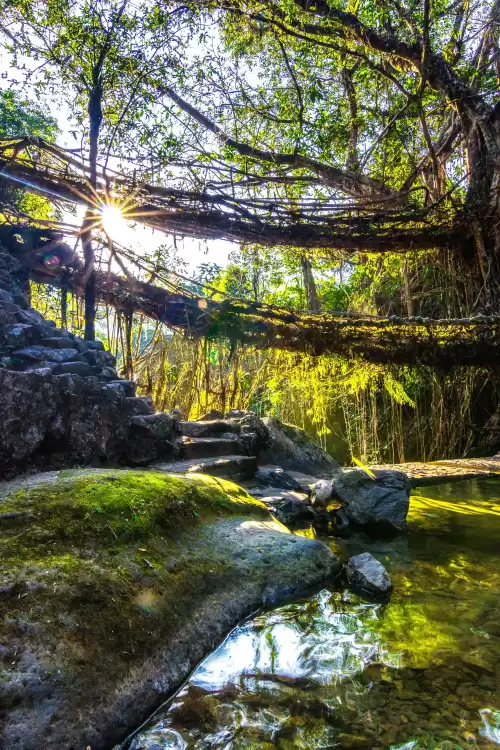
The Double Decker Living Root Bridge in Nongriat is one of the most extraordinary natural structures in Meghalaya, formed by guiding the roots of rubber fig trees across streams over decades. Unlike man-made bridges, this structure grows stronger over time as the roots continue to thicken and intertwine naturally.
Reaching the bridge requires completing the challenging trek from Tyrna village, making the arrival feel especially rewarding after hours of descent through forested terrain. The bridge sits within a lush valley where water, stone, and vegetation combine into a dense natural environment.
It is one of the most iconic natural engineering marvels in the world.
The two-level structure allows visitors to observe both layers of root formation, offering a rare insight into long-term ecological adaptation and human-guided natural growth.
The bridge represents a unique blend of human guidance and natural growth.
The living root bridges of Meghalaya are a traditional practice developed by the Khasi community, where aerial roots of rubber fig trees are carefully guided across gaps and streams. Over many years, these roots grow thicker and stronger, eventually forming stable natural bridges.
This process requires patience, ecological understanding, and generational knowledge passed down within communities. Unlike conventional construction, these bridges evolve continuously and become more durable as time passes.
It is one of the most unique forms of bioengineering in the world.
The craftsmanship reflects a deep harmony between human intention and natural growth without disrupting the ecosystem.
Root bridges showcase centuries of ecological wisdom and patience.
The area surrounding the Double Decker Living Root Bridge is a dense rainforest environment filled with streams, moss-covered rocks, and tall vegetation that thrives in the humid climate of Nongriat valley. The sound of flowing water and birds creates a constant natural backdrop.
Small pools and nearby water channels add to the scenic beauty, making the entire area feel like a hidden ecosystem carved into the hills. Visitors often spend time resting near the bridge to absorb the peaceful environment after the long trek.
It is one of the most immersive rainforest experiences in Meghalaya.
The combination of water, forest, and living structures makes this one of the most unique natural sites in India.
The bridge area feels like a living ecosystem shaped by nature and time.
Rainbow Falls is one of the most beautiful yet challenging natural attractions beyond Nongriat village, requiring an additional trek through dense forest paths and river crossings. The route is longer and more demanding than the main trek to the Double Decker Living Root Bridge, making it suitable for well-prepared trekkers.
The waterfall is known for its deep blue-green pool and tall cascading flow surrounded by untouched rainforest. During certain times of the day, sunlight interacting with mist can create subtle rainbow effects, giving the waterfall its name.
It is one of the most rewarding hidden waterfalls in Meghalaya.
Due to its remote location, the experience feels more like an expedition into untouched wilderness rather than a regular sightseeing visit.
Rainbow Falls offers a true offbeat trekking reward beyond Nongriat.
Along the Nongriat trekking route, several natural pools formed by flowing streams provide refreshing rest points for trekkers. These pools are typically surrounded by rocks, roots, and dense greenery, creating calm spaces within the otherwise demanding trail.
The clear water and shaded surroundings make these spots ideal for short breaks, especially during warmer or more humid sections of the trek. However, care is required as some areas can be slippery due to moss and constant moisture.
It is one of the most refreshing natural rest experiences in Meghalaya.
These pools add variety to the trek, breaking the physical intensity with moments of natural calm.
The natural pools provide peaceful breaks during the challenging trek.
The forests around Nongriat are home to several seasonal waterfalls that appear more prominently during monsoon and post-monsoon months. These waterfalls are not always marked on maps and are often discovered along trekking paths or side trails.
Their flow depends heavily on rainfall, and they can range from gentle trickles to strong cascades during peak monsoon conditions. The surrounding forest enhances their beauty, making them feel like hidden natural surprises along the journey.
It is one of the most unpredictable yet beautiful nature experiences in Meghalaya.
These waterfalls add an element of discovery and spontaneity to the Nongriat trekking experience.
Seasonal waterfalls make every trek to Nongriat slightly different.
The Nongriat region is surrounded by some of the densest rainforest landscapes in Meghalaya, where tall trees, thick undergrowth, and bamboo-covered pathways create a deeply immersive natural environment. The entire trekking route feels enclosed within green layers, offering continuous shade and a humid, earthy atmosphere.
These forest trails are not just pathways but living ecosystems where moss-covered rocks, hanging roots, and natural vegetation shape the experience at every step. The environment changes gradually with altitude, revealing different textures and densities of forest life.
It is one of the most untouched rainforest zones in Meghalaya.
Walking through these trails gives a strong sense of isolation and connection with nature, far away from urban surroundings and road access.
The rainforest around Nongriat feels alive and continuously evolving.
The Nongriat valley is enriched with natural streams that flow through the forest, forming small pools and water channels along the trekking route. These streams are fed by rainfall and underground sources, maintaining a steady flow throughout most of the year.
Many of these pools are naturally formed between rocks and tree roots, creating calm resting spots for trekkers. The water is typically cool and clear, offering a refreshing contrast to the physical exertion of the trek.
It is one of the most refreshing natural water systems in Meghalaya.
These streams play an important role in shaping the ecosystem of the valley and supporting both vegetation and wildlife.
Water streams add constant movement and freshness to the landscape.
Nongriat’s ecosystem supports a rich variety of plant and animal life, including ferns, orchids, mosses, and numerous tropical tree species that thrive in the humid climate. The biodiversity is especially noticeable along the trekking route where vegetation becomes denser closer to the valley floor.
Birds, insects, and small forest creatures contribute to the natural soundscape, creating a continuous background of life throughout the journey. The absence of heavy human interference allows the ecosystem to remain relatively undisturbed.
It is one of the most ecologically rich valleys in Meghalaya.
This biodiversity adds depth to the trekking experience, making it not just a physical journey but also an ecological exploration.
Nongriat’s biodiversity reflects a fully functioning natural ecosystem.
The most essential trekking experience in Nongriat begins at Tyrna village and continues down to the Double Decker Living Root Bridge. This route is entirely a stone staircase descent through dense rainforest, making it both physically demanding and visually immersive from the very beginning.
The trail gradually moves from village edges into deeper forest zones, where humidity increases and the environment becomes more enclosed by greenery. Each section of the trek presents a steady rhythm of steps, rest points, and natural scenery shaped by streams and vegetation.
It is one of the most iconic trekking routes in Meghalaya.
The experience is defined by endurance and immersion, where the journey itself becomes as important as the destination.
This trek sets the foundation for all Nongriat experiences.
Beyond the Double Decker Living Root Bridge, the trail continues deeper into the forest toward Rainbow Falls, creating an extended trekking experience that requires additional time, energy, and preparation. This section of the route is less frequented and feels more remote compared to the main path.
The terrain becomes more rugged with forest paths, stream crossings, and uneven ground that gradually leads to the waterfall area. The deeper you go, the quieter the environment becomes, enhancing the sense of isolation.
It is one of the most challenging extensions of the Nongriat trek.
This continuation is recommended only for travelers who are physically prepared for longer trekking durations.
The Rainbow Falls extension adds depth and challenge to the trek.
Around Nongriat, several smaller forest paths and suspension bridges connect local settlements and natural features, forming an informal network of trails used by villagers and trekkers. These paths offer additional exploration opportunities beyond the main trekking route.
The suspension bridges, often made of steel cables and wood, cross streams and narrow valleys, providing both functional access and scenic viewpoints. Walking across them adds a light adventure element to the experience.
It is one of the most engaging secondary trekking experiences in Meghalaya.
These paths reveal how local life and natural landscapes are interconnected in this remote valley.
These trails add variety and local context to the Nongriat trekking experience.
Nongriat offers a rare opportunity to experience authentic Khasi village life in one of the most remote settlements of Meghalaya. Life here moves at a slow and nature-dependent rhythm, shaped by the surrounding forest, trekking access, and seasonal conditions. The village is small, and interactions with locals feel natural rather than commercial.
Hospitality in Nongriat is simple and grounded, often expressed through basic homestays and informal interactions rather than structured tourism services. Travelers get a close look at how daily life functions in a place where modern access is limited and nature remains the primary influence.
It is one of the most authentic rural cultural experiences in Meghalaya.
The absence of road connectivity preserves the traditional lifestyle, allowing visitors to observe village life in its most natural and undisturbed form.
Nongriat’s culture is experienced through everyday living, not performance.
One of the most important cultural elements of Nongriat is the traditional knowledge behind living root bridge construction. The Khasi community guides the aerial roots of rubber fig trees over time, shaping them across streams and gaps until they naturally form strong, living structures.
This method reflects deep ecological understanding, patience, and generational knowledge passed down through families. The process is slow, often taking decades, but results in durable structures that become stronger as they grow.
It is one of the most unique ecological traditions in the world.
The practice demonstrates how human effort and natural growth can work together without damaging the environment.
Root bridges represent a living cultural and ecological heritage.
Local customs in Nongriat are closely tied to respect for nature, community living, and traditional Khasi values. The village follows informal yet well-understood social systems where cooperation and environmental balance play a central role in daily life.
Visitors may observe traditional practices related to agriculture, water usage, and forest interaction, all of which are adapted to the valley’s remote and resource-dependent environment. These customs are not performed for tourism but exist as part of daily survival and cultural identity.
It is one of the most naturally preserved cultural environments in Meghalaya.
Understanding these customs helps travelers appreciate how deeply culture and nature are interconnected in Nongriat.
Nongriat’s traditions are deeply rooted in nature and community survival.
Preparing for the Nongriat trek requires careful attention to footwear and basic trekking gear, as the entire journey involves long stretches of stone steps, forest paths, and humid conditions. Strong grip shoes are essential because the steps can become slippery, especially during or after rainfall.
Lightweight clothing that allows easy movement is recommended, along with a small backpack for carrying water, snacks, and essential items. Since the trek is long and physically demanding, carrying only what is necessary helps reduce fatigue during both descent and ascent.
It is one of the most physically demanding short treks in Meghalaya.
Simple preparation can significantly improve comfort and reduce strain throughout the journey.
Proper gear selection directly impacts trekking comfort and safety.
One of the most important aspects of visiting Nongriat is planning sufficient time for the return trek, which is significantly more physically challenging than the descent. The climb back to Tyrna involves thousands of uphill steps that require stamina, pacing, and frequent breaks.
Many travelers underestimate the return journey and experience fatigue due to insufficient time allocation. Starting early and avoiding rushed schedules helps ensure that the ascent can be completed safely before dark.
It is one of the most endurance-heavy return treks in Meghalaya.
Allowing extra time ensures a more controlled and less exhausting trekking experience.
Proper timing makes the return journey safer and more manageable.
Weather plays a crucial role in the Nongriat trekking experience, as rain can significantly affect trail conditions, visibility, and overall safety. During monsoon months, the steps may become slippery and streams stronger, increasing the difficulty level of the trek.
Post-monsoon and winter seasons generally offer more stable conditions with clearer paths and better visibility inside the forest. Checking weather forecasts before starting the trek is highly recommended to avoid unexpected challenges.
It is one of the most weather-sensitive treks in Meghalaya.
Choosing the right season and timing greatly enhances both safety and enjoyment.
Good weather planning ensures a safer and smoother trekking experience.
Nongriat is highly influenced by seasonal weather conditions, which directly affect trekking difficulty, forest visibility, and waterfall strength. The post-monsoon months are generally considered the most favorable period, as the trails are relatively stable and the surrounding greenery remains fresh and vibrant.
Winter also offers more comfortable trekking conditions with clearer skies and reduced humidity, making long climbs more manageable. Monsoon, on the other hand, enhances the beauty of the forest and waterfalls but significantly increases the difficulty due to slippery steps and heavy rainfall.
It is one of the most season-sensitive trekking destinations in Meghalaya.
Choosing the right time ensures a safer and more visually rewarding experience across both the trek and the village stay.
Seasonal planning plays a key role in the overall Nongriat experience.
A well-planned Nongriat itinerary balances trekking effort, rest time, and exploration of key attractions like the Double Decker Living Root Bridge and Rainbow Falls. Most travelers prefer a two-day plan that allows an overnight stay in the village to recover from the descent and prepare for the return climb.
This structure helps avoid rushed travel and ensures that the trek remains enjoyable rather than exhausting. Time management is essential, as the return ascent requires significant physical effort and should not be attempted late in the day.
It is one of the most rewarding yet demanding short trekking experiences in Meghalaya.
A balanced itinerary ensures both safety and deeper engagement with the natural surroundings.
Good itinerary planning makes Nongriat both safe and memorable.
Before visiting Nongriat, travelers should prepare for a physically demanding trek in a remote forest environment with limited connectivity and basic facilities. Essential items include sturdy trekking shoes, lightweight clothing, sufficient drinking water, and basic first aid supplies.
It is also important to carry cash, as digital payments may not be reliable in remote areas. Accommodation in the village is basic, so travelers should be prepared for simple living conditions during overnight stays.
It is one of the most important preparation steps for Meghalaya trekking.
Respecting local guidelines, maintaining cleanliness, and pacing the trek properly ensures a safe and responsible journey.
Proper preparation ensures a safe, respectful, and deeply rewarding Nongriat experience.


Get customized Meghalaya tour planning designed around rainfall patterns, road connectivity, seasonal visibility, and realistic hill travel timing. Whether you are visiting for waterfalls, cave exploration, scenic drives, village experiences, or nature-fo
⚡ Quick Response | 💰 Free consultation | 🕒 24×7 expert support