What is Meghalaya Famous For?
Meghalaya is famous for its living root bridges, waterfalls, caves, hills, tribal culture, clean villages, crystal clear rivers, and unique natural landscapes that attract travellers throughout the year.
+91 9910402252
admin@chalbanjare.com


Meghalaya is a paradise for photographers, offering dramatic waterfalls, cloud-covered valleys, crystal-clear rivers, living root bridges, caves, villages, and some of India’s most photogenic landscapes.
Nohkalikai Falls is one of the most photographed natural attractions in Meghalaya because of its dramatic height, deep limestone gorge, and striking blue plunge pool at the base of the waterfall. The main viewing platform offers a wide panoramic perspective that allows photographers to capture both the towering waterfall and the surrounding cliffs within a single composition. During clear weather, the entire valley opens up beautifully, while drifting clouds frequently create changing moods throughout the day.
Morning is generally the most suitable time for photography because sunlight gradually illuminates the opposite cliffs while visibility remains relatively high. After the monsoon, the waterfall carries a tremendous volume of water, creating spectacular images against lush green landscapes. During winter, the flow becomes comparatively lighter but visibility improves considerably, allowing photographers to capture more detail in the surrounding valley. Visitors should remain patient because cloud movement often changes the appearance of the scene within a few minutes.
Nohkalikai Falls rewards photographers who spend time observing changing light and cloud movement rather than taking only a quick photograph. The constantly shifting atmosphere ensures that every visit offers unique photographic opportunities.
Wei Sawdong Falls is considered one of Meghalaya's most photogenic waterfalls because of its distinctive three-tier cascade flowing into remarkably clear turquoise pools. Unlike roadside waterfalls, reaching Wei Sawdong requires a moderately steep descent through forest paths and staircases, making the experience feel more adventurous. The reward is a series of beautiful viewpoints where photographers can capture the layered waterfall, smooth rock formations, and vivid water colors from different elevations.
The waterfall is best photographed during periods of stable weather when sunlight enhances the turquoise appearance of the pools without creating excessive reflections. Visitors should exercise caution while moving across rocks because surfaces remain slippery even outside the monsoon season. Carrying lightweight equipment and waterproof protection is recommended because spray from the waterfall may occasionally reach nearby viewing points.
Wei Sawdong Falls combines dramatic scenery with rewarding access, making it one of Meghalaya's finest destinations for waterfall photography. Careful movement and patience allow photographers to capture the waterfall from multiple perspectives while enjoying the surrounding forest environment.
Krang Suri Waterfall is renowned for its brilliant blue pool, broad cascade, and surrounding forest, making it one of the most visually distinctive waterfalls in Meghalaya. During the golden hour, warm sunlight filters through the surrounding trees and gently illuminates the waterfall, creating a pleasing contrast between the white flowing water and the turquoise pool below. This combination produces striking landscape photographs throughout the late afternoon.
The viewing areas provide multiple angles overlooking the waterfall, while carefully maintained pathways allow photographers to explore different perspectives safely. Water clarity varies slightly throughout the year, but the waterfall remains visually impressive during most seasons. Visitors should avoid rushing between viewpoints because subtle changes in sunlight often create significantly different photographic opportunities within a short period.
Krang Suri Waterfall offers outstanding photography throughout the day, but the softer lighting of the golden hour adds warmth and depth that beautifully complements one of Meghalaya's most scenic waterfalls.
The Umngot River at Dawki is unquestionably Meghalaya's most famous river photography destination because of its extraordinary transparency. During winter, the river becomes so clear that boats appear to float above the rocky riverbed, creating one of India's most recognizable landscape photographs. The calm water, surrounding Khasi Hills, suspension bridges, and traditional wooden boats combine to create visually balanced compositions throughout the boating route.
Photographers can capture the river both from elevated viewpoints overlooking the valley and directly from boats moving slowly across the water. Morning remains the preferred time because calm conditions minimize surface ripples while soft sunlight improves underwater visibility. Visitors should carry waterproof bags to protect equipment during the boat ride while remaining seated according to the operator's safety instructions.
The Umngot River represents one of Meghalaya's greatest photography experiences. Its exceptional water clarity and peaceful surroundings make it a destination where photographers can spend several hours exploring different perspectives rather than capturing only a single image.
Located upstream from Dawki, Shnongpdeng offers quieter river photography opportunities surrounded by forests, rocky banks, and calm sections of the Umngot River. The reduced tourist activity compared to Dawki allows photographers to compose peaceful landscape images featuring reflections, riverside camps, suspension bridges, and tree-covered hills. During the dry season, the river remains exceptionally clear here as well, providing beautiful opportunities for both wide landscapes and detailed nature photography.
Early morning and late afternoon provide the most attractive natural light across the river valley. Campers staying overnight can easily photograph sunrise over the river before other visitors arrive. Adventure activities such as kayaking and boating also add dynamic subjects to landscape compositions while preserving the area's relaxed atmosphere.
Shnongpdeng provides photographers with a peaceful alternative to Dawki while retaining the beauty of the Umngot River. The relaxed environment encourages slow exploration and thoughtful landscape photography throughout the day.
The Simsang River flows through the scenic landscapes of the Garo Hills, offering photographers a completely different river environment compared to the transparent waters of Dawki. Here, broad river channels, forest-covered hills, rocky riverbanks, and traditional rural settlements create compositions that emphasize wilderness rather than crystal-clear water. The river supports diverse ecosystems, making it an attractive destination for both landscape and wildlife photography.
Morning light highlights the surrounding forests while soft mist occasionally drifts above the river, creating atmospheric scenes across the valley. The relatively low visitor numbers allow photographers to work quietly without distractions. Exploring the surrounding countryside also reveals additional viewpoints overlooking the river as it winds through the forests and hills of western Meghalaya.
The Simsang River showcases a quieter side of Meghalaya where forests, rivers, and wildlife dominate the landscape. Photographers seeking peaceful natural scenery away from popular tourist destinations will find this region particularly rewarding.
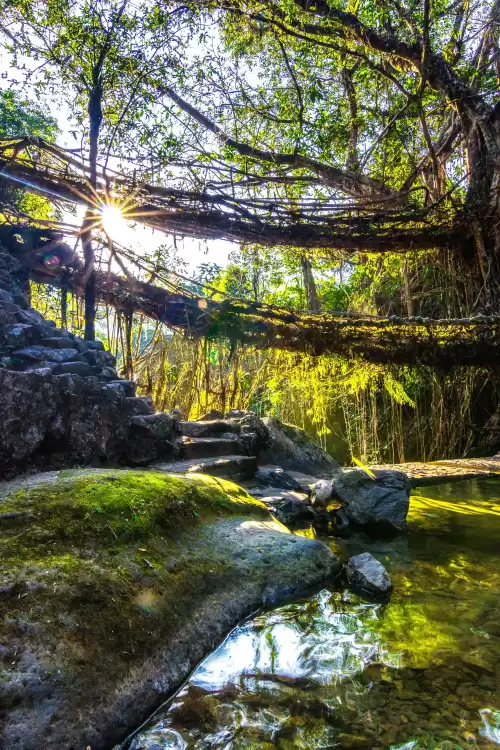
The Double Decker Living Root Bridge at Nongriat is one of Meghalaya's most iconic photography locations and represents a remarkable combination of natural engineering and rainforest scenery. Reaching the bridge requires trekking from Tyrna through thousands of stone steps, suspension bridges, streams, and dense forests. This challenging approach makes the final destination even more rewarding, as photographers encounter one of the world's most unique living structures surrounded by lush tropical vegetation.
The bridge is best photographed during the morning when fewer trekkers are present and natural light filters gently through the forest canopy. The surrounding streams, moss-covered rocks, and hanging roots provide numerous foreground elements that enhance compositions. Because lighting constantly changes beneath the rainforest canopy, photographers should take time to explore multiple viewpoints around the bridge rather than photographing it from only one angle.
The Double Decker Living Root Bridge is more than a landmark—it is an immersive rainforest photography experience where every section of the trail offers opportunities to capture nature, traditional engineering, and Meghalaya's remarkable biodiversity.
The Riwai Living Root Bridge near Mawlynnong provides an easier alternative for photographers who wish to experience Meghalaya's living root bridges without undertaking the demanding Nongriat trek. A short walk through bamboo groves and forest trails leads to the bridge, making it accessible for families, senior travelers, and visitors with limited time. The bridge crosses a small stream beneath a dense forest canopy, creating a peaceful and intimate natural setting.
The surrounding vegetation, filtered sunlight, and flowing water create soft natural lighting that works particularly well for detailed compositions. Visitors can photograph the intertwined roots from different angles while also capturing nearby forest textures, rocks, and streams. Since the bridge remains an important part of the local landscape, photographers should respect the surrounding environment and avoid blocking pathways for other visitors.
The Riwai Living Root Bridge demonstrates the remarkable relationship between nature and traditional Khasi engineering. Its accessibility and peaceful surroundings make it one of Meghalaya's most rewarding photography destinations for visitors seeking beautiful rainforest scenery.
The rainforest trails leading to Meghalaya's living root bridges are equally rewarding for photography. Dense forests, bamboo groves, suspension bridges, moss-covered rocks, waterfalls, streams, and traditional Khasi villages create continuously changing landscapes throughout the journey. Instead of treating the trail simply as access to the bridges, photographers often spend considerable time documenting the surrounding environment, which reflects the rich biodiversity of the East Khasi Hills.
Morning light filtering through the rainforest creates beautiful contrasts between illuminated leaves and shaded forest floors, while humidity adds a soft atmosphere to many compositions. Small streams crossing the trail, hanging roots, and naturally formed stone staircases provide additional subjects that complement photographs of the living root bridges themselves. Good trekking shoes remain essential because damp forest paths can become slippery in every season.
The rainforest surrounding Meghalaya's living root bridges forms an essential part of the overall photography experience. Exploring these trails slowly reveals countless opportunities to capture forests, streams, and traditional landscapes that are just as memorable as the bridges themselves.
During the monsoon, Cherrapunji transforms into one of India's most dramatic photography destinations. Continuous rainfall feeds countless waterfalls that plunge over towering limestone cliffs into deep valleys surrounded by dense tropical forests. Nohkalikai Falls, Seven Sisters Falls, Dainthlen Falls, and many seasonal waterfalls become particularly impressive during this period, creating spectacular opportunities for landscape photography despite the challenging weather conditions.
Clouds and mist move continuously across the valleys, frequently revealing and concealing waterfalls within minutes. This constantly changing atmosphere allows photographers to capture a wide variety of moods from the same viewpoint. Waterproof camera protection, rain covers, microfiber cloths, and patience are essential because heavy rainfall and mist remain common throughout the season.
Monsoon photography in Cherrapunji demands flexibility and preparation, but the reward is an extraordinary landscape filled with waterfalls, mist, forests, and constantly changing light that cannot be experienced during any other season.
The forests surrounding Mawphlang become exceptionally atmospheric during the monsoon as drifting mist moves through ancient trees, moss-covered rocks, and dense vegetation. The famous Mawphlang Sacred Forest is particularly photogenic during this period because continuous moisture enhances the deep green colors of ferns, orchids, lichens, and centuries-old trees. Soft filtered light beneath the forest canopy creates ideal conditions for nature photography.
Rather than focusing on wide landscapes, photographers often concentrate on smaller details including tree roots, moss textures, hanging vines, fungi, and filtered light passing through the canopy. Since humidity remains high, equipment should be protected from moisture between photography sessions. Walking slowly along designated forest paths allows photographers to discover numerous compositions hidden beneath the dense vegetation.
Mawphlang demonstrates how Meghalaya's forests become even more enchanting during the rainy season. The combination of ancient woodland, drifting mist, and lush vegetation creates one of the state's finest nature photography environments.
The monsoon transforms almost every region of Meghalaya into a landscape filled with vibrant forests, overflowing rivers, active waterfalls, and rolling green hills. From the Khasi Hills to the Jaintia and Garo Hills, the countryside becomes exceptionally colorful as continuous rainfall supports dense vegetation across valleys, grasslands, and mountain slopes. Road journeys themselves become rewarding photography experiences because new viewpoints appear around almost every bend.
Travelers exploring Meghalaya during this season should remain flexible because visibility changes rapidly throughout the day. Periods of heavy cloud may suddenly give way to clear views as mist lifts from the valleys. Photographers who remain patient often capture dramatic moments when sunlight briefly illuminates waterfalls, forests, or distant mountain ridges emerging from the clouds.
Monsoon photography across Meghalaya highlights the state's identity as one of India's wettest and most naturally beautiful regions. With proper preparation, photographers can capture landscapes filled with forests, waterfalls, rivers, and mist that remain unmatched during the rest of the year.
Laitlum Canyon is widely considered one of the finest sunrise photography destinations in Meghalaya because of its dramatic cliffs, deep valleys, rolling Khasi Hills, and constantly changing cloud formations. Before sunrise, the valley often remains covered with layers of mist while the surrounding ridges appear as dark silhouettes against the gradually brightening horizon. As the first sunlight reaches the landscape, the clouds begin drifting through the canyon, revealing forests, steep slopes, and distant villages one layer at a time. This constantly changing scenery allows photographers to capture multiple unique compositions during a single visit.
Arriving well before sunrise provides enough time to select viewpoints and prepare camera equipment before natural light begins changing rapidly. Since weather conditions influence visibility every morning, photographers should remain patient rather than leaving immediately if clouds initially cover the valley. The combination of soft golden light, moving mist, and panoramic mountain scenery makes Laitlum Canyon one of Meghalaya's most rewarding sunrise photography locations throughout the year.
Sunrise at Laitlum Canyon is not simply about photographing the first rays of sunlight but about observing how clouds, valleys, forests, and cliffs gradually reveal themselves throughout the morning. Every sunrise produces a different landscape, making repeat visits equally rewarding.
Umiam Lake becomes one of Meghalaya's most peaceful photography destinations during sunset. As the sun gradually lowers behind the surrounding hills, warm light spreads across the calm surface of the reservoir, creating beautiful reflections of forests, islands, and distant mountain slopes. Unlike fast-moving rivers, the still water of Umiam Lake allows photographers to capture smooth reflections that add balance and symmetry to landscape compositions.
Several lakeside viewpoints and camping areas provide excellent locations for photographing the changing colors of the evening sky. During calm weather, the reflections become particularly striking, while scattered clouds often add texture to the sunset scene. Visitors staying overnight near the lake can continue photographing the landscape as twilight gradually fades into evening, creating additional opportunities for long-exposure photography.
Sunset at Umiam Lake combines peaceful surroundings with beautiful natural lighting, allowing photographers to create relaxing landscape images that showcase one of Meghalaya's most scenic freshwater destinations.
Shillong Peak offers excellent golden-hour photography because its elevated position provides unobstructed views across Shillong city, surrounding forests, and distant Khasi Hills. During the final hour before sunset, soft sunlight gradually illuminates the hills while long shadows create depth across the landscape. The combination of changing sky colors, rolling mountains, and scattered urban lights beginning to appear below creates attractive compositions throughout the evening.
Golden-hour photography at Shillong Peak benefits from changing weather because scattered clouds often reflect warm evening colors while creating additional texture across the sky. Visitors should arrive before sunset rather than at the last moment because lighting changes continuously during the final hour of daylight. Allowing sufficient time enables photographers to capture the complete transition from afternoon light through sunset and into early twilight.
Shillong Peak provides photographers with a beautiful combination of natural landscapes and distant urban scenery. The gradual transition from golden sunlight to evening twilight creates one of Meghalaya's most enjoyable sunset photography experiences.
Mawphlang Sacred Forest is one of Meghalaya's most remarkable destinations for forest photography because of its ancient trees, dense canopy, moss-covered rocks, hanging vines, and exceptional biodiversity. The forest has been protected for generations through traditional Khasi customs, allowing many native plant species to thrive within an undisturbed ecosystem. Walking through the designated trails reveals countless photography opportunities featuring massive tree trunks, intricate root systems, orchids, ferns, lichens, and naturally formed forest textures.
Soft natural light filtering through the dense canopy creates ideal conditions for photographing both large landscapes and smaller details. Morning hours often provide the most atmospheric environment as light enters the forest gradually while moisture enhances the vibrant green colors of the vegetation. Visitors should remain on designated paths because the Sacred Forest is culturally important as well as ecologically significant.
Mawphlang Sacred Forest offers photographers an opportunity to document one of Meghalaya's oldest protected ecosystems. The combination of ancient woodland and traditional conservation practices creates a unique environment rarely found elsewhere.
Nokrek National Park and Biosphere Reserve is one of Meghalaya's most important wildlife photography destinations. Located within the Garo Hills, the park contains dense subtropical forests, rolling hills, mountain streams, and diverse habitats supporting numerous bird species, butterflies, orchids, and native mammals. Landscape photographers can capture vast forested valleys while wildlife enthusiasts patiently observe the park's rich biodiversity from designated trails and observation areas.
Morning provides the best opportunity for photography because wildlife activity increases during cooler hours while gentle sunlight reaches the forest gradually. Since many animals remain naturally elusive, patience and quiet observation are essential throughout the visit. Even when wildlife sightings are limited, the surrounding forests, rivers, and mountain scenery provide countless opportunities for nature photography.
Nokrek National Park rewards patient photographers with pristine forests and remarkable biodiversity. Every visit offers opportunities to capture Meghalaya's natural heritage while exploring one of the state's most important protected landscapes.
Balpakram National Park is known for its dramatic cliffs, deep gorges, rolling plateaus, grasslands, forests, and unique geological formations that create some of Meghalaya's most striking natural landscapes. The park's remote location and relatively low visitor numbers provide photographers with peaceful surroundings where untouched wilderness dominates the scenery. Wide valleys, unusual rock formations, and dense forests combine to produce highly varied compositions throughout the region.
Changing weather frequently transforms the appearance of Balpakram, with clouds moving across cliffs and sunlight illuminating different sections of the landscape throughout the day. Photographers should carry sufficient supplies because facilities remain limited within the park. Exploring with experienced local guides improves both navigation and opportunities to discover lesser-known viewpoints overlooking the dramatic terrain.
Balpakram National Park offers photographers a rare opportunity to capture Meghalaya's remote wilderness in its natural state. Its combination of dramatic landforms, forests, and changing weather creates one of the state's most rewarding destinations for landscape photography.
Planning photography around Meghalaya's changing seasons is one of the most important factors in achieving successful landscape images. Winter offers crystal-clear rivers, comfortable temperatures, and excellent long-distance visibility, making it ideal for destinations such as Dawki, Shillong Peak, Umiam Lake, and Laitlum Canyon. Post-monsoon transforms the entire state into a vibrant green landscape where waterfalls remain active and forests appear exceptionally fresh. During the monsoon, photographers experience dramatic clouds, mist, overflowing waterfalls, and constantly changing weather that create unique but more challenging shooting conditions.
Rather than expecting identical conditions throughout the year, photographers should select destinations according to the season's strengths. Checking weather forecasts before traveling each day helps maximize opportunities while allowing flexibility if cloud cover or rainfall temporarily affects visibility. Carrying waterproof equipment, extra batteries, lens cloths, and protective bags ensures cameras remain functional throughout Meghalaya's humid climate.
Matching destinations with seasonal conditions helps photographers experience Meghalaya at its finest. Every season presents different opportunities, making careful planning far more valuable than simply visiting famous locations.
A well-planned photography itinerary should group destinations geographically while allowing enough time for changing weather and natural lighting. Beginning in Shillong provides access to Shillong Peak, Laitlum Canyon, Umiam Lake, and Mawphlang Sacred Forest before continuing toward Cherrapunji for waterfalls, caves, and nearby viewpoints. From there, photographers can travel to Nongriat for the Double Decker Living Root Bridge, Dawki and Shnongpdeng for the Umngot River, and finally explore the Jaintia or Garo Hills for quieter landscapes and offbeat locations.
Rushing between attractions often results in missed photography opportunities because Meghalaya's landscapes change rapidly with cloud movement and sunlight. Spending additional time at fewer locations generally produces better images than attempting to cover every destination within a short itinerary. Early departures each morning also increase opportunities for sunrise photography and quieter conditions before tourist crowds arrive.
A carefully organized itinerary allows photographers to experience Meghalaya's rivers, forests, waterfalls, villages, and mountain landscapes without unnecessary travel fatigue. Flexible planning consistently produces better results than tightly packed schedules.
Photographing Meghalaya requires preparation because weather conditions, humidity, rainfall, and mountain terrain can affect both equipment and travel plans. Essential items include waterproof camera bags, rain covers, microfiber lens cloths, spare batteries, memory cards, lightweight tripods, trekking shoes, warm clothing for early mornings, reusable water bottles, power banks, and basic first-aid supplies. Keeping equipment organized inside waterproof compartments protects valuable gear throughout the journey.
Responsible photography is equally important. Visitors should respect local communities, avoid disturbing wildlife, remain on designated trails, follow safety instructions at viewpoints, and never leave litter behind. Many of Meghalaya's finest locations are ecologically sensitive, making careful behavior essential for preserving the landscapes that attract photographers from around the world. Supporting local guides and community-run tourism initiatives also contributes positively to sustainable travel.
Careful preparation allows photographers to fully appreciate Meghalaya's remarkable diversity of rivers, waterfalls, forests, villages, and mountain landscapes. With the right equipment, realistic planning, and respect for nature, every journey through the state becomes an opportunity to capture some of India's most beautiful natural scenery.


Get customized Meghalaya tour planning designed around rainfall patterns, road connectivity, seasonal visibility, and realistic hill travel timing. Whether you are visiting for waterfalls, cave exploration, scenic drives, village experiences, or nature-fo
⚡ Quick Response | 💰 Free consultation | 🕒 24×7 expert support