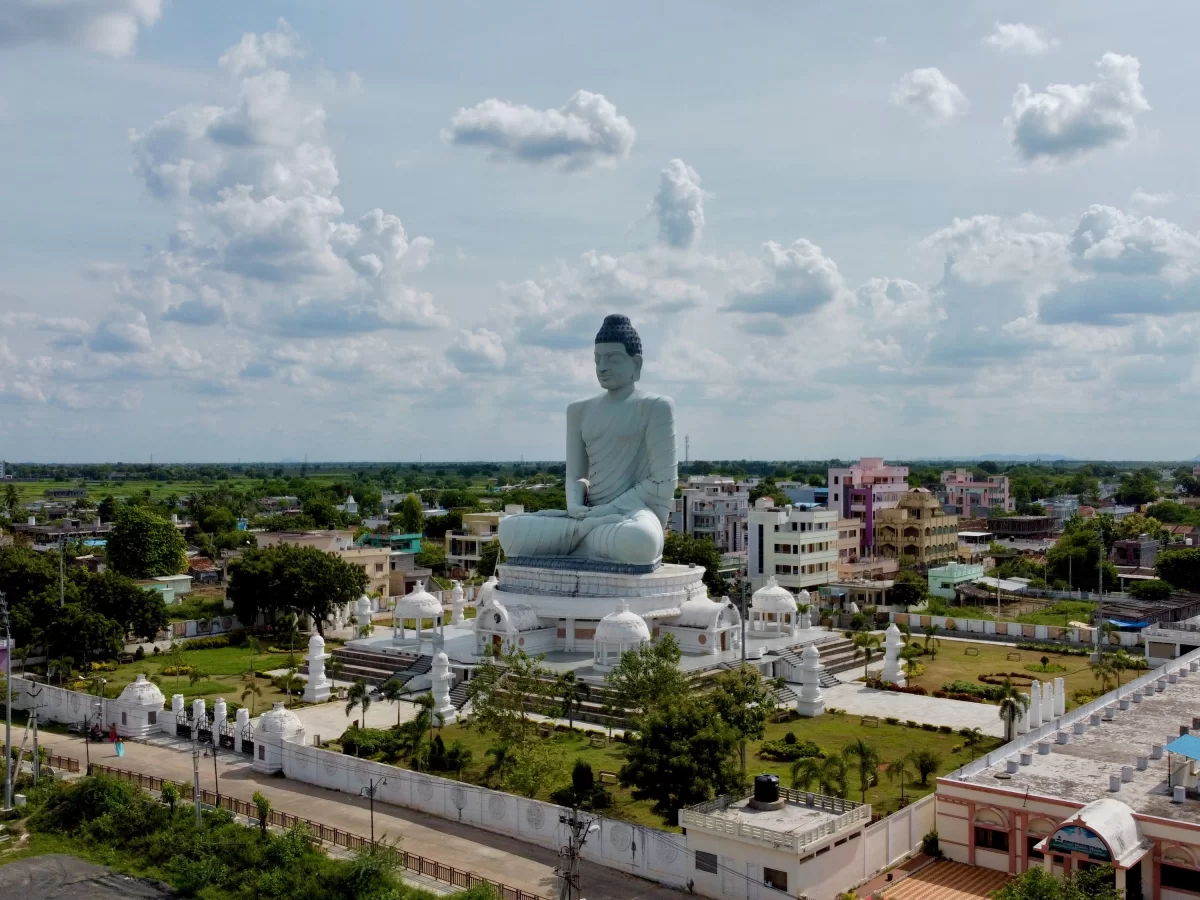
Amaravati Mahachaitya in Amaravati, Andhra Pradesh, India

Amaravati Mahachaitya , Amaravati
Tourists visit to see the remains of one of India’s most important early Buddhist monuments and to understand the Amaravati School of art. The site is maintained by the Archaeological Survey of India and is located near the Amaravati Archaeological Museum.

Quick Facts About Amaravati Mahachaitya

Quick Facts for Amaravati Mahachaitya (Great Stupa), Amaravati

Entry Fee Free (separate entry ticket applies for the ASI Site Museum nearby)
Timings 9:00 AM - 5:00 PM (closed on Fridays; confirm locally as schedules may change)
Altitude (m) Approx. 25 m
Ideal Visit Duration 45 minutes to 1.5 hours (longer if combining with museum visit)
Best Time of Day Morning or late afternoon (open archaeological site with minimal shade)
Crowd Level Low on weekdays; moderate on weekends and Buddhist observance days
Distance from City Centre (km) Approx. 1 km from Amaravati town centre
Walking Difficulty Easy (flat, open archaeological grounds)
Parking Available Yes (limited parking near the site and museum)
Last Mile Access Car/auto accessible up to site entrance; short walk inside premises
Suitable for Kids Yes (open space; supervise around protected remains)
Suitable for Seniors Yes (flat walking surface; minimal elevation change)
Wheelchair Friendly Partially (open grounds are level, but pathways may be uneven in places)

Why Visit Amaravati Mahachaitya

Visitors come to Amaravati Mahachaitya to experience one of India’s most important Buddhist heritage sites, known for the remains of the great stupa that once stood at the center of ancient Amaravati. The site is closely linked to the Amaravati School of Buddhist art, and travelers visit to understand the scale of early Buddhist architecture in the Krishna River region.

The on-ground atmosphere is quiet and archaeological, with fenced pathways, stupa remains, and an open landscape that makes the site feel spacious and reflective. The nearby museum context helps visitors connect the scattered structural remains to the detailed sculptural panels and fragments associated with the stupa. It’s a calm place to walk slowly and absorb the setting without crowds.

What makes Amaravati Mahachaitya distinct for travelers is that it offers a direct, ground-level encounter with a major Buddhist stupa site rather than a fully reconstructed monument. You’re seeing the original footprint and excavated remains in their real landscape, supported by one of India’s strongest collections of early Buddhist sculpture nearby. It’s a meaningful stop for travelers interested in archaeology, Buddhism, and the Krishna River valley’s cultural history.

History of Amaravati Mahachaitya

Amaravati Mahachaitya, located in Amaravati on the banks of the Krishna River in Andhra Pradesh, is one of the most significant Buddhist monuments in India. The Great Stupa is believed to have been originally constructed around the 2nd century BCE during the Satavahana period and later expanded over several centuries as Amaravati developed into a major center of Buddhist learning and art.

The Mahachaitya was renowned for its elaborate limestone railings and sculpted panels depicting scenes from the life of the Buddha, Jataka tales, and symbolic Buddhist motifs. These carvings became known for their refined style and are collectively referred to as the Amaravati School of Art, which influenced Buddhist art across South and Southeast Asia.

Although much of the original structure is now in ruins, excavations in the 19th and 20th centuries revealed its scale and artistic importance. Many of the sculptural panels are preserved in museums in India and abroad. Today, the archaeological site remains a key destination for visitors seeking to understand Amaravati’s role as an ancient Buddhist center.

Best Time to Visit Amaravati Mahachaitya, Amaravati

The best time to visit Amaravati Mahachaitya is from November to February, when cooler and drier weather makes it comfortable to explore the open archaeological site, interpretive areas, and nearby museum stops without the intense summer heat of the Krishna River plains.

  • Ideal months: November to February, with December and January being the most comfortable for daytime exploration and photography.
  • Weather conditions during the best season: Expect daytime temperatures generally between 20°C and 30°C with dry skies and lower humidity, ideal for walking around the exposed ruins and spending time reading site signage.
  • Periods to avoid: April to June due to extreme heat in the Amaravati region, which makes open-site exploration uncomfortable; July to September during the monsoon, when heavy rain and muddy patches can limit movement around the archaeological grounds.

How to Reach Amaravati Mahachaitya (Amaravati Stupa), Amaravati

  • Nearest Airport: Vijayawada International Airport (VGA) at Gannavaram is approximately 40–45 km from Amaravati Mahachaitya. It offers domestic connectivity to Hyderabad, Chennai, Bengaluru, Delhi, and other major cities. Taxis are available at the airport, and the drive to Amaravati typically takes 1 to 1.5 hours depending on traffic.
  • Nearest Railway Station: Vijayawada Junction (BZA), about 35 km away, is the nearest major railway hub with frequent express and superfast trains on the Chennai–Howrah and Delhi–Chennai routes. Guntur Junction (GNT), around 30 km away, is another practical option. From either station, taxis and APSRTC buses operate toward Amaravati.
  • Road Access: Amaravati is well connected by road from Vijayawada and Guntur via state highways. The Mahachaitya site is located near the Archaeological Museum in Amaravati town along the Krishna River. Roads are generally in good condition, though traffic may increase on weekends and public holidays.
  • Last-Mile Connectivity: APSRTC buses, shared autos, and private taxis can drop visitors close to the Amaravati Archaeological Museum and stupa site. Parking is available near the complex. Since the monument is an open archaeological site, visitors should be prepared for short walks within the premises, especially during warmer months.

What to Expect When You Visit Amaravati Mahachaitya Amaravati

Amaravati Mahachaitya, also known as the Great Stupa of Amaravati, is an important Buddhist archaeological site located on the banks of the Krishna River in Andhra Pradesh. The original structure dates back to the early centuries BCE–CE, and what you see today is a protected heritage mound with reconstructed elements rather than a fully standing stupa.

  • Environment and surroundings: The site consists of a large circular mound marking the remains of the ancient stupa, set within a fenced archaeological zone. The area is open and exposed, with limited natural shade. The surroundings are relatively quiet, especially on weekdays, with the Krishna River flowing nearby. Summers can be hot, and the ground surface may feel warm under direct sun.
  • Facilities and amenities: Facilities are minimal, as the focus is preservation. You can expect basic entry arrangements and simple informational signage explaining the historical significance. There are no cafés or large commercial outlets within the site itself. Restroom access may depend on nearby facilities rather than the stupa grounds, so it is advisable to plan accordingly.
  • Accessibility and movement: The site is accessible by road from Vijayawada and Guntur. Visitors walk on level pathways around the stupa mound, making general movement manageable. However, there are no elaborate ramps or modern accessibility enhancements in all sections. The visit typically involves light walking rather than climbing.
  • Typical visitor behavior and conditions: Visitors include history enthusiasts, students, Buddhist pilgrims, and researchers. The atmosphere is quiet and reflective rather than devotional in the active-temple sense. Crowds are usually moderate except during Buddhist commemorative events. Photography is generally allowed in open areas, but visitors are expected not to disturb or climb on protected remains.

Important Visitor Information for Amaravati Mahachaitya (Amaravati Stupa)

  • Crowd and Weather Notes: Amaravati Mahachaitya, the ancient Buddhist stupa site on the banks of the Krishna River, is generally less crowded than nearby temples but sees increased visitor numbers on weekends and during Buddhist observances such as Buddha Purnima. The region experiences high summer temperatures with strong sun exposure across the open archaeological grounds. Winters are significantly more comfortable for extended exploration. During monsoon months, the lawns and pathways around the site can become damp.
  • Peak and Quiet Visiting Hours: The site is typically busiest between late morning and early afternoon, particularly when school groups or tour buses arrive. For a quieter and cooler visit, early morning shortly after opening hours is ideal, offering better light for viewing sculptural remains and site interpretation panels.
  • Dress Code: There is no formal dress code, as this is an archaeological heritage site. However, modest and comfortable clothing is recommended due to cultural sensitivity. Wear light, breathable fabrics and comfortable walking shoes suitable for stone paths and open ground.
  • Safety Notes and Practical Cautions: The Mahachaitya complex features exposed stone foundations and uneven surfaces. Watch your footing while walking around the stupa remains and avoid stepping onto protected or restricted areas. Do not touch or climb on sculptural fragments. Carry water and sun protection, as shade within the open site is limited, especially during peak summer months.

Photography and Viewpoints in Amaravati Mahachaitya (Great Stupa)

Amaravati Mahachaitya, also known as the Great Stupa of Amaravati, is one of India’s most significant Buddhist archaeological sites, located near the Krishna River in Andhra Pradesh. Though the original massive stupa now survives primarily as a reconstructed mound with preserved railing fragments and sculptural panels (many originals housed in museums), the site remains visually compelling for heritage and archaeological photography.
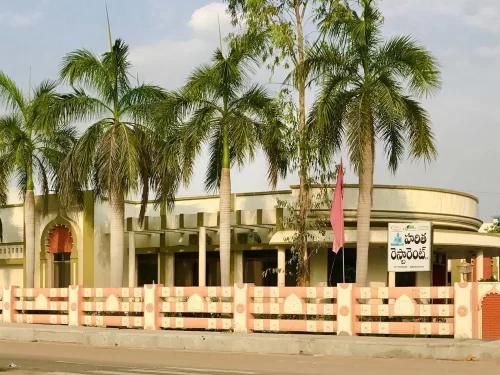
  • Best Viewpoints for Photography: The strongest wide shot comes from slightly off-center on the circular pathway surrounding the stupa mound, where the curve of the structure is visible rather than appearing flat. Close-up compositions of the carved limestone railing fragments and sculptural panels are best captured from a slight side angle to reveal depth and relief details. If photographing the entire site, step back near the entrance boundary to include both the mound and interpretive signage for contextual framing.
  • Lighting Conditions and Time-of-Day Considerations: Early morning provides the best conditions, with soft light enhancing the texture of the limestone fragments without harsh contrast. Late afternoon adds warmth to the stone and improves depth in relief carvings. Midday sunlight can be intense on the pale surfaces, flattening fine sculptural details and creating glare on protective coverings.
  • Rules and Restrictions: As an Archaeological Survey of India (ASI)–protected monument, personal photography in open areas is generally permitted. Tripods, drones, and commercial shoots typically require prior permission. Touching or climbing on protected fragments is prohibited. Follow all ASI signage and staff instructions within the site boundary.
  • Crowd and Access Factors: The site is usually quiet compared to major temple complexes, though visitor numbers increase on weekends and during Buddhist observances. For uninterrupted frames of the stupa mound and railing fragments, weekday mornings offer the calmest environment. The open, exposed layout means shade is limited during peak daylight hours.

Near By Attraction

Kalachakra Museum Amaravati Buddhist heritage attraction in Andhra Pradesh tour packages. Museum

Kalachakra Museum

Kalachakra Museum is an archaeological museum dedicated to the Kalachakra Buddhist art and culture, located in Amaravati.
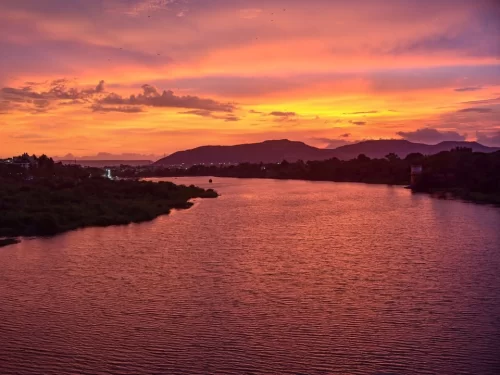
Krishna Riverfront Vijayawada beautiful sunset view over the river in Andhra Pradesh tour packages. River

Krishna Riverfront

Krishna Riverfront in Amaravati is a scenic stretch along the Krishna River, offering picturesque views of the river and nearby landmarks.
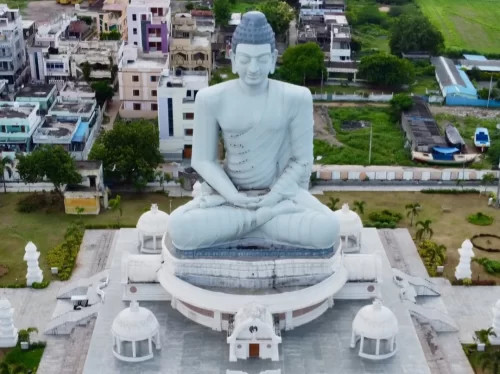
Dhyana Buddha Statue Amaravati giant meditation Buddha landmark and spiritual attraction in Andhra Pradesh tour packages. Statue

Dhyana Buddha statue

The Dhyana Buddha Statue is a large meditation-pose Buddha statue located on the banks of the Krishna River in Amaravati.

Frequently Asked Questions About Amaravati Mahachaitya

Amaravati Mahachaitya is located in Amaravati town near Guntur in Andhra Pradesh along the banks of the Krishna River.
Amaravati Mahachaitya is known as an ancient Buddhist stupa site associated with the historic Amaravati school of art and early Buddhist heritage.
Amaravati Mahachaitya can be reached from Vijayawada by road in about 45 minutes, covering around 35 kilometers toward Amaravati.
Amaravati Mahachaitya is generally open during daytime hours, typically from morning until early evening as managed by archaeological authorities.
There is a nominal entry fee for Amaravati Mahachaitya as regulated by the Archaeological Survey authorities.
The best time to visit Amaravati Mahachaitya is between October and February when the weather remains pleasant for outdoor exploration in Andhra Pradesh.
Visitors usually require 1 to 2 hours to explore Amaravati Mahachaitya and review the surrounding historical remains.
Parking facilities are available near Amaravati Mahachaitya in designated areas close to the entrance.
Amaravati Mahachaitya is suitable for family visits as the site has open walking areas and informative displays about Buddhist heritage.
Nearby attractions from Amaravati Mahachaitya include the Dhyana Buddha Statue, Kalachakra Museum, and other cultural sites in Amaravati.

Loved this place ? Let’s Plan Your Andhra Pradesh Trip

Get customized Andhra Pradesh tour planning designed around coastal weather patterns, temple visit flow, road travel distances, and realistic pacing across regions. Whether you are visiting for spiritual journeys, heritage sites, beach experiences, hill r

⚡ Quick Response | 💰 Free consultation | 🕒 24×7 expert support

×

Plan Your Trip