Quick Facts About Nathmal Ki Haveli
Quick Facts — Nathmal Ki Haveli, Jaisalmer
| Entry Fee | No official entry fee; access to exterior is free. Interior access may depend on private occupants. |
|---|---|
| Timings | Generally accessible daily from around 9:00 AM to 8:00 PM; interior access timings vary as it is partly residential. |
| Altitude (m) | 225 m (based on Jaisalmer city elevation) |
| Ideal Visit Duration | 30–60 minutes |
| Best Time of Day | Early morning or late afternoon for light and lower heat |
| Crowd Level | Moderate; higher during winter tourist season and midday hours |
| Distance from City Centre (km) | 0.3 km (within Jaisalmer old city area) |
| Walking Difficulty | Moderate; narrow lanes, uneven stone pathways, and steps |
| Parking Available | No on-site parking; parking available outside the old city area |
| Last Mile Access | Accessible only on foot through narrow heritage lanes |
| Suitable for Kids | Yes, with supervision due to stairs and narrow passages |
| Suitable for Seniors | Partially; uneven surfaces and walking distance may be challenging |
| Wheelchair Friendly | No; narrow lanes, steps, and uneven flooring prevent wheelchair access |
Why Visit Nathmal Ki Haveli, Jaisalmer
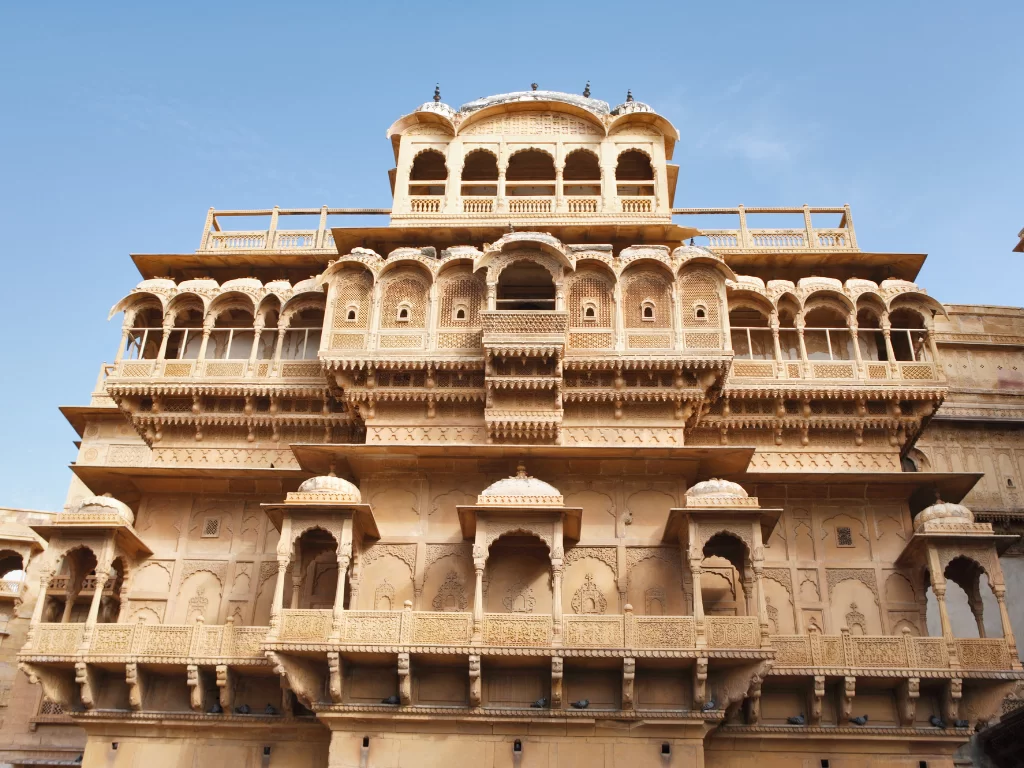
Visitors come to Nathmal Ki Haveli to see one of Jaisalmer’s most detailed sandstone façades, known for its precise carvings, symmetrical design, and traditional Rajput architecture. It is a stop for travelers interested in urban heritage rather than fort complexes or desert landscapes.
The on-ground atmosphere is calm and residential, set within narrow lanes of the old city where daily local life continues around the structure. You’ll hear street sounds, see nearby homes and shops, and experience the haveli as part of a living neighborhood rather than a closed monument.
What makes this place distinct for travelers is its location inside the heritage fabric of Jaisalmer and its finely crafted exterior details, which can be appreciated without long walks, entry tickets, or guided tours, making it easy to include as part of a self-guided old city walk.
History of Nathmal Ki Haveli, Jaisalmer
Nathmal Ki Haveli was built in the late 19th century as the private residence of Diwan Nathmal, the then prime minister of the Jaisalmer state. It reflects the administrative and residential architecture of elite officials during the period of princely rule in the region.
The structure is known for being designed and built by two architect brothers who worked independently on different sides of the façade, resulting in subtle asymmetry that is still visible today. This feature is one of the most recognized architectural characteristics of the haveli.
Unlike royal palaces or forts, Nathmal Ki Haveli functioned as a high-ranking official’s residence rather than a ceremonial or defensive structure, which explains its integration into the residential fabric of the old city and its continued presence within a living neighborhood.
Best Time to Visit Nathmal Ki Haveli, Jaisalmer
Nathmal Ki Haveli can be visited year-round, but comfort and experience depend heavily on Jaisalmer’s extreme desert climate, as access involves walking through open lanes and exploring an unshaded heritage structure.
- Ideal months: October to March
- Weather during best season: Daytime temperatures are generally comfortable for walking in the old city, with cooler mornings and evenings suitable for exploring narrow lanes and exterior architecture
- Periods to avoid: May and June due to extreme heat, which makes walking through the old city lanes physically difficult and limits comfortable viewing time
How to Reach Nathmal Ki Haveli, Jaisalmer
- Nearest airport: Jaisalmer Airport (JSA), located approximately 14–15 km from the old city. The airport has limited commercial connectivity and seasonal flights, so many travelers use Jodhpur Airport (around 280 km away) and continue by road or train.
- Nearest railway station: Jaisalmer Railway Station, about 1.5–2 km from Nathmal Ki Haveli. Auto-rickshaws and taxis operate between the station and the old city, but vehicles cannot enter narrow heritage lanes near the haveli.
- Road access and last-mile connectivity: Jaisalmer is connected by road to Jodhpur and other towns in western Rajasthan. Private taxis, autos, and local transport can reach drop-off points near the old city area; the final access to Nathmal Ki Haveli is on foot through narrow residential lanes where motor vehicles are not permitted.
What to Expect When You Visit Nathmal Ki Haveli, Jaisalmer
- Environment and surroundings: The haveli is located within a dense residential area of the old city, surrounded by narrow stone lanes, local homes, small shops, and everyday neighborhood activity rather than a formal monument ?????.
- Facilities and amenities: There are no official visitor facilities on-site such as ticket counters, restrooms, seating areas, or information boards; basic amenities are available only in nearby market areas.
- Accessibility and movement: Movement involves walking through uneven stone paths and narrow passages; entry points and interior areas may have steps and low doorways, limiting ease of access for people with mobility issues.
- Typical visitor behavior and conditions: Visits are usually short and self-guided, with people stopping for photography and exterior viewing; during peak season, foot traffic can increase due to group tours moving through the lanes.
Important Visitor Information for Nathmal Ki Haveli, Jaisalmer
- Crowd and weather notes: The area experiences higher foot traffic during winter months (October–March) and midday hours; summer heat (especially May–June) makes walking through the surrounding lanes physically demanding.
- Peak and quiet visiting hours: Late morning to early afternoon is usually the busiest period; early morning and late afternoon are quieter and more comfortable for walking and viewing the exterior.
- Dress code: No formal dress code applies, but modest clothing is appropriate as the haveli is located within a residential neighborhood.
- Safety notes and practical cautions: Stone pathways and steps can be uneven and slippery in dusty conditions; lanes are narrow with mixed pedestrian and local movement, so awareness of surroundings is necessary while walking.
Photography and Viewpoints at Nathmal Ki Haveli, Jaisalmer
- Best viewpoints and angles: The most effective angles are from the narrow lane directly in front of the main façade, where the full height and carved details can be captured; side-lane perspectives highlight the asymmetry of the twin structures.
- Lighting conditions: Early morning provides softer light and fewer shadows on the sandstone surface, while late afternoon creates warm tones on the façade; midday light is harsh and reduces surface detail visibility.
- Photography rules and restrictions: Exterior photography is unrestricted; interior photography may depend on access permission, as parts of the haveli are privately occupied.
- Crowd and access factors: Narrow lanes limit space for wide-angle shots, and foot traffic from locals and tour groups can obstruct clear frames, especially during peak hours.