Quick Facts About Darya Khan’s Tomb & Mosque
Quick Facts of Darya Khan’s Tomb & Mosque
Entry Fee – No entry fee
Timings – Open access during daylight hours; no officially fixed timings
Altitude (m) – Approximately 555 meters above sea level (Mandu plateau)
Ideal Visit Duration – 15–25 minutes
Best Time of Day – Morning or late afternoon (better light and fewer visitors)
Crowd Level – Low; rarely crowded
Distance from City Centre (km) – Approximately 0.8 km from Mandu main heritage zone
Walking Difficulty – Easy to moderate (uneven stone paths and short walking distance)
Parking Available – No formal parking; roadside parking in nearby areas
Last Mile Access – Walkable from nearby monuments and local roads; limited vehicle access
Suitable for Kids – Yes, with supervision around ruins and open structures
Suitable for Seniors – Partially suitable; uneven surfaces and lack of seating
Wheelchair Friendly – No; uneven stone ground, steps, and no accessibility infrastructure
Why Visit Darya Khan’s Tomb & Mosque
Visitors come to Darya Khan’s Tomb & Mosque to explore a quiet, less-visited complex that offers a more personal and uncrowded experience compared to Mandu’s larger monuments.
The on-ground atmosphere is calm and still, with open courtyards, simple stone structures, and minimal visitor movement, creating a space suited for slow walking and quiet observation.
What makes this place distinct for travelers is its understated setting, where the experience is shaped by silence, simplicity, and isolation rather than scale, decoration, or tourist activity.
History of Darya Khan’s Tomb & Mosque
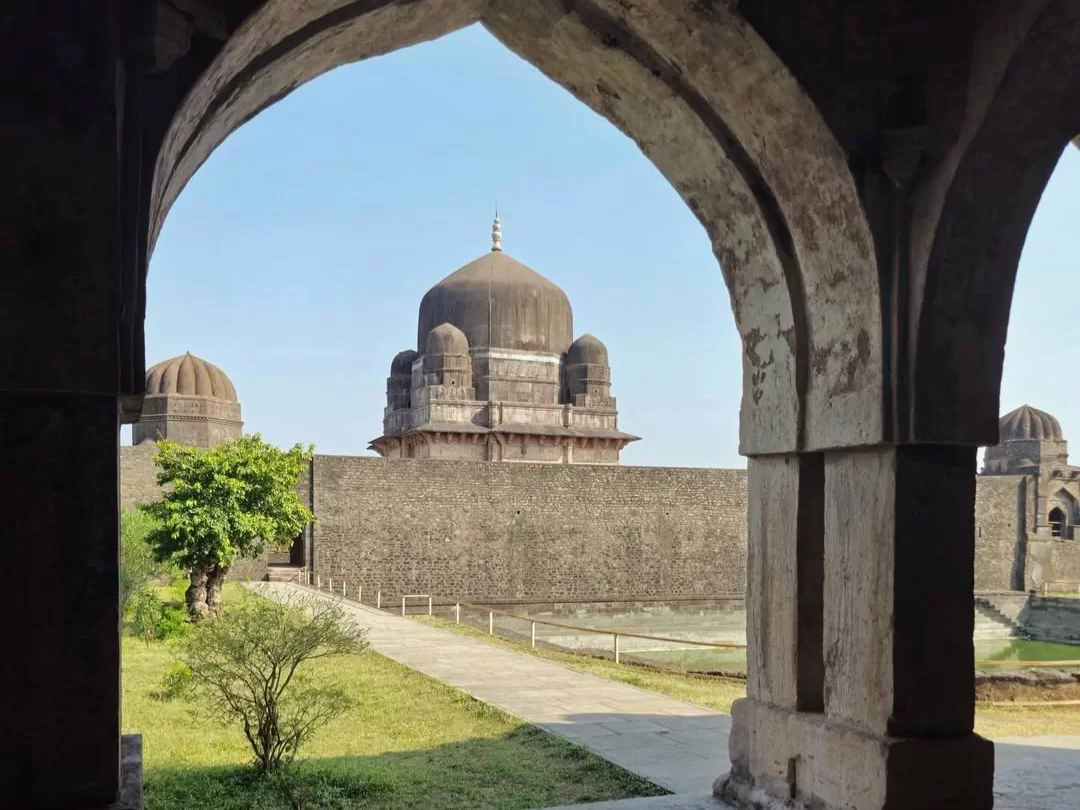
Darya Khan’s Tomb & Mosque is a historic funerary and religious complex located in Mandu (Mandavgarh), Madhya Pradesh. It was constructed during the Malwa Sultanate period in the 16th century.
The complex is associated with Darya Khan, an important court official and noble during the reign of Sultan Mahmud Khalji II and the late Malwa Sultanate administration.
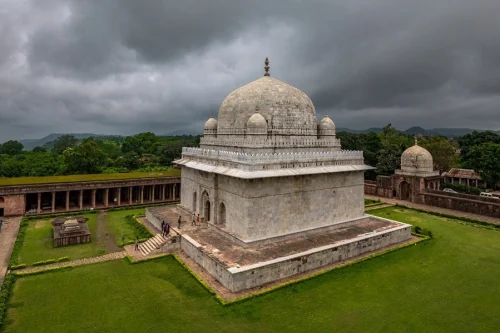
The tomb and mosque were built as a combined commemorative and religious site, reflecting the Islamic architectural and cultural traditions of the Malwa period.
Architectural elements such as domes, arches, and stone masonry reflect the regional Sultanate style rather than Mughal design influence.
Today, the site stands as a preserved historical complex within Mandu, representing the administrative elite of the Malwa Sultanate and the funerary architecture of the medieval period.
Best Time to Visit Darya Khan’s Tomb & Mosque
Darya Khan’s Tomb & Mosque is best visited in the cooler months when walking through the historic complex, exploring stone pathways, and viewing architectural details can be done comfortably without weather-related difficulties.
- Ideal months: October to February
- Best-season conditions: Cool to mild temperatures, low humidity, clear skies, and dry stone surfaces, suitable for sightseeing, photography, and quiet exploration of the monument
- Periods to avoid: March to June due to intense heat and sun exposure in open areas; July to September because of monsoon rainfall, slippery stone floors, damp interiors, and reduced accessibility around the structure