Ultimate Ladakh Road Trip Guide From Delhi, Srinagar and Manali
A Ladakh road trip from Delhi through Srinagar or Manali requires detailed planning around routes, weather, fuel, permits, and high altitude travel conditions.
+91 9910402252
admin@chalbanjare.com


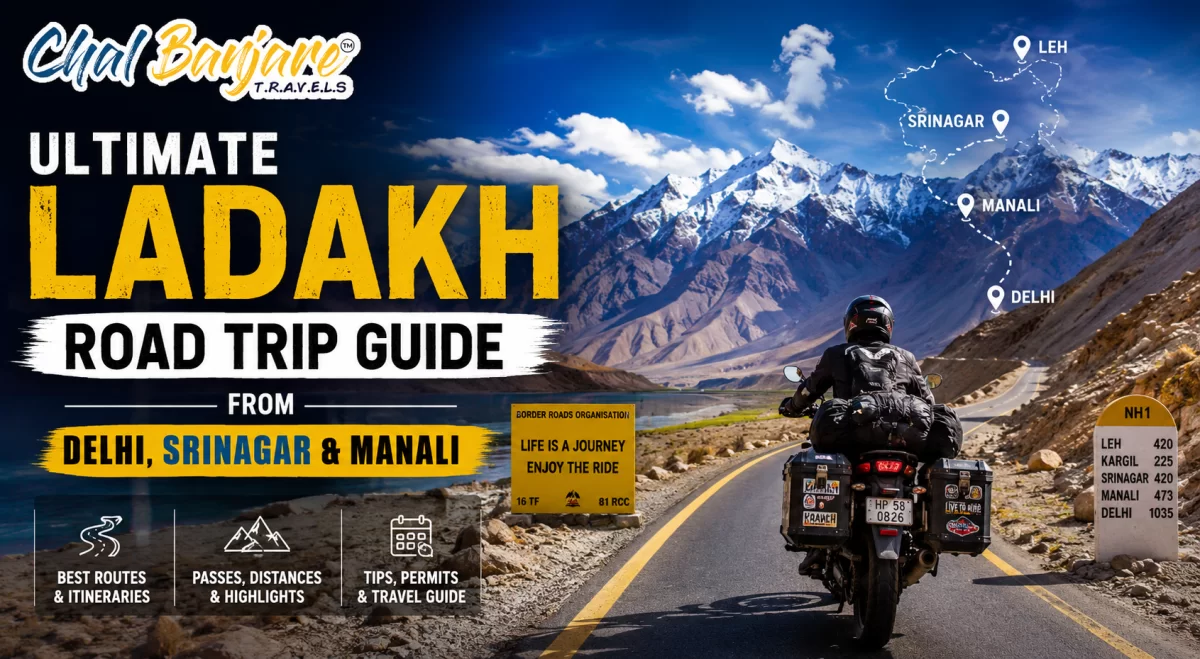
A Ladakh road trip from Delhi through Srinagar or Manali requires detailed planning around routes, weather, fuel, permits, and high altitude travel conditions.
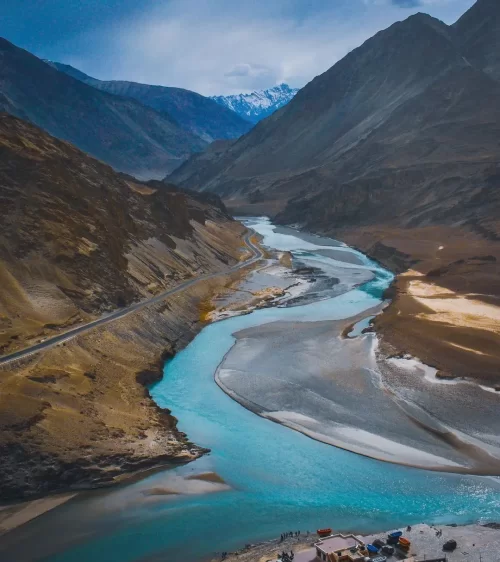
A Ladakh road trip is one of the most iconic Himalayan travel experiences in India because it combines high mountain passes, changing landscapes, remote valleys, alpine lakes, and long scenic highways across northern India. Most road trips to Ladakh begin from Delhi, Chandigarh, Srinagar, or Manali and continue through mountain routes connecting Himachal Pradesh, Kashmir, and Ladakh.
There are mainly two major highway circuits used for reaching Ladakh by road. The Srinagar–Leh highway provides a gradual altitude climb through Sonamarg, Zoji La, Drass, and Kargil, while the Manali–Leh highway offers a more adventurous route with high passes, rough terrain, and long isolated stretches. Many travelers combine both highways into one circular route to experience maximum landscape variation while reducing route repetition.
Road trip planning in Ladakh should always consider altitude, weather conditions, fuel availability, and realistic daily driving limits because mountain terrain significantly increases travel time compared to normal highway journeys.
A Ladakh road journey is best suited for travelers who enjoy long-distance driving, mountain landscapes, changing terrain, and flexible adventure-style travel. Unlike short hill station vacations, Ladakh road trips involve physically demanding travel conditions including rough roads, high-altitude driving, cold weather, and long hours behind the wheel or on a motorcycle.
Bike riders, photographers, self-drive travelers, adventure groups, and slow-travel enthusiasts usually enjoy Ladakh road trips the most because the journey itself becomes a major part of the experience. Travelers preferring comfort, shorter travel duration, or less physical strain often choose flights to Leh instead of full highway journeys from North India.
| Traveler Type | Suitability for Road Trip | Travel Experience |
|---|---|---|
| Adventure Travelers | Highly Suitable | Enjoy mountain roads, high passes, and remote terrain |
| Bike Riders | Very Popular Choice | Road journey becomes the main travel experience |
| Photographers | Excellent Option | Changing landscapes provide diverse photography opportunities |
| Self Drive Travelers | Suitable with experience | Requires confidence on Himalayan roads |
| Families with Seniors | Moderately Suitable | Long driving hours may become tiring |
| Luxury Travelers | Limited Suitability | Flights and private taxis usually offer greater comfort |
| First-Time Mountain Drivers | Requires Caution | Road conditions can become physically demanding |
Travelers considering a Ladakh road journey should prioritize physical readiness, patience, and flexible planning because weather delays, rough terrain, and altitude exposure are a normal part of Himalayan road travel.
A comfortable Ladakh road trip requires significantly more time compared to flying directly into Leh because the highways themselves form a major part of the journey. Travelers planning road trips from Delhi, Chandigarh, Manali, or Srinagar should keep enough days for acclimatization, highway travel, sightseeing, weather delays, and proper rest between long driving stretches.
The ideal minimum duration depends on the route combination and travel style. Travelers attempting both Srinagar and Manali highways along with Nubra Valley and Pangong Lake generally require more than a week for a reasonably comfortable experience. Shorter road trips often become extremely exhausting because of continuous driving and limited recovery time at high altitude.
Travelers who keep realistic road trip durations usually enjoy Ladakh far more comfortably because they experience less exhaustion and better acclimatization throughout the journey. Proper pacing is one of the most important factors for a successful Himalayan road trip.
The Delhi to Manali Leh highway route is one of the most popular and adventurous road trip circuits for reaching Ladakh from North India. This journey combines plains highways, Himachali valleys, high mountain passes, barren landscapes, glacier streams, and remote Himalayan terrain. Travelers choosing this route usually experience dramatic landscape transitions from urban roads near Delhi to cold desert mountain scenery closer to Ladakh.
The journey is physically demanding because the route includes rough mountain roads, rapid altitude gain, unpredictable weather, and long driving hours across isolated sections. Most travelers break the route through overnight stays at Manali, Jispa, or Sarchu before continuing towards Leh. Attempting the journey too aggressively without acclimatization or proper rest often results in exhaustion and altitude discomfort.
| Route Section | Approximate Distance | Average Travel Conditions |
|---|---|---|
| Delhi to Manali | Approx. 520 to 550 km | Long highway drive with heavy traffic near hill entry zones |
| Manali to Jispa | Approx. 140 km | Mountain roads with changing weather and scenic valleys |
| Jispa to Leh | Approx. 330 to 360 km | High passes, rough terrain, and remote stretches |
| Total Delhi to Leh Distance | Approx. 1000 to 1100 km | Usually covered over multiple days for comfort |
| Main Passes | Baralacha La, Lachung La, Tanglang La | High-altitude sections with weather dependency |
Travelers should avoid underestimating the Manali–Leh highway because mountain roads slow travel significantly compared to normal highway driving. Proper acclimatization, early departures, and realistic daily travel plans make the journey much safer and more enjoyable.
The Delhi to Srinagar Leh highway route is considered the more gradual and comfortable road approach into Ladakh because the altitude increases slowly across the journey. This route passes through Punjab plains, Jammu region, Kashmir Valley, and finally enters Ladakh through high mountain passes and scenic Himalayan landscapes.
Compared to the Manali highway, this route is usually easier on the body because travelers gain altitude progressively over several days. Most road trippers prefer entering Ladakh through Srinagar and exiting through Manali because it provides better acclimatization while still allowing travelers to experience both major Himalayan highways.
This route is especially suitable for first-time Ladakh road travelers because it allows the body more time to adjust to high altitude conditions. Keeping an overnight stay at Kargil creates a much more comfortable and less exhausting journey into Leh.
Choosing proper overnight stopovers is extremely important during a Ladakh road trip because continuous mountain driving at high altitude quickly causes fatigue and increases the risk of altitude-related problems. Strategic stopovers improve acclimatization, reduce physical exhaustion, and make the overall journey much safer and more comfortable.
The best stopovers depend on whether travelers are using the Srinagar route or the Manali route. Some towns work better for gradual altitude adjustment, while others mainly function as transit points before crossing difficult mountain passes. Travelers should focus on realistic driving distances rather than trying to minimize overnight halts aggressively.
| Stopover Location | Route Side | Main Importance |
|---|---|---|
| Chandigarh | Delhi Exit Route | Common overnight halt before entering Himalayan roads |
| Manali | Manali Highway | Main preparation point for the Leh highway journey |
| Jispa | Manali Highway | Better acclimatization stop before higher altitude sections |
| Sarchu | Manali Highway | Popular transit camping region between Himachal and Ladakh |
| Jammu | Srinagar Highway | Major transit city before Kashmir Valley roads |
| Srinagar | Srinagar Highway | Comfortable overnight halt before Zoji La crossing |
| Kargil | Srinagar Highway | Most important acclimatization and transit stop before Leh |
Travelers planning Ladakh road trips should always prioritize proper rest and acclimatization over aggressive driving schedules. Well-planned stopovers improve safety, reduce fatigue, and make long Himalayan road journeys significantly more enjoyable.
The Srinagar to Leh highway is one of the most scenic Himalayan road journeys in India and is widely considered the best route for entering Ladakh because of its gradual altitude gain. The route passes through Kashmir Valley, high mountain passes, river valleys, war memorial regions, and Buddhist landscapes before finally reaching Leh. Travelers using this highway experience continuous terrain changes ranging from green meadows and forests to barren cold desert mountains.
The highway generally begins from Srinagar and continues through Sonamarg, Zoji La Pass, Drass, Kargil, Mulbekh, Lamayuru, and finally Leh. Most travelers divide the route into two days with an overnight stay in Kargil because continuous driving from Srinagar to Leh can become exhausting due to mountain roads and changing weather conditions.
Travelers using the Srinagar route generally experience a more comfortable journey because the altitude rises progressively across the highway. Flexible planning remains important because weather conditions and road maintenance can still affect travel timing unexpectedly.
Road conditions on the Srinagar to Leh highway vary depending on snowfall clearance, weather changes, landslides, army movement, and seasonal maintenance work. Compared to the Manali highway, this route is usually considered smoother and more stable for road travel, although sections near Zoji La can still become challenging due to narrow roads, mud patches, and traffic congestion during peak season.
Fuel stations, hotels, restaurants, and basic roadside facilities are comparatively better distributed across this route than many remote Ladakh highways. Srinagar, Sonamarg, Kargil, and Leh provide the most reliable accommodation and fuel access, while smaller settlements offer limited services depending on tourist season and weather conditions.
| Route Section | Road Conditions | Available Facilities |
|---|---|---|
| Srinagar to Sonamarg | Mostly smooth highway roads | Hotels, restaurants, fuel stations |
| Sonamarg to Zoji La | Narrow mountain roads and rough patches | Limited roadside stalls during season |
| Zoji La to Drass | Weather-sensitive mountain roads | Basic food stops and small settlements |
| Drass to Kargil | Comparatively stable roads | Hotels, fuel stations, restaurants |
| Kargil to Lamayuru | Scenic highway with mixed surfaces | Basic accommodation and tea stops |
| Lamayuru to Leh | Generally good road conditions | Roadside cafes and tourist facilities near Leh |
Travelers should still prepare for weather delays, temporary roadblocks, and traffic stoppages because Himalayan highways remain sensitive to snowfall and landslides. Early morning departures and realistic driving schedules improve both safety and comfort during the journey.
The biggest advantage of the Srinagar to Leh highway is its gradual altitude gain, which allows the body to adjust more naturally while traveling towards Ladakh. Unlike direct flights to Leh or the Manali highway, this route increases elevation progressively across multiple regions, reducing the chances of severe altitude sickness for many travelers.
Travelers moving slowly through Srinagar, Sonamarg, Drass, and Kargil before reaching Leh generally experience fewer acclimatization issues because the body gets additional time to adapt to reduced oxygen levels. This makes the route especially suitable for first-time Ladakh travelers, families, senior citizens, and people concerned about high-altitude discomfort.
Although the Srinagar route offers better acclimatization advantages, travelers should still avoid rushing directly towards higher-altitude regions after reaching Leh. Proper rest, hydration, and gradual movement remain important throughout the Ladakh journey.
The Manali to Leh highway is one of the most famous high-altitude road journeys in India and attracts bikers, self-drive travelers, photographers, and adventure groups from across the country. This route connects Himachal Pradesh with Ladakh through barren mountains, glacier streams, remote valleys, high passes, and cold desert landscapes. Unlike the Srinagar highway, the Manali route climbs rapidly in altitude, making the journey more physically demanding but visually dramatic.
Most travelers begin the journey from Manali and continue through Atal Tunnel, Keylong, Jispa, Sarchu, Pang, and finally Leh. Breaking the route with overnight stays is extremely important because continuous driving across high-altitude mountain roads can quickly cause exhaustion and altitude discomfort. Jispa is generally considered a better acclimatization stop compared to Sarchu because of its lower altitude and comparatively more comfortable environment.
Travelers planning the Manali–Leh highway should avoid aggressive driving schedules because altitude gain and rough roads increase physical fatigue significantly. Flexible timing and proper acclimatization greatly improve comfort during the journey.
The Manali to Leh highway is known for its challenging terrain because the route crosses multiple high mountain passes, glacier-fed streams, loose gravel sections, and weather-sensitive roads. This highway is far more demanding than normal road travel because driving conditions can change rapidly depending on snowfall, rain, landslides, or water flow from melting glaciers.
Several stretches involve steep climbs, sharp turns, broken roads, and isolated mountain sections with limited assistance available nearby. Water crossings become especially difficult during afternoons when glacier streams strengthen because of daytime snowmelt. Travelers unfamiliar with Himalayan roads should therefore drive carefully and maintain realistic daily travel distances.
| Major Challenge | Main Difficulty | Ground Reality |
|---|---|---|
| Baralacha La | High-altitude weather exposure | Snow and fog possible even during summer |
| Nakee La | Steep mountain roads | Sharp bends and rough patches common |
| Lachung La | Thin oxygen levels | Physical fatigue increases at higher elevations |
| Tanglang La | Strong winds and cold temperatures | Weather changes rapidly near summit areas |
| River Crossings | Strong glacier streams | Afternoon crossings become more difficult |
| Broken Road Sections | Loose gravel and rough surfaces | Driving speed reduces significantly |
| Remote Highway Stretches | Limited roadside assistance | Help may take several hours to arrive |
Travelers attempting this highway should begin driving early in the morning because weather conditions and river crossings generally worsen later in the day. Slow and careful driving is extremely important throughout the journey because mountain terrain remains unpredictable.
The Manali to Leh highway passes through several isolated Himalayan stretches where fuel stations, mobile networks, accommodation options, and medical support remain limited. Travelers planning road trips on this route should prepare carefully because depending completely on urban-style infrastructure can create serious difficulties during remote travel sections.
Fuel availability is mainly concentrated around Manali, Tandi, Keylong, and Leh, with very long distances between petrol stations after entering higher Himalayan regions. Accommodation ranges from hotels and guesthouses in larger towns to basic camps and roadside tent stays in remote transit areas like Sarchu and Pang. Mobile connectivity also becomes inconsistent throughout the route, especially after crossing major mountain sections.
Travelers using the Manali–Leh highway should carry sufficient cash, downloaded offline maps, power banks, medicines, snacks, and emergency supplies because remote sections of the route have limited infrastructure support. Proper preparation significantly improves safety and travel comfort during this high-altitude Himalayan journey.
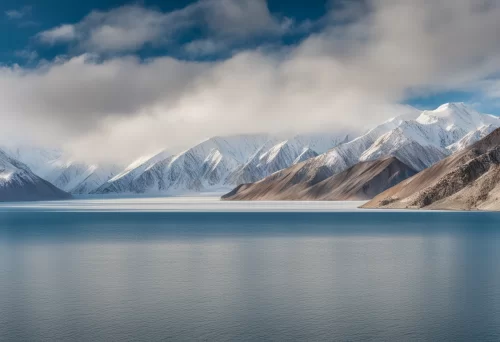
The Leh–Nubra Valley–Pangong Lake circuit is the most popular route during a Ladakh road trip because it combines high mountain passes, cold desert landscapes, monasteries, lakes, rivers, and remote Himalayan villages within a single travel circuit. Most travelers begin this journey from Leh after proper acclimatization and gradually move towards Nubra Valley through Khardung La before continuing to Pangong Lake.
This circuit is considered ideal for first-time Ladakh travelers because it offers a balanced introduction to Ladakh’s terrain and cultural landscape without immediately moving into extremely remote areas. Road conditions vary throughout the route, ranging from smooth stretches near Leh to rough mountain sections, gravel roads, and isolated valley roads closer to Pangong.
Travelers should keep realistic daily driving schedules during this circuit because altitude and long mountain journeys naturally increase physical fatigue. Proper acclimatization before crossing Khardung La and Chang La significantly improves travel comfort.
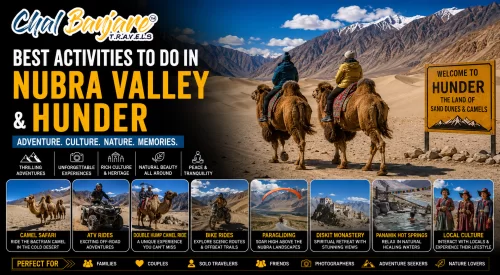
The extended Nubra Valley route covering Turtuk, Diskit, Hunder, Sumur, and Panamik provides a much deeper experience of Ladakh’s mountain culture, cold desert landscapes, and remote Himalayan villages. Unlike shorter Nubra itineraries focused mainly on Hunder dunes and Pangong connectivity, this route allows travelers to explore quieter villages, monasteries, riverside landscapes, and border-region settlements.
Road conditions across this route vary from smooth valley sections to narrower mountain roads near remote villages. Since several regions remain isolated and less commercialized compared to Leh or Pangong, travelers experience a more relaxed atmosphere along with stronger local cultural interaction during the journey.
| Destination | Main Attraction | Travel Importance |
|---|---|---|
| Diskit | Monastery and giant Buddha statue | Main cultural center of Nubra Valley |
| Hunder | Cold desert dunes and camel rides | Most popular overnight stay region in Nubra |
| Sumur | Village landscapes and monasteries | Quieter side of Nubra Valley |
| Panamik | Hot springs and mountain scenery | Remote northern valley extension |
| Turtuk | Balti culture and border-region village | One of the northernmost accessible villages in India |
| Shyok River Region | Mountain river landscapes | Scenic road trip section across Nubra Valley |
Travelers covering this extended Nubra route should keep extra days because road distances and sightseeing opportunities increase considerably beyond the standard Leh–Hunder circuit. Slow travel allows better exploration of villages, local culture, and mountain landscapes.
For travelers wanting deeper Himalayan exploration beyond mainstream Ladakh routes, regions like Hanle, Tso Moriri, Lamayuru, and Zanskar provide some of the most dramatic and remote road trip experiences in northern India. These areas are known for isolated valleys, high-altitude lakes, dark night skies, monasteries, glaciers, and rugged mountain terrain with comparatively fewer tourists.
Road trips across these regions involve long driving hours, rough terrain, limited accommodation, weak network connectivity, and sparse fuel availability. However, they also offer quieter landscapes and a stronger sense of Himalayan isolation compared to the more crowded Nubra and Pangong circuits.
Travelers planning these offbeat Ladakh road trip regions should prioritize weather flexibility, fuel planning, and realistic travel pacing because remote Himalayan terrain can quickly become physically demanding. Extra buffer days are highly recommended while covering these circuits.
The best time for a Ladakh road trip usually begins when the Srinagar–Leh and Manali–Leh highways reopen after winter snowfall clearance. The road opening season generally starts around late April or May for the Srinagar route, while the Manali highway often opens between late May and June depending on snow conditions at high mountain passes.
From June to September, most road trip circuits across Ladakh remain operational, making this the ideal travel window for bikers, self-drive travelers, photographers, and adventure groups. During these months, major tourist regions like Nubra Valley, Pangong Lake, Tso Moriri, Hanle, and Lamayuru become accessible through stable highway conditions and active tourism infrastructure.
September is often considered one of the most balanced months for Ladakh road trips because weather conditions remain relatively stable while tourist congestion gradually decreases after peak summer crowds.
Although Ladakh itself receives relatively low rainfall because of its cold desert geography, the roads connecting Ladakh through Himachal Pradesh and Kashmir are significantly affected during the monsoon season. Travelers entering Ladakh by road during July and August should understand that landslides, road damage, mud sections, and traffic delays are common on both the Srinagar and Manali highways.
The Manali–Leh highway is generally more vulnerable to water crossings and rough road conditions because several sections pass through glacier-fed valleys and unstable mountain terrain. The Srinagar route also faces occasional disruptions near Zoji La and Kashmir Valley sections due to landslides and heavy rainfall. Flexible planning becomes extremely important during monsoon road trips.
| Route Section | Monsoon Impact | Ground Reality |
|---|---|---|
| Manali to Jispa | Rain and slippery roads | Driving speed reduces significantly during heavy rain |
| Sarchu and Pang Region | Water crossings | Afternoon glacier streams become stronger |
| Zoji La Pass | Landslides and fog | Traffic movement may slow during bad weather |
| Kashmir Valley Roads | Heavy rainfall impact | Traffic congestion and delays possible |
| Leh and Nubra | Comparatively lower rainfall | Conditions remain more stable inside central Ladakh |
| Mountain Highways | Road damage and mud patches | Weather disruptions can affect travel schedules |
Travelers planning monsoon road trips should always keep buffer days because road closures and weather delays are common in Himalayan regions during this season. Early morning departures generally improve driving conditions on mountain roads.
As the tourist season moves towards late September, October, and early winter months, snowfall risk gradually increases across Ladakh highways and high mountain passes. Weather conditions become more unpredictable during this period, especially at passes like Zoji La, Baralacha La, Tanglang La, Chang La, and Khardung La.
Road closures during late season usually happen because fresh snowfall blocks mountain routes and creates dangerous driving conditions including black ice, reduced visibility, and slippery roads. Camps and seasonal accommodation near Pangong Lake, Sarchu, and remote villages also begin shutting operations as temperatures fall sharply during nights.
Travelers attempting late-season Ladakh road trips should monitor weather forecasts and highway status carefully because snowfall conditions can change rapidly. Flexible schedules, warm clothing, and backup travel plans become extremely important during this period.
Fuel expenses form one of the biggest components of a Ladakh road trip budget because the journey involves long mountain distances, steep climbs, rough roads, and remote highway stretches. Vehicles generally consume more fuel in Ladakh compared to plains highways because of altitude, mountain terrain, and continuous gear changes during uphill driving.
Travelers starting from Delhi, Chandigarh, Manali, or Srinagar should calculate fuel costs carefully before beginning the trip because petrol stations become limited after entering remote Himalayan regions. Additional expenses such as tolls, permits, parking fees, and emergency fuel backup also increase the overall road trip budget considerably.
| Expense Type | Main Purpose | Ground Reality |
|---|---|---|
| Fuel Costs | Highway and mountain driving | Fuel consumption increases on steep mountain roads |
| Toll Charges | National highways and tunnels | Applicable before entering Ladakh regions |
| Inner Line Permits | Restricted area access | Required for Nubra, Pangong, Hanle, and Tso Moriri |
| Parking Fees | Tourist points and hotel parking | Small but frequent expenses during sightseeing |
| Fuel Backup | Remote route safety | Extra fuel often carried on bike trips |
| Environmental Charges | Tourism management fees | Collected during permit processing |
| Vehicle Maintenance | Tire, puncture, and repair costs | Road conditions increase wear and tear |
Travelers planning Ladakh road trips should always maintain an emergency budget because weather delays, road diversions, and unexpected vehicle repairs can increase expenses suddenly during Himalayan travel.
Accommodation and food costs during a Ladakh road trip depend heavily on the chosen route, travel season, and overnight stopovers. Travelers using the Srinagar or Manali highways usually stay at transit points like Manali, Jispa, Sarchu, Srinagar, Kargil, Pang, and Leh before continuing towards Nubra Valley or Pangong Lake.
Hotels and guesthouses in Leh and larger towns generally provide better comfort and facilities, while accommodation in remote highway regions mostly consists of camps, roadside tents, or basic guesthouses. Food expenses also increase gradually as travelers move into isolated mountain sections where transportation of supplies becomes difficult and seasonal operations remain limited.
Travelers planning budget road trips should remain flexible with accommodation expectations because heating, electricity, internet access, and hot water facilities vary significantly across remote Himalayan regions.
Both bike trips and self-drive car journeys are extremely popular ways to explore Ladakh, but the overall cost and travel experience differ considerably depending on route planning, group size, comfort preference, and driving experience. Bike journeys usually attract adventure-focused travelers, while self-drive cars are preferred by families, couples, and travelers seeking more comfort and luggage space.
Bike rentals may initially appear cheaper, but fuel backup, riding gear, puncture repairs, and harsh weather conditions can increase the overall expense during longer circuits. Self-drive cars generally cost more in terms of fuel and vehicle wear, but they provide better protection from weather, greater comfort, and easier long-distance travel across rough roads.
| Travel Option | Main Advantage | Cost Impact |
|---|---|---|
| Bike Rental | Adventure-focused experience | Moderate cost with additional riding expenses |
| Self Drive Car | Comfort and luggage convenience | Higher fuel and maintenance expenses |
| Shared Bike Group | Reduced group travel cost | Fuel and rental shared among riders |
| SUV Road Trip | Better stability on rough roads | Higher fuel consumption on mountain routes |
| Rental Bike Fuel Backup | Important for remote regions | Extra carrying cost during long circuits |
| Vehicle Repairs | Mountain road wear and tear | Unexpected expenses possible remotely |
| Comfort Level | Car travel less physically exhausting | Better for families and long-distance travel |
Travelers should choose between bikes and self-drive vehicles based on realistic comfort, driving confidence, weather tolerance, and trip duration rather than only focusing on social media trends or adventure expectations. Proper planning improves both safety and overall travel quality during a Ladakh road trip.
Inner Line Permits are mandatory for visiting several tourist regions in Ladakh because many routes pass through sensitive border zones and protected high-altitude areas. Travelers planning road trips to Nubra Valley, Pangong Lake, Tso Moriri, Hanle, Turtuk, and nearby restricted circuits must carry valid permits during the journey because checkpoints regularly verify documents at multiple locations.
Most travelers arrange permits either online before arrival or through local travel agents and hotels in Leh. The process is generally straightforward for Indian travelers, but route planning should be finalized carefully before applying because permits must clearly include every intended destination. Travelers changing plans midway may need additional approvals depending on the region.
Travelers should keep both digital and printed permit copies because network access becomes unreliable in remote Ladakh regions. Proper documentation avoids unnecessary delays during road travel across restricted circuits.
Bike trips are extremely popular in Ladakh, but travelers should understand the local vehicle and transport union rules before planning road journeys. One of the most important restrictions applies to motorcycles rented outside Leh, especially bikes rented from Manali, Delhi, Chandigarh, or other cities. Local taxi and transport unions regulate commercial vehicle operations inside several Ladakh sightseeing circuits.
In many situations, bikes rented outside Leh are not permitted for local sightseeing within major Ladakh tourist routes like Nubra Valley, Pangong Lake, or Tso Moriri when used commercially. Travelers usually continue long-distance transit into Leh with outside rental bikes, but for local circuit travel, restrictions may apply depending on current union enforcement and route conditions.
| Vehicle Type | Rule or Restriction | Ground Reality |
|---|---|---|
| Leh Rental Bikes | Allowed for Ladakh sightseeing circuits | Most commonly used for local exploration |
| Outside Rental Bikes | Restrictions may apply on local routes | Union checks possible at checkpoints |
| Private Personal Bikes | Generally permitted | Valid documents must be carried |
| Taxi Union Rules | Outside commercial taxis restricted | Local taxis preferred within Ladakh circuits |
| Self Drive Vehicles | Usually allowed for personal travel | Proper documentation required |
| Checkpoint Inspections | Vehicle papers may be verified | Frequent during peak tourist season |
Travelers planning bike trips should verify current local regulations before starting the journey because transport rules and union enforcement may change over time. Proper clarification beforehand helps avoid route restrictions and travel disputes during the road trip.
Carrying proper documents is extremely important during a Ladakh road trip because travelers regularly encounter permit checkpoints, hotel verification procedures, fuel station checks, and police or army inspections across remote mountain regions. Missing paperwork can create serious delays, especially in restricted border areas and isolated highways.
Both personal identification documents and vehicle papers should remain easily accessible throughout the journey. Since mobile networks and internet connectivity remain weak in several regions, travelers should always carry printed copies instead of relying completely on digital storage or online access.
Travelers carrying organized documents usually experience smoother movement across Ladakh highways and remote tourist circuits. Proper preparation becomes especially important during long road journeys where access to printing, internet, or emergency assistance remains limited.
Altitude sickness is one of the biggest risks during a Ladakh road trip because travelers spend long hours driving through regions located well above 10,000 feet. Routes crossing Khardung La, Chang La, Baralacha La, Tanglang La, and other high mountain passes expose travelers to lower oxygen levels, cold weather, and physical fatigue, especially during continuous road journeys without proper rest.
Many road trippers make the mistake of driving aggressively without allowing the body enough time to acclimatize. Travelers coming from Delhi, Chandigarh, Manali, or Srinagar often underestimate how exhausting mountain driving becomes at high altitude. Symptoms such as headache, dizziness, nausea, breathing discomfort, weakness, and disturbed sleep commonly appear when acclimatization is ignored.
Travelers who prioritize gradual acclimatization and realistic driving schedules usually experience a much safer and smoother Ladakh road trip. Continuous long drives without proper rest increase both health risks and travel fatigue significantly.
Ladakh road trips remain heavily dependent on weather and terrain conditions because the highways pass through high-altitude mountain passes, landslide-prone valleys, glacier streams, and isolated Himalayan regions. Even during peak tourist season, sudden snowfall, heavy rain, landslides, mudslides, or road repair work can temporarily block routes and increase travel time dramatically.
The Manali–Leh highway is especially vulnerable to water crossings and rough road conditions, while the Srinagar route often faces delays near Zoji La due to landslides and traffic congestion. Travelers should always understand that mountain road conditions can change rapidly and that travel timing in Ladakh depends more on weather than on actual map distance.
| Travel Challenge | Main Impact | Ground Reality |
|---|---|---|
| Landslides | Road closures and traffic delays | More frequent during monsoon and unstable weather |
| Snowfall | High pass blockage | Common during shoulder seasons and winter months |
| Water Crossings | Difficult vehicle movement | Glacier streams strengthen during afternoons |
| Black Ice | Vehicle skidding risk | Dangerous during cold mornings and nights |
| Fog and Low Visibility | Reduced driving safety | Common around Zoji La and high mountain sections |
| Road Repairs | Slow traffic movement | Frequent maintenance work on Himalayan highways |
| Flight Delays | Travel schedule disruption | Weather often affects Leh flight operations |
Travelers planning Ladakh road trips should always keep flexible schedules and additional buffer days because weather disruptions can occur unexpectedly. Early morning departures and cautious driving improve safety significantly during mountain travel.
Although Ladakh tourism infrastructure has improved considerably over recent years, several remote regions still face major limitations related to mobile connectivity, ATM access, electricity supply, fuel availability, vehicle repairs, and emergency medical support. Travelers accustomed to urban convenience often underestimate how isolated many Ladakh highways become after leaving Leh and larger towns.
Network connectivity becomes especially weak in areas like Pangong villages, Hanle, Tso Moriri, Pang, Sarchu, and interior Zanskar routes. ATM access remains reliable mainly in Leh and Kargil, while vehicle repair support and medical facilities become sparse across remote highways. Proper preparation therefore becomes essential before beginning long road journeys.
Travelers carrying sufficient cash, power banks, medicines, offline maps, spare fuel, and emergency essentials usually face fewer problems during remote Ladakh road trips. Proper preparation greatly improves both safety and overall travel comfort across isolated Himalayan regions.
Choosing between the Srinagar–Leh highway and the Manali–Leh highway is one of the most important decisions while planning a Ladakh road trip because both routes offer completely different travel experiences. The Srinagar route is generally considered more comfortable for first-time travelers because the altitude rises gradually across Kashmir Valley, Sonamarg, Drass, and Kargil before reaching Leh.
The Manali route, on the other hand, is more adventurous and visually dramatic because it passes through rough terrain, high mountain passes, glacier streams, and long isolated stretches. However, it also becomes physically more demanding because of rapid altitude gain and difficult road conditions. Many experienced travelers prefer entering Ladakh through Srinagar and exiting via Manali because this combination provides better acclimatization along with maximum route variety.
| Route | Main Advantage | Travel Challenge |
|---|---|---|
| Srinagar to Leh | Gradual altitude gain | Landslide and traffic delays near Zoji La |
| Manali to Leh | Adventure-focused scenery | Rough roads and rapid altitude increase |
| Srinagar Entry Route | Better acclimatization | Longer gradual road travel |
| Manali Exit Route | Dramatic mountain landscapes | Physically exhausting for some travelers |
| Circular Route Combination | Maximum road trip coverage | Requires additional travel days |
| Direct Leh Flights | Fastest arrival option | Sudden altitude exposure |
First-time travelers generally experience a smoother Ladakh journey when they prioritize gradual acclimatization and realistic driving schedules instead of selecting routes only for adventure value. Weather flexibility remains important on both highways because mountain conditions can change rapidly.
Choosing the correct vehicle for a Ladakh road trip is extremely important because mountain highways involve steep climbs, rough surfaces, water crossings, gravel sections, and long remote stretches with limited roadside assistance. Vehicle comfort, ground clearance, reliability, and fuel planning all directly affect the overall road trip experience.
SUVs are generally considered the most practical option for Ladakh highways because they provide better ground clearance and improved stability on rough roads. Bikes remain extremely popular among adventure travelers, while smaller hatchbacks require cautious driving on difficult sections. Travelers unfamiliar with Himalayan roads often prefer private taxis because experienced local drivers understand weather conditions, mountain terrain, and route risks much better.
Travelers should choose vehicles based on comfort, experience, route difficulty, and group size rather than only appearance or social media trends. Reliable vehicles and realistic daily driving plans significantly improve safety on Ladakh highways.
Before beginning a Ladakh road trip in 2026, travelers should carefully review route planning, weather conditions, vehicle preparation, accommodation bookings, permit requirements, and medical readiness. Ladakh highways pass through extremely remote Himalayan terrain where infrastructure remains limited compared to urban regions, making preparation one of the most important parts of the journey.
Many road trip problems in Ladakh happen because travelers underestimate altitude, weather unpredictability, fuel limitations, and long-distance mountain driving. A proper checklist helps reduce stress, improves safety, and ensures smoother travel across challenging Himalayan roads.
A successful Ladakh road trip depends more on preparation, patience, acclimatization, and realistic travel pacing than on covering maximum destinations quickly. Travelers who prepare carefully usually enjoy the mountains, highways, lakes, and remote Himalayan landscapes far more comfortably and safely.
Get customized Ladakh tour planning designed around altitude comfort, acclimatization time, weather windows, and real Himalayan road conditions. Whether you are visiting for high mountain passes, monasteries, lakes, or remote valley experiences, our exper
⚡ Quick Response | 💰 Free consultation | 🕒 24×7 expert support