+91 9910402252
admin@chalbanjare.com


| Entry Fee | Free; there is no charge for entry or darshan. |
|---|---|
| Timings | The Golden Temple complex is open 24 hours daily. Ceremonial timings, including the opening and closing of the sanctum, vary seasonally. |
| Altitude (m) | Approximately 230 m above sea level. |
| Ideal Visit Duration | 2–3 hours; allow additional time for langar and during long darshan queues. |
| Best Time of Day | Early morning before sunrise for the opening ceremonies and relatively lower crowds; evening is popular for the illuminated complex. |
| Crowd Level | High throughout the year; particularly heavy on weekends, Gurpurabs, Baisakhi, and other major Sikh occasions. |
| Distance from City Centre (km) | Located in central Amritsar, approximately 2 km from Amritsar Junction railway station. |
| Walking Difficulty | Easy to moderate; the complex has broad marble walkways, but visitors may need to walk and stand for extended periods during queues. |
| Parking Available | Yes; designated parking facilities are available in the surrounding area, followed by a walk or local transport to the pedestrianized temple zone. |
| Last Mile Access | Accessible by taxi, auto-rickshaw, e-rickshaw, or local transport; the immediate heritage-zone approach is largely pedestrianized. |
| Suitable for Kids | Yes; adult supervision is recommended around the sarovar and in heavy crowds. |
| Suitable for Seniors | Yes; however, long queues and extended walking or standing can be tiring during peak periods. |
| Wheelchair Friendly | Partially; much of the main complex is accessible and wheelchair assistance is available, but crowd conditions and access to some areas can limit movement. |
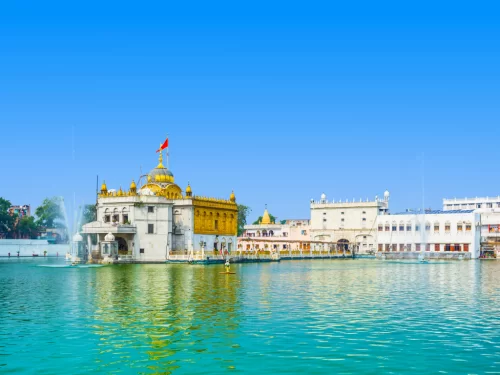
The Golden Temple, or Sri Harmandir Sahib, is the foremost Sikh gurdwara and draws pilgrims and visitors for prayer, reflection, and participation in its living religious traditions. Visitors can walk around the sacred Amrit Sarovar, enter the gold-covered sanctum, and experience the community kitchen known as langar.
The atmosphere is deeply devotional, with continuous Gurbani kirtan, pilgrims bathing at designated areas of the sarovar, and volunteers serving free meals to thousands of people. Early morning and evening visits are especially atmospheric, while major religious occasions can bring very large crowds.
What makes the Golden Temple distinct is the combination of its gilded sanctum surrounded by the Amrit Sarovar and the Sikh principles of equality, service, and open hospitality practiced throughout the complex. The langar and volunteer-run seva allow travelers to experience these traditions directly rather than viewing the site only as a monument.
The Golden Temple, officially known as Sri Harmandir Sahib, is the most revered gurdwara in Sikhism and is located in Amritsar, Punjab. Its development began in the late 16th century under the Sikh Gurus, with Guru Arjan overseeing the construction of the shrine and the completion of the sacred Amrit Sarovar. In 1604, the Adi Granth was installed at Harmandir Sahib, establishing the site as a major centre of Sikh faith.
The shrine suffered damage during conflicts in the 18th century and was subsequently rebuilt. In the early 19th century, Maharaja Ranjit Singh supported major renovations and had sections of the sanctum decorated with marble and gold, giving the Golden Temple its distinctive appearance. Today, the complex remains a major Sikh pilgrimage centre, known for the Guru Granth Sahib, the sacred sarovar, and the tradition of langar that serves visitors without distinction.
The best time to visit the Golden Temple is from October to March, when Amritsar has cooler weather that is comfortable for walking around the large complex, spending time beside the Amrit Sarovar, and visiting during both daytime and evening hours.
 Tourist Attraction
The Attari-Wagah Border is the India–Pakistan land border crossing near Amritsar, Punjab, known for the ceremonial flag-lowering event held by the border forces of both countries.
 Tourist Attraction
Jallianwala Bagh is a national memorial in Amritsar, Punjab, commemorating the victims of the Jallianwala Bagh massacre of 13 April 1919.
Get customized Himachal Pradesh tour planning designed around season, road conditions, hill travel pacing, and comfort preferences. Whether you are visiting for snow experiences, mountain landscapes, temple towns, adventure activities, or relaxed valley s
⚡ Quick Response | 💰 Free consultation | 🕒 24×7 expert support

