
Best Hidden and Less Crowded Beaches in Goa
Discover quieter beaches in Goa away from the busiest tourist areas, with insights into secluded coastal spots, accessibility, facilities and tips for peaceful beach outings.
+91 9910402252
admin@chalbanjare.com


Explore popular water sports in Goa, including parasailing, jet skiing and banana boat rides, with guidance on activity locations, typical costs, seasonal availability and safety precautions.
Water sports in Goa range from short recreational rides to specialised underwater and paddling experiences. Some activities, such as banana boat rides and instructor-assisted jet skiing, are designed for tourists with limited experience. Others, including scuba diving and kayaking, require more detailed safety instructions, suitable weather conditions and professional supervision. The best activity depends on personal interests, fitness, comfort in water and the safety arrangements provided by the operator.
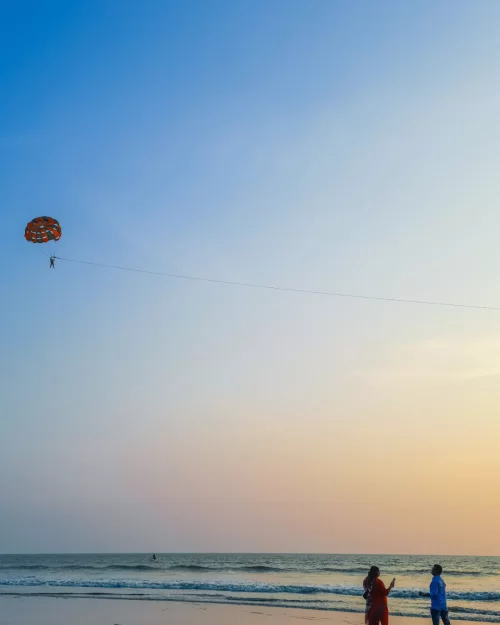
Parasailing is one of Goa's most recognisable adventure activities. Participants wear a harness connected to a parachute-like canopy and are lifted into the air while being towed by a motorboat.
The activity offers elevated views of the coastline and surrounding sea. Parasailing may be available at selected beaches such as Baga, Calangute, Candolim and Sinquerim when authorised operators are active.
Participants should check the operator's equipment, weather assessment, harness arrangements and applicable age or weight restrictions before booking.
Jet skiing involves riding a motorised personal watercraft over the sea. It is popular with tourists looking for a short, energetic activity.
At many tourist locations, beginners may be accompanied by an instructor or given a controlled ride rather than being permitted to operate the watercraft independently.
Travellers should confirm whether the price covers an instructor-assisted ride or independent operation, as well as the actual duration of the experience.
A banana boat ride involves sitting on an inflatable boat pulled by a motorised vessel. It is commonly enjoyed by groups of friends and families.
The ride may involve sharp turns, splashing and the possibility of falling into the water. Participants must wear properly fitted life jackets and follow the crew's safety instructions.
Children and non-swimmers should participate only when the operator's eligibility rules and supervision arrangements make the activity appropriate.
Bumper boat rides use inflatable seating that is pulled over the water by a motorboat. The movement can be fast and bouncy, making it appealing to visitors who enjoy short thrill rides.
Because sudden movements can place strain on the body, travellers with back, neck or other relevant medical conditions should check whether the activity is suitable.
Scuba diving allows participants to explore underwater surroundings using specialised breathing equipment. Goa has diving experiences associated with offshore locations, including areas around Grande Island.
Introductory dives may be available for beginners under qualified professional supervision. More advanced diving requires appropriate training and certification.
Visibility, water conditions and marine life sightings vary. Travellers should avoid operators who promise guaranteed underwater sightings or do not provide proper medical screening and safety briefings.
Snorkelling involves observing underwater surroundings while floating at the surface using a mask and breathing tube. It may be offered as part of selected boat excursions or guided marine experiences.
Conditions in Goa are not always suitable for clear underwater viewing, particularly when waves, sediment or rainfall reduce visibility.
Beginners should use guided arrangements, suitable flotation equipment and areas away from strong currents and boat traffic.
Kayaking offers a quieter alternative to motorised water sports. Guided experiences may be available in suitable rivers, backwaters, mangrove channels and sheltered coastal areas.
It is popular with travellers who enjoy nature, birdwatching and outdoor activity at a slower pace.
Participants should check tidal conditions, route difficulty and whether the experience is suitable for beginners. A life jacket and appropriate supervision are essential.
Stand-up paddleboarding, commonly called SUP, involves standing or kneeling on a board and moving through the water using a paddle.
It is best suited to calm, sheltered water and may be available through selected specialist operators in Goa.
Beginners should start in a supervised area, use suitable safety equipment and avoid strong currents, offshore winds and busy boating routes.
Selected adventure operators may offer wakeboarding, water skiing or other specialist activities when suitable equipment, locations and permissions are available.
These activities are less widely available than parasailing or jet skiing and may require advance booking.
Travellers should confirm the operator's training arrangements, participant requirements and safety procedures before making payment.
Goa has offered seasonal white-water rafting on suitable inland river stretches when water levels and permissions allow. Unlike ordinary beach activities, rafting depends on river flow and specialised safety arrangements.
It should only be undertaken with trained guides, approved equipment and authorised operators.
Current rafting availability must be verified because seasonal operations and access arrangements can change.
Important recommendation: Beginners should prioritise operator quality, proper safety equipment and clear instructions over the number of activities included in a package. A short, professionally supervised experience is preferable to a longer ride with inadequate safety arrangements.
Parasailing, jet skiing and banana boat rides are among the most commonly advertised water sports at Goa's major tourist beaches. They are particularly associated with the busy coastal belt of North Goa, where seasonal operators provide individual rides and combination packages. However, activity availability can differ between beaches and even between designated operating zones on the same beach. Travellers should confirm that an operator is authorised and that the activity is permitted on the intended date.
Baga Beach is one of North Goa's popular locations for seasonal water sports. Parasailing experiences may be offered through authorised operators when sea and wind conditions are suitable.
The activity typically involves a safety briefing, fitting of equipment and a towing arrangement managed by the boat crew. Some packages may include boat transfers or additional rides.
Travellers should ask how much time is actually spent in the air rather than assuming that the advertised package duration refers entirely to the parasailing flight.
Calangute is another well-known location for tourist water sports. Its busy beach environment attracts visitors interested in parasailing, jet skiing and group activities.
During peak periods, waiting times can be significant. Travellers should confirm the boarding arrangement, actual activity duration and whether photographs or videos cost extra.
Parasailing should not proceed when winds, visibility or sea conditions are unsuitable, even if an operator has accepted a booking.
Candolim and Sinquerim are popular coastal areas close to Aguada Fort. Selected authorised operators may offer parasailing and other water activities from designated locations.
These areas can be convenient for visitors staying in Candolim, Sinquerim or nearby North Goa resorts.
Availability should be confirmed locally because not every section of the coastline is designated for motorised water sports.
Baga and Calangute are common locations for short jet ski experiences. Beginners are often offered instructor-assisted rides, although arrangements vary by operator.
The advertised price may cover a short circuit rather than an extended ride. Visitors should confirm the actual duration, supervision arrangements and whether independent operation is permitted.
Proper life jackets and clear safety instructions are essential.
Selected water sports operators around Candolim and Sinquerim may offer jet ski rides during suitable weather and authorised operating periods.
These locations are convenient for travellers who want to combine water sports with sightseeing around Aguada Fort.
Participants should avoid operators who encourage unsafe speeds, riding close to swimmers or ignoring designated activity boundaries.
Banana boat rides are commonly associated with tourist beaches such as Baga, Calangute and selected nearby locations. The ride uses an inflatable boat pulled by a motorised vessel.
It is often marketed as a group activity, but participants should understand that sudden movements and falls into the water may occur.
All participants should wear properly fitted life jackets. Children should only join when the operator's age and safety requirements are satisfied.
Bumper boat rides may be available alongside parasailing, jet skiing and banana boat rides. Operators sometimes combine several short activities into one package.
Before booking, travellers should confirm the exact number of rides, approximate duration of each activity and whether the package includes a separate boat transfer.
Do not assume that every advertised activity will operate if weather conditions change.
Waiting and transfer times may be longer than the actual ride. Travellers should confirm the complete experience duration before booking.
Travel tip: Baga, Calangute, Candolim and Sinquerim are practical starting points for visitors interested in parasailing and motorised water sports. The safest choice is the beach with a properly authorised operator and suitable conditions on the day, not necessarily the one advertising the lowest price.
Scuba diving and snorkelling offer opportunities to explore Goa's underwater environment rather than simply enjoying activities on the sea surface. Selected offshore locations are used for recreational diving, while snorkelling may be included in guided boat excursions when conditions permit. However, Goa's underwater visibility can vary considerably because of waves, suspended sediment and seasonal weather. Travellers should choose professional operators and maintain realistic expectations about marine life and water clarity.
Grande Island, also known as Ilha Grande, is associated with recreational scuba diving excursions in Goa. Diving operators may use suitable sites in the surrounding waters depending on weather, visibility, permissions and participant experience.
Many introductory diving packages involve travelling by boat from a designated boarding location, receiving safety instructions and completing a supervised underwater session.
The island and its surrounding waters should not be treated as unrestricted tourist areas. Boat routes, dive sites and access arrangements depend on the operator and applicable regulations.
Bat Island is a name commonly used in Goa's offshore excursion market for an area associated with snorkelling and diving trips. The exact excursion route and activity location can differ between operators.
Some packages combine a boat ride with snorkelling or other activities. Travellers should confirm the actual location, time in the water and whether the activity is conducted in a suitable supervised area.
Marine visibility and wildlife sightings cannot be guaranteed.
Qualified diving operators may use several established sites in Goa's offshore waters, including areas around Grande Island and suitable reef or wreck environments.
Site selection depends on diver certification, water depth, currents, visibility and local permissions. Not every site is appropriate for beginners.
Travellers should allow the dive professional to select a location based on current conditions rather than insisting on a particular site advertised online.
Introductory scuba diving experiences are designed for eligible people without prior diving certification. They should be conducted under the direct supervision of appropriately qualified dive professionals.
A typical introductory experience may include a medical questionnaire, equipment orientation, breathing practice and a controlled underwater session.
The depth and duration depend on the training programme, participant comfort, medical suitability and environmental conditions. Visitors should never be pressured to descend if they are uncomfortable.
Travellers who already hold recognised diving certifications may be eligible for more advanced recreational dives. Operators should verify certification, recent diving experience and medical suitability before confirming the activity.
Certified divers should discuss maximum depth, dive planning, equipment, currents and emergency arrangements with the operator.
Some specialist sites may not be accessible when conditions are unsuitable, even to experienced divers.
Snorkelling involves observing the underwater environment from the surface using a mask and breathing tube. It can be less equipment-intensive than scuba diving, but it still requires appropriate supervision and suitable water conditions.
Beginners should receive instructions on breathing, mask use and how to signal for assistance. Non-swimmers should not assume snorkelling is safe simply because flotation equipment is available.
Participation should depend on the operator's swimming requirements, the level of supervision and the conditions at the activity site.
Goa's coastal waters support different marine species, including fish and other organisms associated with rocky and offshore habitats. The types of marine life visible during a dive depend on the location, season and water conditions.
Travellers should not expect coral scenery or underwater visibility comparable to every major tropical diving destination. Wildlife encounters are unpredictable.
Responsible divers should avoid touching marine organisms, collecting shells or disturbing underwater habitats.
Package inclusions differ between operators. Some excursions combine diving with boat transfers, refreshments or other activities, while others charge separately for additional services.
Confirm how long the underwater session lasts. The total excursion duration may include several hours of travel, waiting and preparation.
Best time: The main post-monsoon and winter tourism season is generally more suitable for organised diving excursions, although actual conditions vary daily. Operators should cancel or modify activities when visibility, currents or weather make them unsafe.
Goa's rivers, estuaries and backwaters provide opportunities for water activities beyond high-speed beach rides. Kayaking and stand-up paddleboarding are particularly appealing to travellers interested in nature, exercise and quieter surroundings. Depending on the location and operator, visitors may explore mangrove channels, sheltered waterways or calm coastal sections. These activities still require careful planning because tides, currents, wind and boat traffic can create hazards even when the water appears peaceful.
Backwater kayaking is a guided paddling experience through suitable sheltered waterways. Goa's rivers and estuarine environments offer attractive scenery, including vegetation, traditional settlements and mangrove habitats.
Selected operators may organise kayaking in areas associated with the Chapora River, Nerul River or other suitable waterways, depending on permissions and current conditions.
Travellers should confirm the actual route, duration and difficulty level rather than assuming every kayaking tour passes through mangrove forests.
Mangrove kayaking can provide opportunities to observe Goa's estuarine ecosystem from the water. Mangroves support birds, fish and other wildlife, making these environments particularly interesting for nature lovers.
Access to protected habitats may be regulated, and not every mangrove area is open for recreational paddling.
Visitors should use authorised routes, maintain a respectful distance from wildlife and avoid damaging roots or vegetation with paddles.
The Chapora River region is associated with selected kayaking and backwater experiences. Depending on the operator, routes may pass through calm river sections or sheltered channels.
These excursions can be suitable for couples and small groups who prefer a slower activity than jet skiing or parasailing.
River conditions change with tides, so beginners should participate with trained guides rather than setting out independently.
Selected operators in South Goa may offer kayaking on suitable stretches of rivers, backwaters or sheltered coastal waters. The exact locations and routes depend on seasonal conditions and local operating arrangements.
Travellers staying around Palolem, Agonda or other southern areas can enquire about guided experiences nearby.
Do not assume that kayaking is permitted on every lagoon or river. Some areas may have strong currents, sensitive habitats or restrictions on recreational access.
Stand-up paddleboarding involves balancing on a board while moving through the water using a paddle. Beginners often start by kneeling before attempting to stand.
The activity is best undertaken in calm, sheltered conditions under professional guidance. Strong winds and currents can quickly carry a paddleboard away from its intended route.
Suitable flotation equipment and a correctly used board leash, where appropriate to the environment, are important safety considerations.
Some specialist operators may offer late-afternoon kayaking experiences in suitable waterways. These can provide attractive natural light and a quieter atmosphere.
However, sunset activities require careful timing because visibility decreases quickly after dark. Travellers should confirm the planned return time, lighting arrangements and operator safety procedures.
Beginners should avoid unsupervised paddling in unfamiliar waterways after sunset.
Selected operators may provide sailing, windsurfing or other specialist water experiences when suitable equipment, instructors and operating conditions are available.
These activities are not as widely offered as common motorised beach rides, and advance booking may be necessary.
Participants should check the level of instruction provided and any experience requirements before booking.
White-water rafting is a different type of water adventure that may operate on suitable inland river stretches during authorised seasonal periods.
It involves moving through flowing river sections under the supervision of trained rafting guides. Unlike calm-water kayaking, rafting can involve significant physical effort and fast-moving water.
Participation should depend on current operating permissions, water levels, fitness and the operator's safety requirements.
Travel recommendation: Guided kayaking is a practical choice for travellers who want a peaceful water experience in Goa. Select an operator offering an appropriate route, trained supervision and clear information about tides and safety rather than booking solely for scenic photographs.
Choosing the right beach is important when planning water sports in Goa. North Goa has several established tourist beaches associated with parasailing, jet skiing and inflatable boat rides. South Goa offers selected water sports locations, although some beaches are better suited to peaceful sightseeing than motorised activities. Availability depends on designated operating areas, permissions, weather and seasonal demand.
Baga Beach is among the most popular destinations for water sports in North Goa. During suitable operating periods, visitors may find parasailing, jet skiing, banana boat rides and bumper boat rides through authorised providers.
The beach is particularly suitable for groups of friends and first-time visitors who want several activities in one location.
However, Baga can become crowded during weekends and holidays. Visitors should allow time for queues and avoid entering areas designated for moving boats or watercraft.
Calangute is another major water sports destination in North Goa. Its established tourist infrastructure makes it convenient for visitors looking for short adventure rides alongside restaurants and other beach facilities.
Parasailing, jet skiing and selected inflatable boat activities may be available when conditions and permissions allow.
Confirm the operator's authorisation, exact ride duration and total package price before payment.
Candolim is popular with travellers staying in North Goa resorts and hotels. Selected areas may offer jet skiing, parasailing and other seasonal water activities.
The beach can be a convenient option for couples and families who prefer to stay close to their accommodation rather than travelling to a busier activity centre.
Not every section of Candolim has water sports operations, so confirm the designated activity point in advance.
Sinquerim is situated near Aguada Fort and is associated with selected seasonal water sports activities. It is a practical location for visitors combining adventure experiences with historical sightseeing.
Activities may include motorised rides and parasailing depending on the operator and current conditions.
Travellers should check whether activities depart directly from the beach or require transfer to another designated location.
Anjuna and Vagator are popular North Goa destinations known for their scenery, restaurants and nightlife. However, they should not automatically be treated as major centres for every type of water sport.
Rocky coastal sections, local restrictions and changing sea conditions may limit suitable activity areas.
Visitors interested in motorised rides may find Baga, Calangute or designated Candolim and Sinquerim areas more practical.
Colva is one of South Goa's established tourist beaches and may offer seasonal motorised water sports through authorised operators.
It is a convenient starting point for travellers staying around Colva, Margao and nearby coastal resorts.
Activity selection may be smaller than at some major North Goa beaches, so confirm availability before travelling.
Benaulim is known for a relatively relaxed beach atmosphere compared with Goa's busiest northern tourist areas. Selected seasonal water activities or boat excursions may be offered, depending on permissions and operators.
The beach is particularly suitable for travellers who want to combine a peaceful outing with a limited number of recreational activities.
Do not assume that parasailing or jet skiing will be available on every visit.
Cavelossim is a popular South Goa destination associated with resort holidays and coastal sightseeing. Selected water sports or boat activities may be available through suitable operators.
Travellers staying in nearby resorts should enquire about current activities, departure points and safety arrangements.
Some experiences may take place away from the immediate beach rather than directly in front of the accommodation.
Palolem in South Goa is known for its scenic curved coastline and relaxed holiday atmosphere. Depending on conditions and permissions, visitors may find kayaking and organised boat excursions.
Palolem is not necessarily the best choice for travellers seeking the full range of high-speed motorised beach rides.
Boat excursions should be arranged through authorised operators, and kayaking should only be undertaken in suitable conditions.
Agonda is better known for its relatively quiet beach environment than for large-scale motorised water sports.
Travellers visiting Agonda should prioritise relaxed coastal sightseeing and check whether any permitted recreational activities are available.
Do not attempt swimming or independent paddling in unsupervised areas simply because the beach appears less crowded.
Best overall choice: Baga and Calangute are convenient for tourists seeking several common water sports in one outing. Candolim and Sinquerim offer alternatives in North Goa, while Colva and selected South Goa locations may suit travellers staying farther south. Actual activity availability must be confirmed for the chosen date.
Water sports prices in Goa vary according to the activity, beach, operator, season, ride duration and package inclusions. A low advertised price may cover only a short ride, while a more expensive package may include longer activity time, transfers, professional instruction or additional services. Travellers should compare the complete experience rather than relying only on the starting price.
The following amounts are indicative budgeting estimates in Indian rupees, not verified live rates or guaranteed quotations. Actual prices may be lower or higher, especially during Christmas, New Year and other busy holiday periods.
Indicative budget: Rs 800 to Rs 2,000 per person.
Parasailing prices depend on the operator, location, flight duration and whether boat transfers are included. Some packages may charge extra for photographs or videos.
Ask how long the actual flight lasts, whether the price is per participant and what happens if wind conditions prevent the activity.
Indicative budget: Rs 400 to Rs 1,000 per person for a short ride.
Jet ski charges vary according to the ride duration and whether the participant is accompanied by an instructor.
Confirm whether the experience is a short supervised circuit or a longer session. Independent operation may not be permitted for beginners.
Indicative budget: Rs 300 to Rs 800 per person.
Banana boat rides are often sold as group activities, and the price may depend on the number of participants and the duration.
Confirm the group size, safety equipment and whether the ride includes any planned or possible falls into the water.
Indicative budget: Rs 300 to Rs 800 per person.
Bumper boat rides are commonly short experiences. Prices may differ depending on the operator and whether the ride is purchased individually or as part of a combination package.
Indicative budget: Rs 2,500 to Rs 6,000 or more per person for an introductory package.
Scuba diving costs depend on the operator, boat journey, equipment, professional supervision, dive duration and included services.
Some advertised packages include a relatively short underwater session within a much longer boat excursion. Confirm the actual dive time and the qualifications of the supervising professional.
More advanced dives, training programmes and certification courses are priced differently from introductory tourist experiences.
Indicative budget: Rs 500 to Rs 1,500 per person for a guided or package-based experience.
Snorkelling may be sold separately or included in an offshore boat excursion. The price depends on the location, equipment, supervision and transport arrangements.
Check whether the package guarantees an actual guided snorkelling session or merely offers the activity when sea conditions permit.
Indicative budget: Rs 700 to Rs 2,000 or more per person for a guided experience.
Kayaking prices depend on the route, duration, equipment and whether the activity includes a guide or naturalist.
Specialist mangrove or backwater tours may cost more than basic recreational kayaking.
Indicative budget: Rs 700 to Rs 2,000 or more per person.
Paddleboarding charges vary according to the length of the session, equipment hire, instruction and location.
Beginners should choose a package that includes appropriate supervision rather than renting equipment for unfamiliar waters without guidance.
Indicative budget: Rs 1,500 to Rs 4,000 or more per person for selected combinations.
Combination packages may include parasailing, jet skiing, banana boat rides, bumper rides and other short activities.
Packages vary considerably. A five-activity package does not necessarily provide five long sessions, and some experiences may be cancelled if weather conditions change.
These figures are for initial budget planning only. They should not be presented as confirmed prices from any particular beach or operator.
When comparing two packages, ask for a written breakdown of the activities and inclusions. A slightly more expensive package may offer better supervision, clearer terms or more suitable equipment.
There is no reliable rule that water sports are always cheaper in North Goa or South Goa. Prices depend more on the specific operator, activity duration, season, inclusions and local competition.
North Goa may offer more package choices at major tourist beaches, while South Goa can have fewer operators for certain activities. Travellers should compare authorised providers near their accommodation rather than travelling a long distance solely for an advertised discount.
Budget recommendation: Set aside approximately Rs 1,500 to Rs 4,000 per person for a selection of common short water sports, or a separate higher budget for a professionally supervised diving experience. Confirm current quotations before finalising the holiday budget.
The best time for water sports in Goa is generally during the post-monsoon and winter tourist season, when sea conditions are more likely to support organised recreational activities. However, safe operating conditions cannot be determined by the calendar alone. Wind, waves, currents, visibility, rainfall and official permissions can affect availability on any day. Operators should postpone or cancel activities whenever conditions are unsafe.
Water sports commonly resume after the southwest monsoon once sea conditions improve and the relevant authorities permit operations. October can be a transitional month, so not every operator or activity will necessarily be available from the beginning of the month.
November to February is generally the most convenient period for tourists interested in parasailing, jet skiing, banana boat rides and other popular activities.
These months also offer relatively comfortable weather for combining water sports with sightseeing, shopping and beachside dining.
Many water sports may continue during March, April and parts of May when sea conditions and permissions allow. However, temperatures and humidity are generally higher than during winter.
Travellers should consider morning activity sessions to reduce exposure to strong afternoon heat.
As the monsoon approaches, changing weather and sea conditions may affect operations. Availability should be confirmed close to the activity date.
The southwest monsoon generally affects Goa from June to September. During this period, the Arabian Sea can experience strong waves, dangerous currents, heavy rainfall and poor visibility.
Commercial sea-based water sports are generally suspended or heavily restricted during the monsoon under applicable safety regulations.
Travellers should not attempt parasailing, jet skiing, snorkelling, diving or independent sea kayaking when activities are prohibited or conditions are unsafe.
Some inland adventure experiences may operate seasonally under separate permissions, but availability must be verified with authorised providers.
November to February is generally a practical period for parasailing and jet skiing at authorised beach locations. March and April may also offer suitable operating days.
Parasailing is particularly sensitive to wind conditions. Even when the sea appears calm, unsuitable wind can make a flight unsafe.
Travellers should accept weather-related cancellations rather than pressuring operators to proceed.
Scuba diving and snorkelling are generally more practical during suitable post-monsoon and winter sea conditions. However, underwater visibility can change significantly between days.
Waves, sediment, currents and weather affect whether a dive site is appropriate. A qualified dive operator should assess conditions before departure and again at the activity location.
Travellers should not expect consistently clear underwater visibility throughout the season.
Kayaking and paddleboarding can be enjoyable during periods of calm weather, especially on suitable sheltered waterways.
Early morning may offer calmer conditions at some locations, but tides, currents and wind patterns remain important.
River and backwater experiences may follow different seasonal operating arrangements from sea-based water sports. Check the specific route and permissions rather than assuming that an inland location is automatically safe during the monsoon.
Morning sessions can be convenient because temperatures are often more comfortable and some locations may experience calmer conditions. However, the safest time depends on the day's actual weather and sea state.
Afternoon sessions may still operate safely when authorised operators determine that conditions are suitable.
For parasailing, diving and other weather-sensitive activities, follow the operator's professional assessment rather than choosing a time based only on convenience.
Christmas and New Year are among Goa's busiest tourist periods. Popular water sports locations may experience longer queues, higher demand and increased prices.
Travellers should book with established operators, confirm meeting times and allow flexibility for weather-related changes.
Advance booking does not guarantee that an activity will proceed if conditions become unsafe.
Cancellation and refund policies differ between operators. Some may offer rescheduling, while others may provide partial or full refunds depending on the booking terms and whether part of the package has already been completed.
Travellers should ask about weather cancellation arrangements before paying and retain written confirmation of the agreed terms.
Travel recommendation: Plan water sports during November to February when possible, but keep at least one flexible day in the itinerary. Weather conditions and official safety decisions should always take priority over a confirmed booking.
Water sports safety is the most important consideration when choosing adventure activities in Goa. Parasailing, jet skiing, scuba diving, snorkelling and kayaking involve different physical demands and risks, so there is no single age limit or swimming requirement that applies to every activity. Eligibility depends on the operator's rules, equipment, participant health, weather conditions and relevant safety standards. Travellers should confirm these requirements before making a booking.
Age restrictions vary by activity and operator. Some short recreational rides may accept eligible children with appropriate supervision, while scuba diving and specialist activities have stricter requirements.
Travellers should not rely on a single advertised minimum age for every beach or operator. The following guidance explains the main considerations.
Parents should confirm eligibility before booking and should never assume that an activity is suitable simply because it is advertised as family-friendly.
Swimming requirements differ between activities. Some recreational rides are offered to eligible non-swimmers under professional supervision with suitable flotation equipment. Other activities require swimming skills or water confidence.
Non-swimmers must disclose their ability honestly and should not participate if the operator cannot provide suitable supervision or if the activity conditions are unsafe.
Appropriate safety equipment is essential, but the exact requirements depend on the activity. Equipment should be correctly sized, maintained and explained to participants before use.
Do not participate if essential equipment is missing, damaged or unsuitable for your size.
Some water sports may be unsuitable for people with particular medical conditions or physical limitations. Scuba diving requires special attention because changes in underwater pressure can affect the body.
Travellers should disclose relevant medical conditions, recent surgery, pregnancy or other concerns during the operator's screening process. Depending on the activity, medical clearance may be necessary.
People with heart, respiratory, ear, back, neck or other relevant conditions should seek appropriate medical advice before participating in activities that could create additional risks.
Do not conceal medical information to meet an operator's eligibility requirements.
Choosing a reliable operator is more important than finding the cheapest package. Travellers should ask for evidence of applicable authorisation and check whether the provider follows relevant safety procedures.
Some tourists encounter problems involving unclear pricing, unexpectedly short rides or services that differ from the advertised package. These issues can often be reduced by confirming the booking terms in advance.
Families should choose activities according to each child's age, physical ability, water confidence and willingness to participate. An activity that is suitable for adults may not be appropriate for children.
Follow the operator's clothing and equipment requirements. Avoid carrying unsecured phones, jewellery or valuables during rides.
Travellers should know how to alert the operator if they feel unwell, become frightened or notice unsafe conditions. A reliable provider should explain emergency signals and rescue procedures before the activity begins.
Final recommendation: Goa offers water sports for different interests, from short parasailing and jet ski rides to professionally supervised scuba diving and peaceful guided kayaking. Baga, Calangute, Candolim and Sinquerim are popular starting points for motorised activities, while suitable offshore and inland locations provide other experiences. Plan your visit during the permitted operating season, confirm current prices and eligibility requirements, and choose operators who place safety ahead of sales.


Get customized Delhi tour planning designed around traffic flow, seasonal weather comfort, heritage site exploration time, and realistic city pacing. Whether you are visiting for historical monuments, cultural experiences, food walks, shopping districts,
⚡ Quick Response | 💰 Free consultation | 🕒 24×7 expert support

