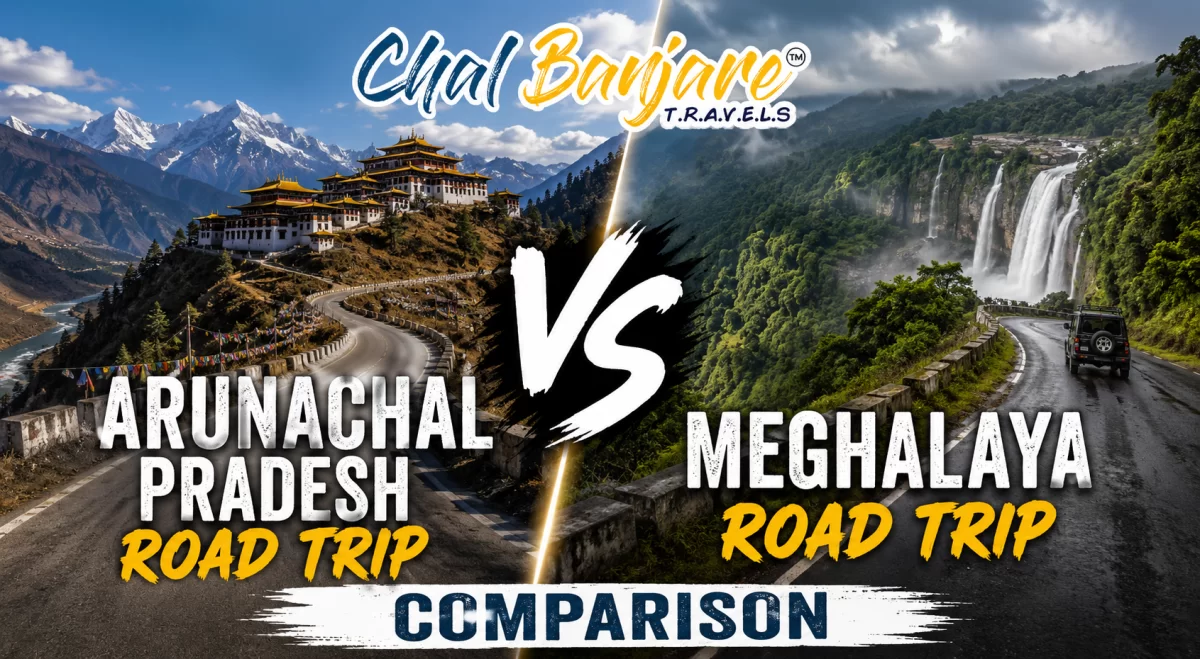
Homepage Banner

Arunachal Pradesh Road Trip vs Meghalaya Road Trip Comparison

Arunachal Pradesh and Meghalaya offer two of Northeast India’s most scenic road trip experiences, but they differ greatly in landscapes road conditions travel style weather and overall Himalayan versus plateau travel atmosphere.

Comparison


28 Apr, 2026 By: Pema Khandu

Overview of Arunachal Pradesh and Meghalaya Road Trips

Understanding the travel style of both Northeast road trips

Arunachal Pradesh and Meghalaya offer two very distinct road trip experiences within Northeast India, shaped by geography, infrastructure, and cultural landscapes. Arunachal Pradesh road trips are defined by long-distance travel through remote Himalayan terrain, where journeys often pass through high mountain passes, deep valleys, and sparsely populated regions. The travel style here is slow, immersive, and highly dependent on changing road and weather conditions.

Meghalaya road trips, in contrast, are more structured and accessible, with well-connected routes linking popular destinations like Shillong, Cherrapunji, and Dawki. The travel style is more compact, allowing travelers to cover multiple attractions in shorter distances while still experiencing rich natural diversity.

It is a contrast between remote Himalayan exploration and scenic hill circuit travel.

  • Arunachal: long-distance Himalayan travel.
  • Meghalaya: compact scenic road circuits.
  • Remote terrain vs connected highways.
  • Slow exploration vs structured travel.
  • Different road trip philosophies.

Both journeys offer unique but contrasting Northeast India experiences.

Why Arunachal Pradesh and Meghalaya offer completely different journeys

The fundamental difference between Arunachal Pradesh and Meghalaya road trips lies in their geography and environmental conditions. Arunachal Pradesh features rugged Himalayan terrain with significant altitude changes, remote villages, and limited connectivity in certain regions, making travel more challenging but highly immersive.

Meghalaya, on the other hand, is characterized by plateau landscapes, dense forests, and a monsoon-driven ecosystem where waterfalls, caves, and river systems are easily accessible through relatively shorter routes. This makes Meghalaya more suitable for frequent stops and diverse sightseeing.

It is a difference between high-altitude wilderness and accessible natural beauty.

  • Himalayan terrain vs plateau geography.
  • Remote access vs easy connectivity.
  • Long routes vs short circuits.
  • Altitude variation vs stable elevation.
  • Different environmental systems.

Arunachal is rugged and remote, Meghalaya is accessible and diverse.

Choosing between remote Himalayan routes and scenic plateau drives

Choosing between Arunachal Pradesh and Meghalaya for a road trip depends on whether travelers prefer remote Himalayan exploration or scenic plateau drives with frequent attractions. Arunachal Pradesh offers a more adventurous and demanding journey, where travel itself becomes an exploration of untouched landscapes.

Meghalaya offers a smoother and more structured experience where travelers can enjoy waterfalls, viewpoints, and cultural sites within shorter distances and better road conditions. Both provide strong scenic value but differ significantly in travel intensity.

It is a choice between adventure-driven and comfort-driven travel styles.

  • Remote adventure vs scenic comfort.
  • Long journeys vs short drives.
  • Challenging terrain vs smooth highways.
  • Immersive vs flexible travel.
  • Different travel expectations.

Arunachal suits explorers, Meghalaya suits comfort travelers.

Arunachal Pradesh Road Trip Landscape and Experience

Driving through mountain passes river valleys and remote villages

Arunachal Pradesh road trips are defined by long and challenging drives through high mountain passes, deep river valleys, and remote villages scattered across vast Himalayan terrain. Roads often wind through dense forests, steep ascents, and dramatic elevation changes that make the journey both physically engaging and visually rewarding.

The experience is highly immersive, with frequent transitions between landscapes such as snow-covered peaks, green valleys, and rugged cliffs. Travel time is usually longer, but the changing scenery ensures that the journey remains consistently engaging.

It is one of the most adventurous road travel experiences in India.

  • High mountain pass routes.
  • River valley crossings.
  • Remote village connectivity.
  • Steep elevation changes.
  • Long immersive journeys.

Arunachal road trips are defined by raw Himalayan geography.

Exploring Tawang Ziro Mechuka and Dibang Valley routes

Major road trip circuits in Arunachal Pradesh include destinations like Tawang, Ziro, Mechuka, and Dibang Valley, each offering distinct landscapes and cultural environments. Tawang is known for its monasteries and high-altitude passes, Ziro for its peaceful valley and rice fields, Mechuka for its remote river valley setting, and Dibang Valley for its untouched wilderness.

These routes are often long and interconnected through mountain highways that pass through varying terrain and climatic zones. Each destination requires significant travel time, making the journey itself a core part of the experience.

It is one of the most diverse road trip networks in Northeast India.

  • Tawang: high-altitude circuit.
  • Ziro: cultural valley route.
  • Mechuka: remote exploration drive.
  • Dibang: untouched wilderness travel.
  • Long interconnected highways.

Each route offers a completely different Himalayan experience.

Experiencing one of India's most adventurous Himalayan road trips

Arunachal Pradesh road trips are widely considered among the most adventurous in India due to their remote terrain, unpredictable weather conditions, and limited infrastructure in certain regions. Travelers often navigate through narrow mountain roads, occasional landslide-prone areas, and high-altitude passes that demand careful driving and planning.

Despite the challenges, the reward lies in the untouched natural beauty and cultural authenticity that remains largely unaffected by mass tourism. The sense of exploration is constant throughout the journey.

It is a destination built for true Himalayan road adventure seekers.

  • Remote and rugged terrain.
  • Weather-dependent conditions.
  • Limited infrastructure zones.
  • High adventure value.
  • Authentic exploration routes.

Arunachal delivers raw and immersive Himalayan road adventure.

Meghalaya Road Trip Landscape and Experience

Driving through waterfalls caves and lush green hills

Meghalaya road trips are defined by continuous visual richness, where highways pass through dense forests, mist-covered hills, and frequent waterfall viewpoints that appear along the route. The landscape remains consistently green for most of the year due to heavy rainfall, giving every stretch of road a fresh and vibrant appearance.

Unlike long Himalayan drives, Meghalaya’s routes are shorter and more connected, allowing travelers to experience multiple natural attractions within a single day. Caves, cliffs, and river valleys often appear unexpectedly along the journey, making travel highly engaging and varied.

It is one of the most visually dense road trip regions in Northeast India.

  • Waterfall-lined highways.
  • Mist-covered forest roads.
  • Short travel distances.
  • Frequent scenic stops.
  • Green monsoon landscape.

Meghalaya roads are scenic, compact, and constantly changing.

Exploring Shillong Cherrapunji Dawki and Jaintia Hills

The Meghalaya road trip circuit typically includes Shillong, Cherrapunji, Dawki, and the Jaintia Hills, each offering distinct natural and cultural experiences. Shillong serves as the central hub with urban comforts, while Cherrapunji is known for its waterfalls and rainfall-driven landscapes.

Dawki offers crystal-clear river experiences, and the Jaintia Hills add depth with caves and rolling terrain. These destinations are closely connected through scenic highways, allowing for efficient multi-location travel within short distances.

It is one of the most accessible circuit-based road trips in India.

  • Shillong urban hill station.
  • Cherrapunji waterfall region.
  • Dawki river valley routes.
  • Jaintia Hills cave systems.
  • Connected short-distance circuit.

Meghalaya offers a tightly connected scenic travel circuit.

Experiencing scenic roads surrounded by forests and clouds

One of the defining features of Meghalaya road trips is the constant presence of clouds and mist moving across forested hills and valleys. Roads often pass through areas where visibility changes rapidly, creating a dynamic driving experience where landscapes appear and disappear within moments.

This atmospheric condition enhances the emotional and visual depth of travel, making even short drives feel cinematic. The combination of rain, fog, and dense vegetation creates a continuously immersive environment.

It is one of the most atmospheric road travel experiences in India.

  • Misty cloud-covered roads.
  • Dense forest surroundings.
  • Dynamic visibility changes.
  • Rain-fed landscapes.
  • Cinematic driving conditions.

Meghalaya roads feel alive with weather and motion.

Which Road Trip Offers Better Natural Scenery

Arunachal Pradesh's snow-capped mountains and untouched valleys

Arunachal Pradesh offers a road trip experience dominated by raw Himalayan scenery, where snow-capped mountains, deep river valleys, and untouched forests define the visual journey. The landscapes feel vast and largely untouched, with long stretches of road passing through isolated natural environments.

The scenery changes significantly with elevation, transitioning from green valleys to high-altitude snow regions, especially in areas like Tawang and nearby passes. This creates a sense of scale and wilderness that is rarely found in more developed regions.

It is one of the most untouched natural road trip landscapes in India.

  • Snow-capped Himalayan peaks.
  • Remote untouched valleys.
  • High-altitude transitions.
  • Long wilderness stretches.
  • Minimal human intervention.

Arunachal delivers raw and expansive Himalayan beauty.

Meghalaya's waterfalls rivers and mist-covered landscapes

Meghalaya presents a contrasting natural experience defined by continuous rainfall, dense forests, and powerful waterfall systems. The landscape is shaped by water at every level, from flowing rivers to cascading waterfalls and mist-covered hills that shift throughout the day.

The visual diversity is high, with short distances between major attractions allowing travelers to experience multiple natural environments in a single journey. The combination of rain and greenery creates a constantly vibrant atmosphere.

It is one of the most dynamic monsoon landscapes in India.

  • Waterfall-dominated terrain.
  • River valley systems.
  • Mist and cloud coverage.
  • Evergreen green landscapes.
  • High visual diversity.

Meghalaya offers rich and constantly evolving scenery.

Choosing between Himalayan wilderness and monsoon beauty

The choice between Arunachal Pradesh and Meghalaya for natural scenery depends on whether travelers prefer vast Himalayan wilderness or dense monsoon-driven landscapes. Arunachal provides expansive mountain views, remote valleys, and snow-covered terrain that emphasize scale and isolation.

Meghalaya offers a more intimate but highly dynamic natural experience, where waterfalls, forests, and mist create a constantly changing visual environment. Both are rich in beauty but differ in scale and intensity.

It is a contrast between scale and diversity.

  • Wilderness vs monsoon ecosystems.
  • Scale vs diversity.
  • Mountains vs waterfalls.
  • Isolation vs vibrancy.
  • Different scenic identities.

Arunachal is vast and rugged, Meghalaya is vibrant and fluid.

Road Conditions and Driving Difficulty Comparison

Arunachal Pradesh's remote mountain roads and challenging routes

Road travel in Arunachal Pradesh is widely regarded as one of the most challenging yet rewarding driving experiences in India. The routes pass through high-altitude mountain passes, narrow cliffside roads, river crossings, and remote stretches where infrastructure is limited and weather conditions can change quickly. These factors collectively increase travel complexity across most circuits.

Drivers often encounter landslide-prone zones, unpaved sections, and steep ascents, especially on routes leading to destinations like Tawang, Mechuka, and Dibang Valley. Despite the difficulty, the scenic payoff is immense, with untouched Himalayan landscapes unfolding continuously along the journey.

It is one of the most demanding road trip regions in India.

  • High-altitude mountain roads.
  • Narrow and winding routes.
  • Landslide-prone sections.
  • Limited infrastructure support.
  • Weather-dependent travel risks.

Arunachal roads require patience, skill, and flexibility.

Meghalaya's smoother highways connecting major attractions

Meghalaya offers a comparatively smoother and more structured road network, where well-maintained highways connect key destinations such as Shillong, Cherrapunji, Dawki, and Jaintia Hills. The roads are generally easier to navigate, with shorter distances between attractions and frequent access to towns and facilities.

While monsoon conditions can occasionally affect visibility due to fog and rain, the overall driving difficulty remains moderate, making it suitable for both experienced and casual travelers. The presence of continuous tourist flow also ensures better road usability throughout the year.

It is one of the most accessible road trip regions in Northeast India.

  • Well-connected highway system.
  • Moderate driving difficulty.
  • Short inter-destination routes.
  • Regular tourist infrastructure.
  • Stable accessibility levels.

Meghalaya roads are easier and more travel-friendly.

Comparing driving difficulty travel time and accessibility

The difference in driving experience between Arunachal Pradesh and Meghalaya is primarily defined by terrain complexity and infrastructure development. Arunachal involves long travel times, unpredictable road conditions, and high-altitude challenges that demand careful planning and adaptability.

Meghalaya, on the other hand, offers shorter travel distances, better road conditions, and more predictable routes, allowing travelers to cover multiple destinations efficiently with less physical and logistical strain.

It is a contrast between rugged adventure and structured travel convenience.

  • High difficulty vs moderate difficulty.
  • Long routes vs short circuits.
  • Remote terrain vs connected highways.
  • Unpredictable vs stable conditions.
  • Adventure vs convenience balance.

Arunachal is challenging, Meghalaya is accessible and smooth.

Best Photography Experiences in Arunachal Pradesh

Capturing monasteries mountain passes and alpine landscapes

Arunachal Pradesh offers some of the most dramatic photography opportunities in Northeast India, where monasteries, mountain passes, and alpine landscapes come together in visually powerful compositions. Iconic locations like Tawang Monastery and Sela Pass provide wide-angle frames that combine spiritual architecture with rugged Himalayan terrain.

High-altitude passes often feature shifting weather conditions, where snow, mist, and sunlight interact to create constantly changing lighting scenarios. This makes every frame unique and highly dynamic, especially during early morning or late afternoon hours.

It is one of the most visually intense Himalayan photography regions in India.

  • Monastery landscape compositions.
  • High-altitude mountain passes.
  • Alpine snow-covered terrain.
  • Dynamic weather lighting.
  • Wide Himalayan perspectives.

Arunachal blends spirituality with raw mountain visuals.

Photographing tribal villages and remote Himalayan valleys

The tribal villages of Arunachal Pradesh provide deeply authentic cultural photography opportunities, where traditional wooden homes, agricultural fields, and everyday rural life form naturally composed scenes. These villages are often located in remote valleys, surrounded by forests and mountains, adding depth to cultural storytelling.

Each region, from Ziro to Mechuka and Dibang Valley, offers distinct visual identity, allowing photographers to capture a wide variety of tribal cultures and landscapes within a single state.

It is one of the most diverse cultural photography regions in India.

  • Traditional tribal settlements.
  • Remote valley environments.
  • Rural lifestyle documentation.
  • Forest and mountain backdrops.
  • Multi-cultural visual diversity.

Arunachal offers deep cultural and natural storytelling frames.

Exploring sunrise viewpoints across Arunachal Pradesh

Sunrise photography in Arunachal Pradesh is highly rewarding due to its vast elevation changes and open Himalayan viewpoints. Early morning light often spreads across valleys, monasteries, and snow-covered peaks, creating layered compositions with soft gradients and strong depth.

Locations such as Ziro Valley, Sela Pass, and Mechuka offer distinct sunrise experiences, ranging from calm valley illumination to dramatic mountain silhouettes.

It is one of the most scenic sunrise regions in Northeast India.

  • Wide sunrise viewpoints.
  • Valley and mountain lighting.
  • Soft gradient skies.
  • Silhouette compositions.
  • High-altitude perspectives.

Arunachal sunrise scenes are vast, layered, and dramatic.

Best Photography Experiences in Meghalaya

Capturing waterfalls living root bridges and crystal-clear rivers

Meghalaya offers one of the most visually rich photography environments in Northeast India, where waterfalls, living root bridges, and crystal-clear rivers come together to form constantly changing natural compositions. The region’s heavy rainfall ensures that water remains the defining element of the landscape throughout most of the year.

Waterfalls such as Nohkalikai and Seven Sisters create powerful vertical frames, especially during monsoon when water flow increases dramatically. Living root bridges add a unique human-nature interaction element, where centuries-old natural engineering blends seamlessly into dense forest surroundings.

It is one of the most dynamic water-based photography regions in India.

  • Major waterfall compositions.
  • Living root bridge structures.
  • Crystal-clear river scenes.
  • Dense forest backdrops.
  • Monsoon-enhanced visuals.

Meghalaya turns water and forest into living photography subjects.

Photographing mist-covered hills and dramatic cloudscapes

One of Meghalaya’s most defining photography features is its constantly shifting mist and cloud movement across hills and valleys. Due to high rainfall and humidity, landscapes often appear partially hidden, creating atmospheric layers that change within minutes.

This dynamic weather system allows photographers to capture moody compositions where hills emerge and disappear through fog, especially in regions like Cherrapunji and Mawsynram. The interplay of light, rain, and cloud adds emotional depth to every frame.

It is one of the most atmospheric landscape photography environments in India.

  • Mist-covered valleys.
  • Cloud-dynamic landscapes.
  • Rain-enhanced textures.
  • Moody lighting conditions.
  • Ever-changing visibility.

Meghalaya photography is defined by movement and atmosphere.

Exploring scenic viewpoints across Khasi and Jaintia Hills

The Khasi and Jaintia Hills offer numerous elevated viewpoints where photographers can capture sweeping landscapes of valleys, forests, and cloud-covered terrain. These viewpoints are especially striking during early morning and post-rain conditions when visibility and lighting create layered depth.

The rolling topography allows for wide-angle compositions that highlight Meghalaya’s green plateau landscapes, often enhanced by drifting clouds and shifting light patterns throughout the day.

It is one of the most scenic hill photography regions in Northeast India.

  • Elevated hill viewpoints.
  • Rolling plateau landscapes.
  • Cloud-layered compositions.
  • Wide-angle scenery.
  • Dynamic lighting conditions.

Meghalaya offers layered, atmospheric hill photography.

Cultural and Local Experience Comparison

Experiencing tribal traditions and Buddhist heritage in Arunachal Pradesh

Arunachal Pradesh offers a deeply diverse cultural landscape shaped by multiple tribal communities and strong Buddhist influences in certain regions. Each valley, from Ziro to Tawang and Mechuka, presents distinct cultural identities, languages, and traditional practices that remain closely tied to daily life.

Buddhist heritage is especially prominent in regions like Tawang, where monasteries, rituals, and festivals form an integral part of community life. At the same time, tribal cultures in other valleys maintain traditional agricultural and forest-based lifestyles that reflect centuries-old customs.

It is one of the most culturally diverse Himalayan regions in India.

  • Multiple tribal communities.
  • Buddhist monastery culture.
  • Traditional village lifestyles.
  • Festival-based traditions.
  • Deep cultural diversity.

Arunachal culture is layered, diverse, and deeply rooted.

Discovering Khasi Garo and Jaintia culture in Meghalaya

Meghalaya’s cultural identity is primarily shaped by the Khasi, Garo, and Jaintia tribes, each contributing unique traditions, social structures, and community practices. Unlike highly isolated tribal regions, Meghalaya’s cultural expression is more visible and integrated into everyday tourism circuits.

Festivals, local markets, and village life are more accessible to travelers, allowing for easier cultural interaction while still preserving traditional values. The cultural experience is closely linked with the natural environment, especially in rural hill areas.

It is one of the most accessible tribal cultural regions in Northeast India.

  • Khasi, Garo, Jaintia tribes.
  • Visible cultural traditions.
  • Festival celebrations.
  • Village and town integration.
  • Nature-linked lifestyle.

Meghalaya culture is diverse, open, and highly visible.

Choosing between Himalayan monasteries and indigenous communities

The cultural difference between Arunachal Pradesh and Meghalaya lies in how traditions are experienced and expressed. Arunachal offers a combination of deeply rooted tribal cultures and strong Buddhist monastery traditions that vary significantly across regions, creating a highly diverse cultural map.

Meghalaya offers a more unified but still diverse tribal cultural experience, where Khasi, Garo, and Jaintia traditions are more accessible and integrated into everyday travel routes. Both destinations provide meaningful cultural engagement but differ in structure and visibility.

It is a contrast between deep cultural layers and accessible cultural diversity.

  • Deep diversity vs visible diversity.
  • Monastery culture vs tribal systems.
  • Remote traditions vs accessible heritage.
  • Multiple identities vs regional cohesion.
  • Different cultural structures.

Arunachal is layered, Meghalaya is openly accessible culturally.

Adventure and Outdoor Experience Comparison

Arunachal Pradesh trekking rafting and mountain expeditions

Arunachal Pradesh offers some of the most rugged and immersive adventure experiences in Northeast India, where trekking routes, river rafting zones, and high-altitude mountain expeditions define the outdoor landscape. The terrain is largely untouched, with long trekking trails passing through dense forests, remote valleys, and high Himalayan ridges.

River systems such as the Siang and Subansiri provide strong rafting opportunities, especially in remote stretches where the rivers flow through deep gorges. Combined with long-distance mountain road journeys, the overall adventure experience is physically demanding and highly rewarding.

It is one of the most extreme adventure regions in India.

  • High-altitude trekking routes.
  • River rafting in wild rivers.
  • Remote mountain expeditions.
  • Dense forest exploration.
  • Long-duration adventure travel.

Arunachal is built for raw and demanding adventure travel.

Meghalaya caving hiking and waterfall exploration

Meghalaya offers a different type of adventure experience focused on accessibility and variety, where caving, short-distance trekking, and waterfall exploration form the core outdoor activities. The presence of extensive limestone cave systems makes it one of the most unique geological adventure destinations in India.

Hiking routes are generally shorter and more structured, allowing travelers to explore waterfalls, forests, and river valleys within a single day. This makes Meghalaya suitable for moderate adventure seekers who prefer variety without extreme physical strain.

It is one of the most diverse soft-adventure destinations in India.

  • Limestone cave exploration.
  • Waterfall-based trekking.
  • Short hiking routes.
  • Forest and river activities.
  • Moderate adventure intensity.

Meghalaya blends adventure with accessibility and variety.

Comparing adventure opportunities across both destinations

Adventure experiences in Arunachal Pradesh and Meghalaya differ significantly in scale, intensity, and accessibility. Arunachal is suited for high-endurance travelers seeking long treks, remote expeditions, and physically demanding journeys through untouched Himalayan terrain.

Meghalaya is better suited for travelers who prefer short, varied, and accessible adventure experiences involving caves, waterfalls, and forest trails without extreme physical challenges.

It is a contrast between extreme adventure and accessible exploration.

  • Extreme vs moderate adventure.
  • Long expeditions vs short activities.
  • Remote terrain vs accessible sites.
  • High endurance vs casual exploration.
  • Different adventure styles.

Arunachal is extreme, Meghalaya is varied and accessible.

Family Travel Comparison

Arunachal Pradesh for offbeat Himalayan family journeys

Arunachal Pradesh offers a unique but more demanding family travel experience due to its remote geography, long travel distances, and varying road conditions. Families visiting this region experience deep Himalayan immersion, where destinations like Tawang, Ziro, and Mechuka provide a mix of cultural exposure and natural beauty in relatively untouched surroundings.

The experience is highly rewarding for families who are comfortable with long journeys and changing weather conditions, but it requires careful planning, especially when traveling with children or elderly members due to altitude and accessibility factors.

It is one of the most offbeat family travel regions in India.

  • Remote Himalayan travel experience.
  • Long-distance road journeys.
  • Limited but immersive infrastructure.
  • High scenic reward factor.
  • Requires careful planning.

Arunachal suits adventurous and prepared family travelers.

Meghalaya for relaxed sightseeing and shorter travel routes

Meghalaya is generally more suitable for family travel due to its shorter travel distances, better road connectivity, and variety of easily accessible attractions. Families can explore waterfalls, caves, viewpoints, and towns without long hours of continuous driving, making the journey more relaxed and manageable.

The availability of structured tourism infrastructure in places like Shillong and Cherrapunji ensures comfortable stays and easier movement between destinations, which is especially beneficial for children and senior travelers.

It is one of the most family-friendly destinations in Northeast India.

  • Short and easy travel circuits.
  • Better road connectivity.
  • Accessible tourist attractions.
  • Comfortable accommodation options.
  • Suitable for all age groups.

Meghalaya offers relaxed and convenient family travel.

Choosing the better road trip based on family comfort

The choice between Arunachal Pradesh and Meghalaya for family road trips depends on comfort level and travel expectations. Arunachal is better suited for families seeking adventure, cultural depth, and offbeat destinations, but it requires endurance for long journeys and variable road conditions.

Meghalaya is more appropriate for families who prefer convenience, shorter travel times, and a wider range of easily accessible attractions, making it ideal for stress-free holiday planning.

It is a balance between adventure and comfort-driven travel.

  • Adventure vs comfort travel style.
  • Long routes vs short circuits.
  • Remote vs accessible destinations.
  • High effort vs relaxed planning.
  • Different family needs.

Arunachal is for adventure families, Meghalaya for comfort-focused trips.

Accommodation and Travel Infrastructure Comparison

Homestays hotels and eco-lodges across Arunachal Pradesh

Accommodation in Arunachal Pradesh is largely centered around homestays, small hotels, and eco-lodges that are distributed across remote valleys and hill towns. The stay experience is deeply connected to local culture, with many properties operated by local families offering simple but warm hospitality.

Infrastructure varies significantly by region, with towns like Tawang and Ziro offering more structured options, while remote areas such as Mechuka and Dibang Valley rely heavily on basic homestay setups. This creates a travel experience that feels authentic but less standardized.

It is one of the most raw and culturally immersive accommodation networks in Northeast India.

  • Homestay-dominated stay system.
  • Eco-lodges in select regions.
  • Basic to moderate facilities.
  • Strong local hospitality.
  • Remote area limitations.

Arunachal stays focus on authenticity over luxury.

Resorts boutique hotels and guesthouses throughout Meghalaya

Meghalaya offers a more developed and structured tourism infrastructure, with a wide range of resorts, boutique hotels, and guesthouses spread across major tourist hubs such as Shillong, Cherrapunji, and Dawki. The accommodation options are more varied and cater to different budget levels.

Many stays in Meghalaya are designed to take advantage of scenic landscapes, offering views of waterfalls, valleys, or mist-covered hills, while maintaining modern comfort and amenities. This makes travel more convenient and predictable for visitors.

It is one of the most well-developed hospitality networks in Northeast India.

  • Wide range of hotels and resorts.
  • Boutique and premium stays.
  • Better infrastructure support.
  • Scenic view accommodations.
  • High tourism readiness.

Meghalaya balances comfort with scenic tourism infrastructure.

Comparing tourism facilities connectivity and travel convenience

The difference in infrastructure between Arunachal Pradesh and Meghalaya is significant and directly impacts travel experience. Arunachal provides a more rugged and authentic setup where facilities are limited but culturally immersive, often requiring advance planning and adaptability.

Meghalaya, in contrast, offers better connectivity, more developed tourist circuits, and easier access to accommodation and transport services, making travel smoother and more convenient for a wider range of travelers.

It is a contrast between raw infrastructure and developed tourism systems.

  • Limited vs developed infrastructure.
  • Remote vs connected travel networks.
  • Basic vs modern facilities.
  • Authentic vs convenient experience.
  • Planning-heavy vs flexible travel.

Arunachal is raw and immersive, Meghalaya is structured and convenient.

Final Arunachal Pradesh vs Meghalaya Road Trip Planning Guide

Which road trip suits your travel style and interests

Choosing between an Arunachal Pradesh road trip and a Meghalaya road trip depends primarily on how you prefer to experience travel itself. Arunachal Pradesh is designed for travelers who enjoy long, immersive journeys through remote Himalayan terrain, where the road is not just a connector but a core part of the adventure. Every stretch reveals shifting landscapes, from deep valleys to high mountain passes and isolated villages.

Meghalaya, on the other hand, suits travelers who prefer shorter, more frequent stops across a network of scenic destinations. Here, the journey is structured around waterfalls, caves, rivers, and hill viewpoints, making it easier to explore multiple attractions within a limited time frame.

It is a choice between immersive endurance travel and compact scenic exploration.

  • Arunachal: long immersive journeys.
  • Meghalaya: short scenic circuits.
  • Remote exploration vs structured travel.
  • Adventure focus vs comfort focus.
  • Different travel rhythms.

Both offer strong but completely different road trip identities.

Choosing between remote Himalayan adventures and scenic hill drives

Arunachal Pradesh offers remote Himalayan adventures where road conditions, altitude changes, and distance combine to create a challenging but highly rewarding travel experience. It is best suited for those seeking raw landscapes, cultural depth, and long-distance exploration across untouched regions.

Meghalaya provides scenic hill drives that are more accessible and comfortable, where travelers can enjoy waterfalls, green valleys, and cloud-covered roads with less physical strain and better connectivity between destinations.

It is a contrast between rugged adventure and smooth scenic travel.

  • Remote mountains vs hill circuits.
  • High challenge vs easy access.
  • Long expeditions vs short drives.
  • Raw nature vs curated routes.
  • Different travel comfort levels.

Arunachal is for explorers, Meghalaya is for scenic road travelers.

Final checklist before planning a Northeast India road trip

Before planning a road trip to either Arunachal Pradesh or Meghalaya, travelers should carefully consider seasonality, road conditions, accommodation availability, and travel experience preferences. Arunachal requires more detailed planning due to remote terrain, weather sensitivity, and longer travel durations between destinations.

Meghalaya requires comparatively less logistical preparation but still benefits from seasonal awareness, especially during monsoon when rainfall can influence travel timing and visibility. Both destinations reward well-planned itineraries with rich natural and cultural experiences.

It is a journey where planning directly improves travel quality.

  • Check seasonal weather conditions.
  • Plan for road distance and time.
  • Prepare for terrain differences.
  • Book stays in advance.
  • Align itinerary with travel style.

Proper planning ensures a smooth and rewarding Northeast road trip experience.

Frequently Asked Questions About Arunachal Pradesh Road Trip vs Meghalaya Road Trip Comparison

Arunachal Pradesh road trips are known for Himalayan mountain scenery snow peaks monasteries valleys and remote mountain highways. Meghalaya road trips focus more on waterfalls forests rivers caves and cloud covered green hills. Travelers choose based on whether they prefer rugged mountains or lush green landscapes.
Arunachal Pradesh road trips involve remote Himalayan regions long mountain drives and high altitude valleys while Meghalaya road trips focus on waterfalls caves forests and easier scenic countryside highways. Both destinations provide different Northeast India travel experiences shaped by landscapes road conditions and travel atmosphere.
Meghalaya generally provides smoother highways easier road conditions and more comfortable driving experiences for travelers. Arunachal Pradesh roads often include steep mountain routes sharp bends remote highways and longer travel hours. Travelers with limited mountain driving experience usually find Meghalaya easier for self drive road trips.
Meghalaya is more famous for waterfalls rivers caves and monsoon landscapes compared to Arunachal Pradesh. Scenic destinations like Shillong Cherrapunji and Dawki attract travelers interested in water based scenery and green mountain roads while Arunachal focuses more on valleys monasteries and Himalayan landscapes.
Arunachal Pradesh road trips require greater preparation because of remote roads mountain weather long travel distances and permit requirements. Travelers should carefully plan fuel accommodation and road conditions before travel. Meghalaya road trips are comparatively easier because of broader tourism infrastructure and smoother accessibility.
First time Northeast road trip travelers often choose Meghalaya because of easier transportation better tourism infrastructure and shorter driving distances between major attractions. Arunachal Pradesh suits travelers interested in remote Himalayan journeys high altitude mountain roads and offbeat travel experiences across Northeast India.
Both destinations provide strong photography experiences but with different landscape styles. Arunachal Pradesh highlights monasteries snow peaks mountain valleys and remote Himalayan roads while Meghalaya focuses on waterfalls rivers caves fog covered roads forests and dramatic monsoon scenery throughout Northeast India travel routes.
Families usually find Meghalaya more comfortable because of smoother roads shorter travel durations and easier sightseeing access. Arunachal Pradesh road trips involve longer mountain journeys and remote travel conditions requiring greater planning. Travelers should choose based on driving comfort travel pace and road trip experience.
Arunachal Pradesh offers more remote road trip experiences through Himalayan valleys monasteries forests and mountain highways. The region feels less commercialized and more isolated compared to Meghalaya. Travelers seeking rugged offbeat journeys and quieter mountain landscapes usually prefer Arunachal Pradesh road trips.
Meghalaya road trips are famous for waterfalls cloud covered hills green valleys caves rivers and scenic countryside highways. Monsoon weather transforms the region into one of the greenest travel destinations in Northeast India attracting travelers interested in lush landscapes and nature focused road journeys.
Arunachal Pradesh is known for Himalayan valleys monasteries snow mountains forests and remote mountain highways across Northeast India. Destinations like Tawang Dirang and Ziro Valley provide dramatic mountain scenery and peaceful countryside travel experiences surrounded by tribal culture and rugged landscapes.
Meghalaya generally provides broader tourism infrastructure including hotels restaurants transport services and organized sightseeing facilities. Arunachal Pradesh remains more remote with simpler guesthouses homestays and mountain accommodations. Travelers prioritizing convenience and comfort often find Meghalaya easier for long road trip planning.
Meghalaya supports adventure activities like cave exploration trekking boating river experiences and nature walks across forest regions. Arunachal Pradesh adventure mainly focuses on long Himalayan drives remote valleys and mountain exploration. Travelers should choose based on whether they prefer active activities or remote mountain travel.
Travelers visiting Arunachal Pradesh generally require permits for entry because of regional travel regulations in Northeast India. Meghalaya usually does not involve similar permit planning for most domestic tourists. Permit requirements make Arunachal road trips slightly more preparation focused compared to Meghalaya travel experiences.
Meghalaya becomes especially scenic during monsoon because waterfalls rivers forests and cloud covered hills appear more dramatic. Arunachal Pradesh also turns greener but mountain road conditions may become more difficult during heavy rainfall. Travelers interested in lush rain landscapes often prefer Meghalaya monsoon road trips.
Arunachal Pradesh highlights tribal traditions monasteries Buddhist culture and mountain village lifestyles while Meghalaya showcases Khasi culture music traditions and countryside communities. Both destinations provide strong cultural experiences shaped by unique tribal heritage and Northeast India regional traditions.
Arunachal Pradesh road trips usually require longer travel duration because destinations are farther apart across mountainous terrain and remote highways. Meghalaya road trips can often be completed in shorter durations because of better road connectivity and relatively closer sightseeing destinations within the state.
Travelers should compare road conditions driving difficulty weather sightseeing preferences permit requirements accommodation comfort and travel duration before choosing between Arunachal Pradesh and Meghalaya road trips. Meghalaya suits easier scenic journeys while Arunachal Pradesh supports rugged Himalayan exploration and remote mountain travel experiences.

Explore Arunachal Pradesh Tour Packages

Explore All Packages

Latest Travel Blogs

View all Blogs β†’

Loved this place ? Let’s Plan Your Arunachal Pradesh Trip

Get customized Arunachal Pradesh tour planning designed around mountain road distances, permit requirements, seasonal weather windows, and realistic travel pacing. Whether you are visiting for monasteries, high-altitude passes, river valleys, tribal cultu

⚑ Quick Response | πŸ’° Free consultation | πŸ•’ 24Γ—7 expert support

×

Plan Your Trip