Visiting Varaha Temple in Pushkar, Rajasthan, India

Varaha Temple , Pushkar
Tourists visit to see one of the few temples in India dedicated to Lord Varaha and to examine the fortified architecture that features intricate carvings of mythical creatures and golden pillars. The site is a primary stop on the Pushkar spiritual circuit, known for its historical resilience having been destroyed by Mughal forces and later rebuilt by Maharaja Sawai Jai Singh II in 1727.

Quick Facts About Varaha Temple

Quick Facts for Varaha Temple, Pushkar

Entry Fee Free
Timings 06:00 AM – 12:00 PM and 04:00 PM – 08:00 PM
Altitude (m) Approx. 510 m
Ideal Visit Duration 20 to 30 minutes
Best Time of Day 07:00 AM – 09:00 AM
Crowd Level Low to Moderate
Distance from City Centre (km) 0.5 km from Pushkar Lake (Main Market area)
Walking Difficulty Easy (Short walk through market lanes)
Parking Available No (Located in a narrow lane; park at designated lots on the town periphery)
Last Mile Access Pedestrian access or auto-rickshaw to the nearest market point
Suitable for Kids Yes
Suitable for Seniors Yes (Involves a short flight of steps to reach the main platform)
Wheelchair Friendly No (Narrow entrance and stone steps at the temple threshold)

Why Visit Varaha Temple Pushkar: An Architectural Survivor

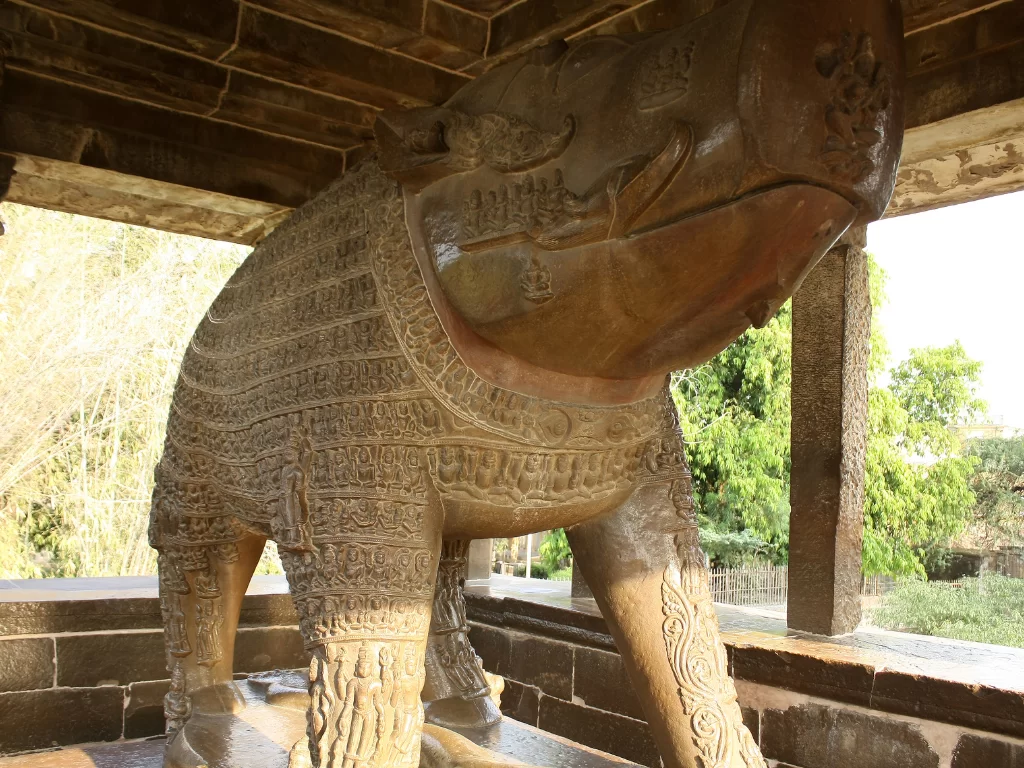
Visitors come to the Varaha Temple to witness one of the few remaining major shrines dedicated to the third incarnation of Lord Vishnu as a wild boar. As one of the oldest temples in Pushkar, it attracts travelers who want to see a structure that survived multiple historical iconoclastic events, showcasing a resilient 12th-century foundation and a massive stone image of the deity that remains central to the town's Vaishnava identity.

The on-ground atmosphere is defined by its fort-like appearance, featuring high walls and a narrow entrance that leads into a spacious, sun-lit courtyard. Unlike the more colorful, modern renovations found elsewhere in Pushkar, the air here feels deeply historical; the grey sandstone walls are adorned with weathered carvings of celestial beings and mythical creatures, providing a grounded, ancient contrast to the vibrant chaos of the nearby main bazaar.

What makes this temple distinct for travelers is its unique architectural blend of Hindu temple design and defensive fort-like elements, a direct result of its history of reconstruction. It stands out as a site of exceptional detail, particularly the intricate pillars and the dome of the inner sanctum, offering a specialized look at the early medieval Rajasthani aesthetic that predates the more common Mughal-influenced designs seen in the region.

History and Cultural Heritage of Varaha Temple Pushkar

The Varaha Temple is the oldest and one of the most historically significant shrines in Pushkar, originally constructed in the 12th century by King Anaji Chauhan. Dedicated to the Varaha avatar of Lord Vishnu—represented as a wild boar who rescued the earth—it is a rare architectural site that has survived multiple historical upheavals. The temple was famously destroyed by the Mughal Emperor Aurangzeb and subsequently reconstructed in 1727 by Raja Sawai Jai Singh II of Jaipur, making it a physical record of the resilience of Hindu architecture in Rajasthan.

Architecturally, the temple is a fortress-like structure that blends traditional Hindu temple design with defensive medieval elements. It features a fortified enclosure wall and an ornate dome supported by carved pillars, with detailed stone sculptures depicting various incarnations of Vishnu and celestial beings. As a primary site of worship in the sacred town of Pushkar, the temple continues to be a central point for Vaishnava pilgrimage, preserving ancient iconography and the legendary history of Lord Vishnu's intervention in the cosmos.

Best Time to Visit Varaha Temple in Pushkar

http://googleusercontent.com/map_location_reference/1 Pushkar ke sabse prachin aur vishal mandiron mein se ek, [Varaha Temple (Swayam Vyakta Kshetra)](http://googleusercontent.com/map_location_reference/0) ki yatra ke liye thanda mausam sabse anukul hota hai, kyunki iska vastukala ka kaam aur prachin patthar garmi ko jaldi sokhte hain. Bhagwan Vishnu ke Varaha avatar ko samarpit is mandir ki shanti aur aitihasik mahatva ka anubhav lene ke liye winter season hi sabse shresth hai, jab aap bina kisi jaldbazi ke iski barikiyaan dekh sakte hain.

  • Ideal Months: October se March tak ka samay sabse uttam hai. Kartik Purnima (November) ke samay yahan ki dharmik urja aur raunak dekhne layak hoti hai, jo Pushkar Mele ke saath judi hoti hai.
  • Weather Conditions: Sardiyon mein tapman 10°C se 25°C ke beech rehta hai, jo mandir ke khule prangan mein ghumne aur purani nakshikariyon ka adhyayan karne ke liye behad sukhad hai.
  • Periods to Avoid: April se June ki garmi (40°C+) se bachein, kyunki nange pair mandir ke prangan mein chalna kaafi mushkil ho jata hai. Saath hi, dophar ke samay (12:30 PM se 4:00 PM) mandir darshan ke liye band rehta hai, isliye apne samay ka dhyan rakhen.

How to Reach Varaha Temple Pushkar: Practical Access and Transport Guide

The Varaha Temple, dedicated to the third incarnation of Lord Vishnu, is one of the oldest and most significant temples in Pushkar. It is located in the heart of the town, making it easily accessible for pilgrims and tourists alike.
  • Nearest Airport: Kishangarh Airport (KQH) is the closest domestic airport, situated approximately 45 km away. For broader international and domestic connectivity, Jaipur International Airport (JAI) is located 150 km from Pushkar. From either airport, private taxis are the most efficient way to reach the town.
  • Nearest Railway Station: Ajmer Junction (AII) is the primary railhead, located about 15 km away. It is a major stop for trains from Delhi, Mumbai, and Ahmedabad. Regular buses, taxis, and auto-rickshaws operate from Ajmer to Pushkar, navigating the winding Ghati road in approximately 30–45 minutes.
  • Road Access: Pushkar is well-connected via NH48 (Delhi-Jaipur-Ajmer Highway). Most intercity buses and private cars park at the main entrance of the town or at the Marwar Bus Stand, as the narrow, cobblestone streets leading to the temple are often crowded and restricted for large vehicles.
  • Last-Mile Connectivity: The temple is situated in the main market area and is best reached on foot or by auto-rickshaw from the Pushkar Lake ghats. It is roughly a 10-minute walk from the Brahma Temple, allowing visitors to easily combine both sites in a single walking tour.
  • Travel Conditions and Limitations: The temple is located within a densely populated area with narrow lanes that can become extremely congested during the Pushkar Camel Fair and religious festivals. While the main structure is at ground level, there are some stone steps and uneven surfaces within the courtyard that may require caution.

What to Expect When You Visit Varaha Temple, Pushkar

  • Historical Resilience: As one of the oldest and most significant temples in Pushkar, expect a structure that reflects a history of destruction and reconstruction. Originally built in the 12th century and partially destroyed by Mughal Emperor Aurangzeb, the current temple showcases 18th-century restoration work by Raja Jai Singh II, featuring fortified walls that give it a unique, castle-like appearance.
  • Architectural Detail: The temple is dedicated to the Varaha incarnation of Lord Vishnu (the boar). Expect to see intricate carvings on the pillars and lintels that have survived from the original medieval structure. The central image of the Varaha is particularly striking, though the interior remains relatively dark and atmospheric.
  • Physical Access: Located within the dense grid of Pushkar’s old town, the temple is reached through narrow, winding lanes. The entrance involves a flight of stone steps leading to a raised courtyard. While the main area is paved, the stones are aged and can be uneven; sturdy footwear is recommended for the walk through the town, though shoes must be removed before entering the temple plinth.
  • Atmosphere and Quietude: Unlike the high-traffic Brahma Temple, the Varaha Temple offers a much quieter and more contemplative environment. It is less frequented by large tour groups, allowing visitors to appreciate the ancient masonry and spiritual vibe without significant crowding.
  • Strict Religious Protocols: This is a highly revered site where traditional customs are strictly maintained. Visitors are expected to dress modestly (covering shoulders and knees) and refrain from loud conversation. Photography of the main deity inside the sanctum sanctorum is strictly prohibited, though photos of the exterior architecture are generally permitted.
  • Wildlife Presence: The high walls and surrounding trees are home to many pigeons and monkeys. Be cautious when carrying offerings or food items near the temple entrance, as the monkeys are known to be opportunistic. The stone floors may also be dusty or marked by birds, reflecting the temple’s age and natural surroundings.

Safety and Essential Visitor Information for Varaha Temple Pushkar

  • Peak vs. Quiet Hours: To witness the intricate 12th-century architecture in a serene environment, visit between 6:30 AM and 8:30 AM. The temple follows a traditional split schedule (closing from 12:00 PM to 4:00 PM); the evening session (4:00 PM – 8:00 PM) is busier, especially during the daily Aarti ceremonies at the nearby Varaha Ghat.
  • Strict Dress Code: This is a highly conservative Vaishnava shrine. Visitors must wear clothing that covers both shoulders and knees. Shorts, mini-skirts, sleeveless tops, and tight-fitting athletic wear are strictly prohibited; failure to comply will result in being denied entry at the fortified gate.
  • Staircase Safety: Entry to the main platform involves climbing approximately 40 steep stone steps. These steps can be uneven and lack modern handrails. Ascend slowly, especially during the monsoon when the ancient masonry becomes deceptively slick.
  • Security and Prohibited Items: Like many heritage temples in Pushkar, photography is strictly prohibited inside the sanctum sanctorum. Alcohol and tobacco are forbidden in the entire temple precinct. Avoid carrying large bags, as there are no official locker facilities and security may ask to inspect all hand luggage.
  • Wildlife and Touting Safety: The fortified walls often attract local macaques; keep all food and plastic bags hidden to avoid aggressive behavior. Be wary of "Pandas" (local priests) offering "free" threads or flowers; these often lead to high-pressure donation demands. Stick to the temple's official donation boxes for all offerings.

Capturing Ancient Fortifications: Photography Guide for Varaha Temple, Pushkar

  • The Fortified Entrance at Golden Hour: Unlike the white-washed temples of Pushkar, Varaha Temple is constructed from weathered yellow sandstone and features high, fortress-like walls. Photograph the massive arched gateway during the late afternoon (4:30 PM – 5:30 PM) to capture the warm, golden glow on the stone and the intricate carvings of celestial guardians.
  • Architectural Symmetry of the Mandapa: Stand at the base of the main flight of stairs to capture the symmetrical Nagara-style architecture. The temple's structure, rebuilt by Raja Sawai Jai Singh II, combines traditional Hindu elements with heavy, defensive Rajput masonry, providing a unique "fortress-temple" aesthetic for wide-angle compositions.
  • Intricate Pillar and Ceiling Details: The interior pillars are covered in high-relief carvings of mythical creatures and floral patterns. Use a fast prime lens (f/1.8 or f/2.0) to handle the lower light levels inside the open-sided hall, as the contrast between the shaded interior and the bright sunlit courtyard can be challenging for standard mobile sensors.
  • Strict Prohibition in the Inner Sanctum: Photography of the Boar-incarnation (Varaha) idol inside the Garbhagriha is strictly forbidden. While you can photograph the temple's structural elements and the carvings on the exterior walls, ensure your camera remains lowered when facing the deity out of respect for active worship and temple laws.
  • Managing Narrow Street Sightlines: The temple is located within the dense network of Pushkar's market lanes. To get an unobstructed shot of the temple's rising shikhara (spire), find a vantage point from the rooftops of nearby cafes or guesthouses, which allows you to clear the overhead wires and narrow street congestion.
  • Timing for a Quiet Atmosphere: As one of the oldest temple sites in Pushkar, it attracts fewer casual tourists than the Brahma Temple but remains a site for serious pilgrims. Arrive between 7:30 AM and 9:00 AM for clean architectural shots without the distractions of the midday market rush or large tour groups.

Near By Attraction

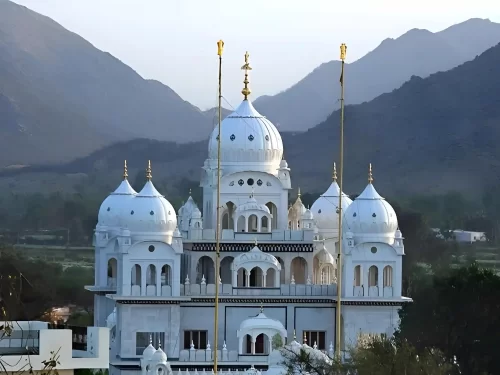
Gurudwara Sahib Pushkar historic white marble Sikh temple dedicated to Guru Nanak Dev Ji and Guru Gobind Singh Ji located near the holy Pushkar Lake in Rajasthan. Gurudwara

Gurudwara Sahib

A Sikh place of worship located near the center of Pushkar town.

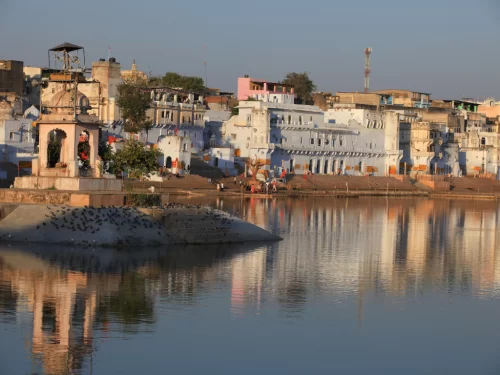
Whitewashed havelis temples and ghats along Pushkar Lake Rajasthan at golden hour with serene reflective waters pigeons and vibrant sky, iconic spiritual cultural Rajasthan tour package destination Lake

Pushkar Lake

A sacred freshwater lake located at the center of Pushkar town.

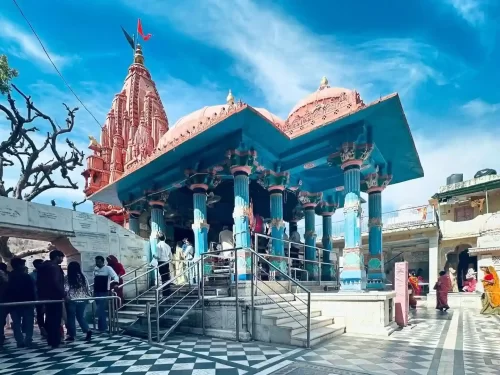
Jagatpita Shri Brahma Temple rare and sacred white marble Hindu shrine featuring a distinctive red spire and bird motifs in the holy town of Pushkar Rajasthan. Temple

Jagatpita Shri Brahma Mandir

A prominent Hindu temple dedicated to Lord Brahma, located in Pushkar.

Frequently Asked Questions About Varaha Temple

Varaha Temple is located in Pushkar and is easily accessible by road followed by a short walk from the main market area.
Varaha Temple is generally open from morning to evening, and visitors should confirm updated timings before planning their visit.
There is no entry fee to visit Varaha Temple, though donations are welcomed inside the temple premises.
The best time to visit Varaha Temple is between October and March when the weather is pleasant for sightseeing.
Travelers can reach Varaha Temple by taxi, auto rickshaw, or private vehicle to Pushkar followed by a short walk to the temple.
Most visitors spend around 30 to 45 minutes at Varaha Temple depending on crowd levels and prayer participation.
Visitors are expected to dress modestly at Varaha Temple and remove footwear before entering the temple complex.
Photography inside Varaha Temple may be restricted in certain areas, and visitors should follow on site guidelines.
Varaha Temple is suitable for family visits, offering a peaceful spiritual environment near Pushkar Lake.
Varaha Temple can easily be included in a one day sightseeing itinerary along with Pushkar Lake and nearby temples.

Loved this place ? Let’s Plan Your Rajasthan Trip

Get customized Rajasthan tour planning designed around desert climate comfort, long-distance road travel flow, heritage exploration time, and realistic pacing between regions. Whether you are visiting for fort architecture, palace heritage, cultural exper

⚑ Quick Response | πŸ’° Free consultation | πŸ•’ 24Γ—7 expert support

×

Plan Your Trip