Quick Facts About Gavi Gangadhareshwara Temple
| Entry Fee | Free |
| Timings | Morning / Evening |
| Altitude (m) | 920 |
| Ideal Visit Duration (hrs) | 0.75 |
| Best Time of Day | Morning |
| Crowd Level | Low / High |
| Distance from City Centre (km) | 5 |
| Walking Difficulty | Moderate |
| Parking Available | Yes |
| Last Mile Access | Road |
| Suitable for Kids | Yes |
| Suitable for Seniors | Yes |
| Wheelchair Friendly | No |
Why Visit Gavi Gangadhareshwara Temple
Visitors come to Gavi Gangadhareshwara Temple for its unique cave shrine and the rare astronomical alignment where sunlight passes through stone openings to illuminate the Shiva linga on specific days in February–March.
The on-ground atmosphere is quiet and devotional, with dim natural light, stone pathways, and a cool interior created by the rock cave structure, contrasting with the busy city surroundings outside.
What makes this place distinct for travelers is the combination of natural rock formation, controlled light alignment, and active daily worship inside a functioning cave temple within central Bengaluru.
History of Gavi Gangadhareshwara Temple
Gavi Gangadhareshwara Temple is attributed to Kempe Gowda I, the founder of Bengaluru, and is believed to have been established in the 16th century as a cave shrine dedicated to Lord Shiva.
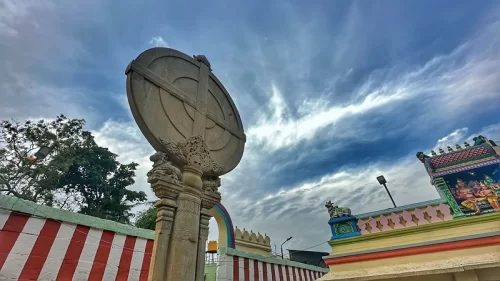
The temple is known for its stone construction and natural cave setting, with carved stone discs aligned to allow sunlight to pass through and illuminate the Shiva linga on specific days in the Hindu calendar, a feature that continues to draw devotees and visitors.
It functions as an active place of worship, with daily rituals and periodic religious gatherings that maintain its relevance as a living religious site rather than a preserved monument.
Best Time to Visit Gavi Gangadhareshwara Temple
Gavi Gangadhareshwara Temple can be visited throughout the year, but cooler months and specific festival periods offer more comfortable conditions and a fuller on-ground experience.
- Ideal months: October to February, when temperatures are moderate and the temple surroundings are more comfortable for walking and waiting during darshan.
- Best-season conditions: Dry weather, cooler mornings and evenings, and clearer visibility inside the cave structure.
- Periods to avoid: Peak summer afternoons (March–May) due to heat and humidity, and Mahashivaratri day if you prefer quieter visits, as crowd levels become extremely high.
How to Reach Gavi Gangadhareshwara Temple
- Nearest airport: Kempegowda International Airport (BLR), approximately 38 km away. Travel time to the temple area in Gavipuram Guttahalli typically ranges from 1.5 to 2.5 hours depending on traffic.
- Nearest railway station: KSR Bengaluru City Junction (Majestic), about 5 km from the temple, with easy availability of auto-rickshaws, taxis, and city buses.
- Road access and last-mile connectivity: The temple is accessible via city roads through Basavanagudi and Gavipuram areas. BMTC buses operate regularly to nearby stops, but the final approach involves narrow local roads and a short uphill walk, which can be congested during peak hours and festivals.
What to Expect When You Visit Gavi Gangadhareshwara Temple
- Environment and surroundings: The temple is located on a rocky hillock in Gavipuram, surrounded by dense residential neighborhoods. The setting includes natural rock formations, temple courtyards, and shaded areas, with noticeable city noise from surrounding roads.
- Facilities and amenities: Basic facilities are available, including footwear stands, small prasad counters, and limited seating areas. There are no large visitor amenities such as cafés, restrooms for tourists, or information counters within the temple complex.
- Accessibility and movement: Access involves walking on uneven stone pathways and steps, with narrow entry points inside the temple. Movement becomes slow during peak hours due to limited space in the inner sanctum areas.
- Typical visitor behavior and conditions: Visitors are primarily worshippers and local devotees. Quiet movement, queuing for darshan, and ritual participation are common. Crowd density increases significantly on Mondays, Pradosham days, and during the annual Makar Sankranti sun-ray alignment event.
Important Visitor Information for Gavi Gangadhareshwara Temple
- Crowd and weather notes: The temple experiences high footfall during early mornings, Mondays, Pradosham days, Shivaratri, and during the annual Makar Sankranti solar alignment event. Hot afternoons can make the rock surfaces and cave interiors feel warmer, especially in summer months.
- Peak and quiet visiting hours: Peak hours are typically 6:00–9:00 AM and 5:30–8:00 PM. Quieter periods are mid-morning and early afternoon when local worship traffic is lower.
- Dress code: Modest attire is expected. Visitors should wear clothing that covers shoulders and knees, as this is an active place of worship with regular rituals.
- Safety notes and practical cautions: Cave floors and stone steps can be uneven and slippery during monsoon months. Low-light interiors require careful footing. Personal belongings should be kept secure during crowded darshan periods.
Photography and Viewpoints at Gavi Gangadhareshwara Temple
- Best viewpoints: Exterior shots are best taken from the temple courtyard and the raised approach area, capturing the rock-cut façade and surrounding boulders. Inside the cave complex, the main Shiva lingam chamber and stone pillars offer visually distinct compositions, though space is limited.
- Lighting conditions and timing: Natural light is low inside the cave interiors throughout the day, with limited artificial lighting. Exterior photography is clearer in the morning hours when sunlight falls on the rock surfaces without harsh shadows.
- Rules and restrictions: Photography is generally restricted inside the inner sanctum and active ???? (pooja) areas. Visitors should follow on-site instructions, as rules may vary during rituals, festivals, and special events.
- Crowd and access factors: Narrow cave passages and small chambers limit movement and camera angles, especially during peak worship hours. Crowds during mornings, evenings, and festival days make stable photography inside the temple complex difficult.