Pir Ki Gali: High-Altitude Mountain Pass on the Mughal Road, Jammu and Kashmir, India

Pir Ki Gali , Jammu
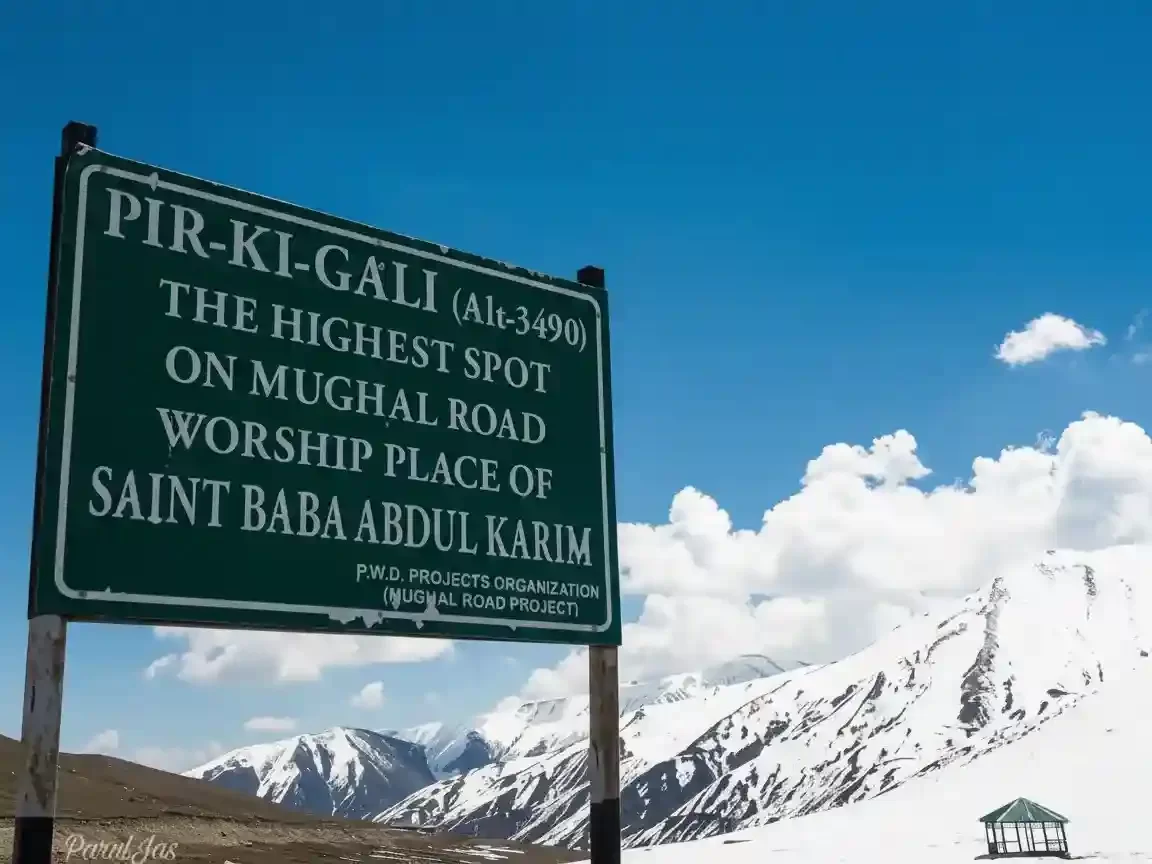
Tourists visit Pir Ki Gali as it is the highest point on the historic Mughal Road, connecting the Shopian district in the Kashmir Valley with the Rajouri and Poonch districts. The location is a destination for travelers seeking panoramic mountain views, high-altitude meadows, and a visit to the shrine of the Sufi saint Sheikh Ahmed Karim, which is a significant site for prayer and meditation for people of various faiths.

Quick Facts About Pir Ki Gali

Entry Fee Free
Timings 24 Hours (Seasonal)
Altitude (m) 3490
Ideal Visit Duration (mins) 45
Best Time of Day Midday
Crowd Level Moderate
Distance from Shopian (km) 40
Distance from Srinagar (km) 95
Distance from Poonch (km) 55
Walking Difficulty Easy
Parking Available Yes
Last Mile Access Road
Suitable for Kids Yes
Suitable for Seniors Yes
Wheelchair Friendly Partial

Why Visit Pir Ki Gali on the Mughal Road

Pir Ki Gali serves as the highest point and the spiritual heart of the historic Mughal Road, situated at an elevation of 11,450 feet. Travelers visit this mountain pass to traverse the ancient imperial route that connects the Poonch and Rajouri districts with the Kashmir Valley, offering a scenic alternative to the traditional Jammu-Srinagar highway while providing a gateway to the high-altitude alpine lakes of the Pir Panjal range.

The atmosphere on the ground is defined by vast, rolling green meadows and the cool, mist-laden winds that frequently sweep across the ridge. Visitors experience a unique blend of natural beauty and spiritual serenity at the shrine of the 17th-century saint, Sheikh Ahmad Karim, where the silence of the mountains is complemented by the presence of nomadic Gujjar and Bakarwal tribes moving their herds through the verdant pastures during the summer months.

What makes Pir Ki Gali distinct is its role as a dramatic climatic and topographical divide between the subtropical Jammu hills and the temperate Kashmir highlands. It offers a rare vantage point to view the snow-capped peaks of the Pir Panjal mountains alongside the historical remains of Mughal-era inns (sarais), making it a premier destination for those interested in the intersection of medieval history, nomadic culture, and pristine Himalayan landscapes.

Historical and Geographic Significance of Pir Ki Gali

Pir Ki Gali is a high-altitude mountain pass situated at an elevation of 3,485 meters (11,433 feet) in the Pir Panjal Range. It serves as the highest point on the historic Mughal Road, connecting the Shopian district of the Kashmir Valley with the Poonch and Rajouri districts of the Jammu region.

Geographically, the pass acts as a natural gateway and a climatic divide between the lush Kashmir Valley and the rugged hilly terrain of Jammu. It is surrounded by alpine meadows, known as marg-s, and snow-capped peaks that remain white for a large part of the year. The pass is a critical landmark for the nomadic Bakarwal and Gujjar tribes who traverse this route during their seasonal migration with livestock between the high pastures and the plains.

Historically, Pir Ki Gali has been an integral part of the ancient Imperial Road used by Mughal Emperors like Akbar, Jahangir, and Shah Jahan to travel to Kashmir. The pass is named after a local Sufi saint, Sheikh Ahmed Karim, popularly known as Peer Baba, whose shrine (Dargah) is located at the summit and is revered by travelers of all faiths. Today, it is a major stop for tourists and locals alike, maintained by the Public Works Department to ensure connectivity through the majestic Pir Panjal mountains during the summer and autumn months.

Best Time to Visit Pir Ki Gali

Pir Ki Gali, the highest point of the historic Mughal Road at 11,450 feet, serves as the scenic gateway between the Shopian and Poonch-Rajouri districts. Unlike the all-weather NH44, this pass is a seasonal high-altitude crossing that remains buried under several feet of snow for half the year, making timing essential for those wishing to experience its alpine meadows and the Sufi shrine of Sheikh Ahmed Karim.

  • Ideal months: May to September is the peak window for travel, with May and June being the best for witnessing massive snow walls and September offering the most stable road conditions and lush green landscapes.
  • Weather conditions: Summer days are remarkably cool and pleasant, with temperatures ranging from 10°C to 20°C, though the pass is famous for its sudden "rolling mists" and sharp winds that can drop temperatures significantly within minutes.
  • Periods to avoid: Avoid travel from December to April when the Mughal Road is officially closed due to heavy snow accumulation often exceeding 10 feet; additionally, the peak monsoon weeks of late July and August should be approached with caution as the Shopian-side ascent is highly prone to landslides and shooting stones during heavy downpours.

How to Reach Pir Ki Gali

Pir Ki Gali, situated at an elevation of approximately 3,485m (11,433 ft), is the highest point and the heart of the historic Mughal Road. It serves as a scenic mountain pass connecting the Shopian district of the Kashmir Valley with the Poonch and Rajouri districts of the Jammu region, offering a high-altitude alternative to the traditional Jammu-Srinagar National Highway (NH44).
  • Nearest Airport: Srinagar International Airport (SXR) is the closest air gateway, located about 90 km away via Shopian. The drive from the airport to the pass typically takes 3 to 4 hours, passing through the famous apple orchards of South Kashmir.
  • Nearest Railway Station: Jammu Tawi is the nearest major railhead for those approaching from the south, approximately 230 km away. For those already in the valley, the Anantnag railway station is about 60 km from the pass.
  • Road Access via Mughal Road: The pass is located directly on the Mughal Road. From the Srinagar side, travelers move through Pulwama and Shopian before ascending the pass. From the Jammu side, the route follows the NH144A toward Rajouri and then winds through Bafliaz and Poshana to reach the summit.
  • Last-Mile Connectivity: The road is well-surfaced and accessible by all vehicle types, including sedans, hatchbacks, and SUVs. During the summer months, private taxis and local shared cabs ply regularly between Shopian and Poonch/Rajouri via this pass. However, there is limited public bus frequency compared to the main highway.
  • Seasonal Accessibility: Pir Ki Gali is a seasonal pass, usually open from May to late November. Heavy snowfall during the winter months leads to the closure of the Mughal Road, as it lacks the extensive tunnel infrastructure of the NH44. Travelers should check with local traffic authorities in Shopian or Bafliaz before starting their journey during the shoulder months.
  • Traveler Logistics and Amenities: The pass is famous for the shrine of the Sufi saint Sheikh Ahmed Karim, which is a common stop for travelers. There are no fuel stations at the summit; the nearest petrol pumps are in Shopian (approx. 40 km) or Surankote. Basic tea stalls and local eateries are available near the pass during the peak season. Mobile connectivity can be spotty, with BSNL providing the most reliable coverage.

Essential Visitor Information for Pir Ki Gali

  • Crowd and Weather: Located at 3,490 meters (11,450 feet), Pir Ki Gali is a tranquil alternative to mainstream Kashmiri routes, though it attracts devotees and road-trippers during weekends; the weather is famously unpredictable, with sudden fog, biting winds, and misty conditions even in peak summer.
  • Peak and Quiet Visiting Hours: Best visited between 9:00 AM and 3:00 PM for the clearest views of the Pir Panjal range; early mornings are the quietest but are often shrouded in thick fog, while late-day travel is discouraged as the Mughal Road is prone to landslides and temperature drops.
  • Dress Code: Modest clothing is required for visiting the shrine of Sufi saint Sheikh Ahmed Karim; visitors must remove footwear before entering the shrine area, and carrying a shawl or light jacket is essential as temperatures remain cool year-round.
  • Safety and Practical Cautions: The pass is typically closed from November to April due to heavy snowfall; during the open season, be alert for slippery road patches and steep curves between Shopian and Bafliaz, and limit physical exertion if you are not accustomed to the altitude.
  • Logistics and Facilities: Mobile connectivity is weak to non-existent at the summit; there are no fuel stations on the pass (refuel at Shopian or Bufliaz) and only basic tea stalls are available for refreshments.

What to Expect When You Visit Pir Ki Gali

  • Environment and Surroundings: Pir Ki Gali is the highest point on the historic Mughal Road, situated at an altitude of 3,490 meters (11,450 feet) in the Pir Panjal Range. The area is a sprawling alpine meadow surrounded by snow-capped peaks and deep valleys. It serves as both a scenic viewpoint and a spiritual site, housing the shrine of the Sufi saint Sheikh Noor-ud-Din Noorani (Peer Baba). The environment is characterized by dramatic weather shifts, where clear skies can turn into thick mist or rain within minutes.
  • Facilities and Amenities: Infrastructure at the pass is very basic. There are no hotels, permanent restaurants, or modern restrooms at the summit. During the peak season, a few temporary tea stalls and dhabas offer basic refreshments like tea, sattu (roasted flour), and snacks. Visitors are served "salty tea" as prasad at the shrine. For proper meals, fuel, or accommodation, travelers must rely on the towns of Shopian (45 km away) or Bafliaz (55 km away).
  • Accessibility and Movement: The pass is located on the Mughal Road, connecting the Kashmir Valley (via Shopian) to the Poonch and Rajouri districts. The road is paved but features steep gradients and numerous hairpin bends that require careful driving. It is strictly a seasonal route, typically open from May to October; heavy winter snowfall blocks the pass from November to April. Mobile connectivity is extremely poor or non-existent at the summit.
  • Typical Visitor Behavior and Conditions: The site is a major stop for pilgrims, bikers, and road-trippers. Visitors typically spend 30 to 60 minutes here to offer prayers at the shrine and photograph the panoramic views. It is mandatory to remove footwear before entering the shrine and to dress modestly; covering one's head with a scarf or shawl is a common sign of respect. Due to the high altitude, it remains chilly even in summer, and the pass is frequently used by nomadic shepherds (Bakarwals) moving their livestock.

Capturing the Scenic Grandeur of Pir Ki Gali

  • Summit Shrine and Plateau: The central photography point is the site of the dargah of Sheikh Ahmad Karim, located at the highest point of the pass (11,450 feet). The surrounding meadows provide a 360-degree vantage point of the Pir Panjal Range and the transitioning landscape between the Poonch and Shupiyan districts.
  • Mughal Road Hairpin Curves: For dramatic travel photography, several viewpoints on the ascent from the Shupiyan side allow for high-angle shots of the winding Mughal Road. These "serpentine" perspectives are best captured with a wide-angle lens to include the deep valleys and the engineering of the historic mountain pass.
  • Seasonal Lighting and Mist: The pass is known for rapid weather shifts and rolling mists. The "Golden Hour" shortly after sunrise offers the best clarity for long-distance shots of the snow-capped peaks, whereas the late afternoon often brings atmospheric fog that provides a moody, ethereal quality to landscape compositions.
  • Wilderness and Pastoral Life: During the summer months, the meadows serve as grazing grounds for the migratory Gujjar and Bakarwal tribes. Photographers can capture authentic cultural shots of livestock herds against the dramatic alpine backdrop, provided they maintain a respectful distance from the temporary encampments.
  • High-Velocity Wind Factors: Due to the funneling effect of the pass, wind speeds are consistently high. Photographers should use a sturdy tripod with a weight hook and high shutter speeds to avoid motion blur in the foreground flora and to stabilize gear during long-exposure shots of moving clouds.
  • Access and Winter Restrictions: Photography is strictly limited to the summer and autumn months. Heavy snowfall typically closes the pass from December to late March, making the viewpoints inaccessible. The best window for vibrant green landscapes is July and August, while October offers crisp skies and golden autumnal hues.

Near By Attraction

 Pilgrimage Site

Shri Ranbireshwar Temple

A historic Hindu temple dedicated to Lord Shiva, located in the Niranjani Akhara area of Jammu.

 Pilgrimage Site

Shri Raghunath Temple

A prominent Hindu temple complex dedicated to Lord Rama, located in the old city area of Jammu.

Frequently Asked Questions About Pir Ki Gali

Pir Ki Gali is located on the Mughal Road in Jammu and Kashmir, situated at a high mountain pass in the Pir Panjal range. It connects the Kashmir Valley with the Rajouri and Poonch regions.
Pir Ki Gali can be reached by road from Srinagar via Shopian along the Mughal Road. The drive takes several hours depending on traffic and weather, and the pass lies on a winding mountain route.
Special tourist permits are generally not required to visit Pir Ki Gali, but travelers should carry valid identification as the area is part of a high altitude strategic route. Checking road status before travel is important.
The best time to visit Pir Ki Gali is between May and October when the Mughal Road remains open and weather conditions are stable. Clear summer days offer wide mountain views.
Around 30 to 60 minutes are usually enough to stop and explore Pir Ki Gali. Most visitors pause to enjoy the scenery and take photographs before continuing their journey.
Pir Ki Gali is suitable for families who are comfortable with long mountain drives. The stop itself involves minimal walking but requires attention to changing weather conditions.
Pir Ki Gali is often closed during peak winter due to heavy snowfall in Jammu and Kashmir. Snow can block the Mughal Road, so travel plans must be based on official road updates.
Travelers at Pir Ki Gali can see panoramic views of snow covered peaks, green slopes during summer, and open high altitude landscapes. The site is primarily a scenic mountain pass rather than a developed tourist attraction.
Facilities at Pir Ki Gali are very limited, with occasional temporary stalls during open seasons. Permanent infrastructure is minimal at this high elevation point.
Pir Ki Gali experiences moderate traffic during summer when the Mughal Road is open. Even during peak months, it remains a brief stop rather than a crowded destination.
Pir Ki Gali can be combined with visits to other scenic spots along the Mughal Road during the same trip. It naturally fits into a broader mountain road exploration plan.
Travelers visiting Pir Ki Gali should carry warm layers, water, and basic essentials. Weather at high altitude in Jammu and Kashmir can change quickly, so preparation ensures a safe and comfortable stop.

Loved this place ? Let’s Plan Your Jammu and Kashmir Trip

Get customized Jammu and Kashmir tour planning designed around seasonal weather patterns, valley travel routes, snow conditions, and realistic hill road timing. Whether you are visiting for scenic landscapes, serene lakes, spiritual journeys, meadow stays

⚑ Quick Response | πŸ’° Free consultation | πŸ•’ 24Γ—7 expert support

×

Plan Your Trip