Quick Facts About Ranjit Vilas Palace
Quick Facts About Ranjit Vilas Palace
| Entry Fee | Not open for regular public entry (view from outside is free) |
|---|---|
| Timings | No fixed public visiting hours (palace is not officially open for tourism) |
| Altitude (m) | Approx. 190 m |
| Ideal Visit Duration | 20–40 minutes (external viewing and photography) |
| Best Time of Day | Early morning or late afternoon |
| Crowd Level | Low (mainly visited by architecture and heritage enthusiasts) |
| Distance from City Centre (km) | Approx. 2–4 km (from Wankaner town centre) |
| Walking Difficulty | Easy (short walk around the outer area) |
| Parking Available | Limited roadside parking available near the palace area |
| Last Mile Access | Auto-rickshaw, local taxi, or private vehicle (best option) |
| Suitable for Kids | Yes (only for brief visit and viewing from outside) |
| Suitable for Seniors | Yes (easy access if visiting only the outer surroundings) |
| Wheelchair Friendly | Partially (outer area is accessible, but interiors are not open) |
Why Visit Ranjit Vilas Palace, Wankaner
Visitors come to Ranjit Vilas Palace in Wankaner to explore one of Gujarat’s most striking royal residences, known for its grand architecture, regal interiors, and heritage charm that reflects the lifestyle of the former Wankaner rulers.
On-ground, the atmosphere feels calm and elegant, with wide palace grounds, quiet corridors, and a sense of old-world luxury that stands out from typical city attractions, making the visit feel slow-paced and immersive.
What makes Ranjit Vilas Palace distinct for travelers is its rare combination of European-inspired design, royal heritage, and the chance to witness an authentic palace setting in a lesser-explored town, offering a more exclusive experience compared to crowded heritage sites.
History of Ranjit Vilas Palace
Ranjit Vilas Palace is a historic royal palace in Wankaner, built during the princely era when Wankaner was a prominent princely state under the British Raj. The palace served as the residence of the Maharaja of Wankaner and was designed to reflect the wealth, power, and refined lifestyle of the royal family during the late 19th and early 20th centuries.
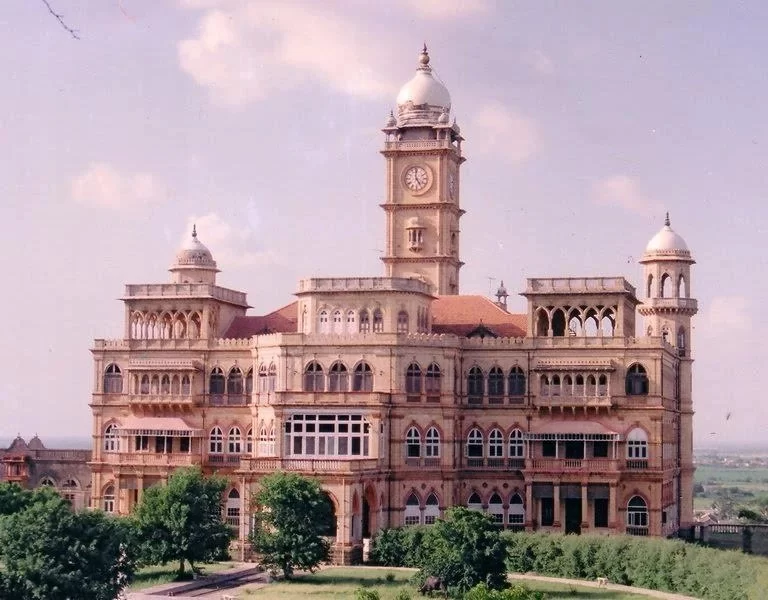
The architecture of Ranjit Vilas Palace is strongly influenced by European styles, particularly Victorian and Gothic elements, which became popular among Indian royal families during colonial rule. Its grand halls, elaborate interiors, and imported decorative materials highlight the cultural exchange and modernization trends adopted by princely states at the time.
Over the years, Ranjit Vilas Palace has remained an important symbol of Wankaner’s royal heritage. Today, it is known not only for its historical value but also for preserving the legacy of Gujarat’s princely history, making it a significant heritage attraction for visitors interested in royal architecture and regional history.
Best Time to Visit Ranjit Vilas Palace
Ranjit Vilas Palace is best visited during the cooler months when Wankaner’s weather is pleasant for sightseeing and exploring the palace architecture comfortably. Since the palace experience involves walking through open courtyards and large heritage spaces, avoiding peak summer heat makes the visit far more enjoyable.
- Ideal Months: October to March (most comfortable season for palace visits and photography).
- Weather During Best Season: Mild daytime temperatures, cooler evenings, and clear skies—ideal for exploring the palace interiors, gardens, and exterior façade without heat discomfort.
- Periods to Avoid: April to June due to intense summer heat in Wankaner, which can make outdoor movement around the palace tiring, especially in the afternoon.
How to Reach Ranjit Vilas Palace, Wankaner
- Nearest Airport: The nearest airport is Rajkot International Airport (Hirasar Airport), located around 45–55 km from Ranjit Vilas Palace. From the airport, tourists can hire a taxi or take a cab to reach Wankaner.
- Nearest Railway Station: The nearest railway station is Wankaner Junction Railway Station, located around 2–4 km from the palace. It is well-connected to Rajkot and other major cities via regular trains.
- Road Access & Last-Mile Connectivity: Ranjit Vilas Palace is easily accessible by road via the Rajkot–Morbi Highway (NH 27 / NH 8A route). Wankaner town has good connectivity from Rajkot (approx. 50 km) and Morbi (approx. 30 km). The last mile is smooth, as the palace is located within the town area and can be reached by auto-rickshaw, local taxi, or private vehicle.
- Travel Conditions to Note: Roads to Wankaner are generally in good condition throughout the year. However, during peak hours inside town areas, traffic can slow down travel slightly. Parking is usually available nearby, but entry access depends on palace visiting permissions or hotel guest access if staying inside the heritage property.
What to Expect When You Visit Ranjit Vilas Palace
- Grand heritage palace setting: Expect a large royal-era palace structure with traditional architecture, spacious corridors, and an old-world atmosphere that reflects the lifestyle of the former ruling family.
- Historic interiors and rooms: Visitors typically see selected halls, rooms, and heritage sections. Some areas may be open for viewing, while others may remain restricted depending on maintenance and preservation rules.
- Calm and quiet surroundings: The palace environment is generally peaceful compared to crowded tourist spots, with fewer visitors at a time, allowing slow exploration and photography.
- Limited tourist facilities: Do not expect modern tourist amenities like cafes, large food courts, or multiple rest areas inside the palace premises. Facilities are usually basic and limited.
- Walking required inside the palace: You should be prepared to walk through large indoor sections and open palace grounds. Some staircases and uneven flooring may be present in older parts of the building.
- Accessibility constraints: Wheelchair-friendly access may be limited due to steps, narrow passages, and heritage design. Seniors may find certain sections difficult if there are multiple stairways.
- Photography expectations: The palace is highly photogenic from the outside and inside, but some interior rooms may have photography restrictions, especially in preserved sections.
- Maintenance and restoration reality: Certain parts may show signs of aging, restoration work, or restricted entry zones, which is common in historic palaces that are still under preservation.
- Visitor behavior: Most visitors spend time exploring the architecture, taking photos, and learning about royal history rather than engaging in activities. The visit is usually slow-paced and observation-based.
- Time needed for visit: Expect to spend around 45 minutes to 1.5 hours depending on how many sections are accessible and how much time you spend photographing the palace.
Important Visitor Information for Ranjit Vilas Palace, Wankaner
- Crowd & Weather Notes: Ranjit Vilas Palace is generally not overcrowded like major Gujarat heritage sites, but visitor flow increases during winter tourist season (October to February). Summers in Wankaner can be extremely hot, making midday exploration uncomfortable, while monsoon months may cause humid conditions around the palace grounds.
- Peak Visiting Hours: The busiest time is usually late morning to early afternoon (11:00 AM to 2:00 PM), especially on weekends and during holiday travel seasons when tourists visit Wankaner as part of a Rajkot–Morbi route.
- Quiet Visiting Hours: The palace is most peaceful during early opening hours and weekday afternoons, when group tours are less frequent and you can explore the architecture and interiors with fewer interruptions.
- Dress Code (If Applicable): There is no strict dress code, but as the palace is a respected royal heritage property, visitors are expected to dress modestly and avoid inappropriate clothing while inside the palace areas and museum-style sections.
- Safety & Practical Cautions: Some palace sections may have polished flooring and old staircases, so footwear with good grip is recommended. Photography restrictions may apply in certain interior rooms, so confirm before clicking pictures. Carry water in summer months, as outdoor areas can feel harsh due to heat, and mobile network may be inconsistent inside thick-walled heritage structures.
Photography and Viewpoints at Ranjit Vilas Palace, Wankaner
- Best photo viewpoint from the entrance: The most iconic frame is from the palace driveway and main gate approach, where you can capture the full façade of the Indo-Saracenic structure with its domes, arches, and long symmetry.
- Top exterior photography angle: The best wide-angle shots come from the palace lawn side, where the building appears grander and the landscaped foreground adds depth to the composition.
- Most photogenic architectural details: Close-up photography works best on the carved balconies, arched windows, royal columns, and decorative stonework—these are the features that highlight the palace’s heritage character.
- Best time of day for lighting: Early morning (8 AM to 10 AM) gives soft natural light on the palace walls, while late afternoon (4 PM to sunset) creates warm tones and stronger contrast, ideal for dramatic heritage photography.
- Midday photography conditions: Between 11 AM and 3 PM, sunlight is harsh and reflections on white or pale stone surfaces can reduce detail, making the palace appear flat in photos.
- Interior photography experience: Indoor areas often have lower light, so photos may require steady hands or higher ISO. Some rooms may have restrictions on flash photography to protect antique interiors and heritage artifacts.
- Best crowd-free photography window: The palace looks most photogenic during opening hours and weekdays, as tourist movement is lower and you can take clean corridor and hall shots without people in the frame.
- Photography restrictions to note: Certain museum sections, private areas, or royal residence zones may not allow photography. Always follow signboards and staff instructions before clicking interior rooms.
- Drone photography rules: Drone use is generally not permitted without special approval, as the palace is a heritage property and may have security restrictions in the surrounding zone.
- Best heritage composition tip for this palace: The palace photographs best in wide horizontal frames that include the full front elevation, gardens, and domes together, giving a complete royal-scale perspective.