Homepage Banner

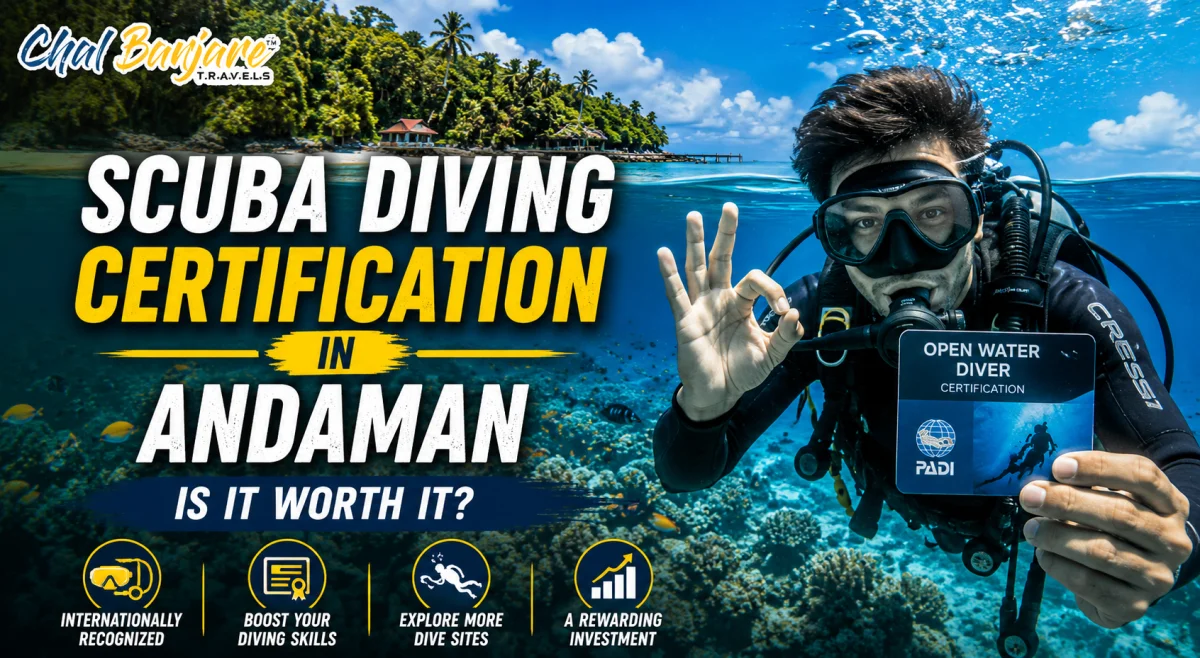
Scuba Diving Certification in Andaman – Is It Worth It?

Scuba diving certification in Andaman allows travellers to develop professional diving skills, explore deeper marine environments, and experience underwater adventures beyond beginner dives.

Things to Do


14 Jul, 2026 By: Pravalika Iyer

Understanding Scuba Diving Certification in Andaman

Explore what scuba diving certification courses include

Scuba diving certification is a structured training programme that teaches participants how to dive safely and independently while using scuba equipment. Unlike introductory diving experiences that are conducted under the constant supervision of an instructor, certification courses focus on developing the knowledge, practical skills and confidence required to plan and complete dives responsibly. The training combines classroom learning, confined water practice and open water dives where students gradually apply the techniques they have learned.
Certification courses cover a wide range of topics including underwater physics, pressure and buoyancy, breathing techniques, dive planning, equipment assembly, emergency procedures and responsible diving practices. Students also learn how to inspect diving equipment, perform buddy safety checks, communicate underwater using recognised hand signals and manage different underwater situations calmly. Throughout the course, professional instructors assess each participant's progress before allowing them to move to the next stage of training.
  • Understand scuba diving principles before entering open water.
  • Learn how diving equipment functions and how to assemble it correctly.
  • Practice buoyancy control in controlled training environments.
  • Develop underwater communication skills using standard hand signals.
  • Understand dive planning and safe underwater procedures.
  • Learn emergency response techniques for common diving situations.
  • Complete practical underwater skill assessments.
  • Receive internationally recognised certification after meeting course requirements.
A certification course is designed to build long-term diving ability rather than simply providing a single underwater experience. By completing structured training, divers gain the knowledge and confidence needed to participate in recreational diving around the world while following internationally accepted safety standards.

Understand the difference between beginner dives and certified diving

Many visitors confuse introductory scuba experiences with certified diving, but the two are very different. Beginner or discovery dives are designed for first-time participants who want to experience breathing underwater without completing a full certification programme. These sessions are conducted under direct instructor supervision, with the instructor controlling most aspects of the dive while the participant focuses on enjoying the underwater environment.
A certification course, however, prepares divers to become capable of managing many aspects of recreational diving independently with a qualified dive buddy. Students learn how to assemble equipment, perform safety checks, calculate dive limits, monitor underwater conditions and respond appropriately to different situations. Successful completion requires both theoretical knowledge and practical demonstrations of diving skills rather than simply participating in a guided underwater excursion.
Aspect Beginner Dive Certification Course
Purpose Experience scuba diving Learn independent recreational diving skills
Training Basic briefing Detailed theory practical training and assessments
Instructor Role Continuous direct supervision Training guidance with gradual skill development
Outcome Single diving experience Recognised diving certification upon successful completion
Travellers should decide between an introductory dive and a certification course based on their long-term interest in diving. Those wishing to continue exploring underwater destinations in the future often find certification to be a valuable investment that opens access to a wider range of diving opportunities worldwide.

Discover why Andaman is a popular destination for diving courses

The Andaman Islands have become one of India's leading scuba diving destinations because of their healthy coral reefs, diverse marine ecosystems and favourable underwater visibility during much of the diving season. These natural conditions provide an excellent environment for learning diving skills while observing colourful marine life in relatively comfortable surroundings. The combination of clear water and well-established dive centres makes Andaman attractive for both beginners and experienced divers seeking professional training.
Havelock Island, officially Swaraj Dweep, serves as the primary centre for scuba diving certification because it hosts numerous professional dive schools offering internationally recognised training programmes. Neil Island, officially Shaheed Dweep, also provides quality diving opportunities in a quieter setting, while selected operators around Port Blair offer introductory training and shorter courses depending on the certification level. The availability of experienced instructors, structured facilities and varied dive sites allows students to gain practical experience under real underwater conditions.
  • Clear water supports comfortable underwater learning.
  • Healthy coral reefs provide diverse marine environments.
  • Professional dive centres offer internationally recognised courses.
  • Multiple dive sites accommodate different experience levels.
  • Experienced instructors guide students throughout training.
  • Marine biodiversity enhances the overall learning experience.
  • Suitable conditions are available across several major islands.
  • Certification can be combined with a complete Andaman holiday.
For travellers interested in learning scuba diving, Andaman provides an excellent balance of professional training infrastructure and outstanding natural underwater environments. The opportunity to learn while exploring coral reefs and marine life makes certification here both educational and memorable.

Why Choose Andaman for Scuba Diving Certification

Explore clear waters coral reefs and diverse marine ecosystems

One of the main reasons divers choose Andaman for certification is the quality of its marine environment. The islands are surrounded by coral reef systems that support hundreds of marine species, creating ideal conditions for both training and underwater exploration. During favourable weather, underwater visibility often allows students to observe coral formations, reef fish and changing underwater landscapes while practising essential diving techniques.
The variety of underwater environments also contributes to effective learning. Students may encounter sandy seabeds, gently sloping reefs, coral gardens and areas with different depths suitable for progressive training. Instead of practising only in artificial conditions, learners develop their skills in natural marine habitats while remaining under instructor supervision. This combination of practical training and marine exploration makes the learning experience both enjoyable and highly educational.
  • Clear underwater visibility supports effective skill development.
  • Coral reefs provide diverse natural training environments.
  • Observe colourful reef fish during practical sessions.
  • Experience different underwater landscapes during open water dives.
  • Natural marine ecosystems improve overall diving confidence.
  • Multiple dive sites reduce overcrowding during training.
  • Healthy reefs encourage responsible environmental awareness.
  • Students gain practical experience in real underwater conditions.
Learning in a rich marine environment allows students to develop diving skills while appreciating the ecological importance of coral reef conservation. The underwater scenery becomes an important part of the educational experience rather than simply a background for training.

Understand how Andaman provides suitable conditions for learning diving skills

Successful scuba training depends heavily on environmental conditions, and Andaman provides several advantages for beginner divers. Many training locations offer relatively calm water during favourable seasons, allowing instructors to introduce new skills gradually without unnecessary environmental challenges. Stable conditions help students concentrate on buoyancy control, breathing techniques, equipment management and underwater communication before progressing to more complex diving situations.
Professional dive schools carefully select training sites according to weather, sea conditions and student experience. Confined water sessions begin in controlled environments before students move into open water where skills are practised under realistic conditions. Throughout the programme, instructors monitor each student's progress closely, ensuring that practical skills are mastered safely before advancing to deeper or more challenging training dives.
  • Calm conditions support beginner confidence during early training.
  • Structured progression moves from confined to open water.
  • Professional instructors supervise every stage of learning.
  • Training sites are selected according to student ability.
  • Students practise essential safety skills repeatedly.
  • Open water sessions develop real diving confidence.
  • Environmental awareness is included throughout the course.
  • Weather conditions determine daily training schedules.
The combination of suitable environmental conditions and professional instruction allows students to focus on learning safely without unnecessary pressure. This gradual progression builds both technical ability and confidence, preparing divers for future recreational diving beyond the certification course.

Discover underwater locations available for certified divers

After completing certification, divers gain access to a wider range of recreational dive sites than those available during introductory experiences. The Andaman Islands feature numerous underwater locations with different depths, reef structures and marine ecosystems that appeal to newly certified as well as experienced divers. Training also introduces students to responsible dive planning so they can select future dive sites according to their certification level and experience.
Havelock Island offers many well-known dive sites suitable for newly certified divers, while Neil Island provides quieter underwater environments that appeal to those seeking relaxed exploration. As divers gain experience through additional training, they may eventually qualify for deeper or more technically demanding locations where advanced certification is recommended. Professional dive centres continue to guide certified divers towards sites appropriate for their qualifications and comfort level.
  • New certification expands access to recreational dive sites.
  • Havelock offers numerous reef-based diving locations.
  • Neil Island provides quieter underwater exploration opportunities.
  • Certified divers learn to select sites according to experience.
  • Dive centres recommend locations matching certification level.
  • Progressive training supports future advanced diving.
  • Marine biodiversity varies across different dive sites.
  • Responsible dive planning remains essential after certification.
Scuba certification is more than a training programme—it is the beginning of long-term underwater exploration. Andaman provides an excellent starting point by combining professional instruction with access to diverse marine environments that continue to inspire divers well beyond their first certification course.

Types of Scuba Diving Certification Courses Available

Explore beginner certification courses for first-time divers

Beginner scuba diving certification courses are designed for people with little or no previous diving experience. These programmes introduce participants to recreational scuba diving through structured theoretical learning, confined water practice and supervised open water dives. The objective is to help students become comfortable using scuba equipment while learning internationally accepted safety procedures that prepare them for independent recreational diving with a certified buddy.
Most beginners start with an entry-level recreational certification offered by internationally recognised diving organisations. Before entering open water, students learn diving principles, pressure effects, buoyancy control, underwater communication, dive planning and emergency procedures. Practical sessions allow students to repeat essential skills until they demonstrate confidence and consistency. Throughout the programme, instructors evaluate performance carefully before progressing to more advanced underwater exercises.
  • Suitable for participants with no previous scuba diving experience.
  • Includes classroom learning and practical underwater training.
  • Develops confidence through gradual skill progression.
  • Teaches buoyancy control and underwater breathing techniques.
  • Introduces equipment assembly and maintenance basics.
  • Covers underwater communication and buddy procedures.
  • Includes supervised open water training dives.
  • Successful completion leads to internationally recognised recreational certification.
Entry-level certification provides the foundation for all future recreational diving. Instead of simply experiencing the underwater world once, participants develop the knowledge and practical skills required to continue diving safely at destinations around the world within the limits of their certification.

Understand advanced courses and skill development programmes

After completing an entry-level certification, divers may continue developing their knowledge through advanced scuba diving courses. These programmes focus on expanding underwater skills, improving confidence and introducing divers to different types of recreational diving environments. Rather than repeating basic techniques, advanced training helps divers become more comfortable handling varied underwater situations while improving decision-making and dive planning abilities.
Depending on the training organisation and course selected, advanced programmes may introduce navigation techniques, deeper recreational diving, underwater naturalist skills, peak performance buoyancy, night diving, underwater photography or search and recovery techniques. Each speciality develops specific skills while reinforcing safe diving practices learned during beginner certification. Students continue working closely with professional instructors who evaluate performance throughout every practical dive.
  • Builds upon previously learned recreational diving skills.
  • Improves underwater confidence and situational awareness.
  • Introduces navigation and advanced buoyancy techniques.
  • Provides experience in different recreational diving environments.
  • Develops better dive planning and underwater judgement.
  • Offers speciality training according to personal interests.
  • Encourages responsible diving and environmental awareness.
  • Prepares divers for more varied recreational dive sites.
Advanced certification should be viewed as a gradual progression rather than a race to complete additional qualifications. Building experience slowly allows divers to strengthen their practical abilities while remaining comfortable in increasingly varied underwater environments.

Choose certification levels according to diving goals and experience

Selecting the appropriate certification course depends on previous diving experience, long-term goals and available training time. First-time divers should begin with entry-level recreational certification before considering advanced programmes. Travellers who only want to experience scuba diving during a holiday may find an introductory dive sufficient, whereas those planning to dive regularly in the future benefit greatly from completing a recognised certification course.
Experienced certified divers returning to Andaman may choose refresher programmes if they have not dived for an extended period before progressing to advanced or speciality training. Divers interested in underwater photography, marine conservation or technical skill development can also select specialised courses once they meet the necessary certification requirements. Choosing an appropriate training level ensures that learning remains enjoyable, safe and suited to individual experience.
Experience Level Recommended Course Primary Objective
No Previous Experience Entry Level Certification Learn recreational scuba diving fundamentals
Recently Certified Diver Advanced Recreational Course Develop additional underwater skills
Certified Diver Returning After Long Gap Refresher Programme Rebuild confidence and review safety skills
Experienced Recreational Diver Speciality Courses Expand diving knowledge and experience
Choosing the correct certification level helps students learn at a comfortable pace while developing practical skills that remain useful throughout future diving adventures. Progressing gradually creates stronger confidence, better underwater judgement and a more enjoyable long-term diving experience.

What You Learn During a Diving Certification Course

Learn underwater safety techniques and diving procedures

Safety forms the foundation of every scuba diving certification course. Before students begin open water training, they learn why careful planning, proper equipment preparation and disciplined underwater behaviour are essential for safe recreational diving. Rather than memorising rules, participants understand the reasons behind every procedure so they can make informed decisions throughout future dives.
Training covers topics such as pre-dive planning, buddy checks, controlled descents and ascents, underwater awareness, air management, buoyancy control and emergency response techniques. Students repeatedly practise these procedures until they become comfortable performing them naturally during supervised dives. Instructors closely monitor every skill to ensure that correct habits are developed from the beginning.
  • Understand safe dive planning before entering the water.
  • Perform complete buddy safety checks before every dive.
  • Practice controlled descents and safe ascents.
  • Learn underwater air management techniques.
  • Develop awareness of depth, time and surroundings.
  • Understand emergency procedures for recreational diving.
  • Follow internationally recognised recreational diving practices.
  • Build confidence through repeated practical exercises.
Learning safety procedures thoroughly allows divers to enjoy underwater exploration with greater confidence. These skills remain valuable long after certification and form the basis of every safe recreational dive completed in the future.

Understand equipment handling breathing techniques and communication signals

Scuba certification introduces students to every major piece of recreational diving equipment and explains how each component functions as part of the complete diving system. Participants learn how to assemble equipment correctly, inspect it before use and identify potential issues before entering the water. Understanding equipment operation reduces uncertainty and allows divers to become more comfortable during practical training.
Students also learn efficient breathing techniques using the regulator, methods for maintaining relaxed underwater movement and internationally recognised hand signals used for communication beneath the surface. Since verbal communication is impossible underwater, clear hand signals become an essential part of safe diving. Throughout confined water and open water sessions, instructors reinforce these communication techniques until students can use them confidently during every dive.
  • Assemble scuba equipment correctly before diving.
  • Inspect equipment using systematic safety procedures.
  • Practice relaxed breathing through the regulator.
  • Understand mask clearing and regulator recovery techniques.
  • Use recognised underwater hand signals confidently.
  • Communicate effectively with dive buddies and instructors.
  • Maintain equipment responsibly throughout training.
  • Develop comfort while using full scuba equipment underwater.
Proper equipment knowledge and clear underwater communication help divers remain calm and prepared throughout every recreational dive. These practical skills improve both confidence and overall safety while allowing students to concentrate on enjoying the underwater environment.

Develop skills required for independent underwater exploration

The ultimate objective of scuba certification is to prepare students for independent recreational diving with an appropriately qualified dive buddy. This does not mean diving alone, but rather becoming capable of participating responsibly without requiring constant physical guidance from an instructor. Students gradually develop the judgement, planning ability and underwater awareness necessary for safe recreational diving after certification.
Throughout the course, practical sessions reinforce buoyancy control, underwater navigation, air monitoring, environmental awareness and responsible interaction with marine ecosystems. Students also learn how to recognise changing underwater conditions, respond appropriately to minor challenges and make sensible decisions before, during and after every dive. These combined skills allow newly certified divers to continue exploring recreational dive sites confidently while remaining within the limits of their certification.
  • Plan recreational dives responsibly with certified dive buddies.
  • Develop consistent buoyancy control throughout underwater exploration.
  • Monitor air supply and underwater conditions independently.
  • Improve underwater navigation and orientation skills.
  • Protect coral reefs through responsible diving practices.
  • Recognise personal diving limits and operate within them.
  • Strengthen confidence through repeated open water experience.
  • Prepare for recreational diving at destinations worldwide.
Certification is not simply about receiving a qualification—it is about becoming a responsible recreational diver. The combination of technical knowledge, practical experience and environmental awareness prepares students to continue exploring the underwater world safely while respecting the fragile marine ecosystems they visit.

Certification Training Experience in Andaman

Explore classroom sessions pool training and open water dives

Scuba diving certification in Andaman follows a structured learning process that gradually develops knowledge and underwater skills. Training normally begins with classroom or digital theory sessions where students learn the scientific principles of diving, safety procedures, underwater communication, equipment operation and responsible diving practices. These lessons create a strong theoretical foundation before participants enter the water.
After completing the theoretical component, students move to confined water or pool training where they become familiar with scuba equipment in a controlled environment. Here they practise breathing through the regulator, clearing water from the mask, buoyancy control, regulator recovery and emergency skills under constant instructor supervision. Once instructors are satisfied with the student's confidence and ability, the course progresses to open water dives around suitable reef locations where these skills are applied under real diving conditions.
  • Begin with classroom or digital theory sessions.
  • Understand diving physics, pressure and safety principles.
  • Practice essential skills in confined water before open water.
  • Develop buoyancy control gradually under supervision.
  • Complete multiple practical underwater exercises.
  • Experience supervised open water dives in natural marine environments.
  • Receive continuous evaluation throughout the training programme.
  • Progress only after demonstrating required competency.
This step-by-step learning approach helps beginners develop confidence without feeling overwhelmed. Each stage prepares students for the next, allowing them to build practical skills safely while becoming comfortable in the underwater environment before earning certification.

Understand the role of professional instructors during training

Professional scuba instructors play an essential role throughout the certification programme. Their responsibility extends beyond teaching technical skills, as they also monitor student confidence, explain underwater concepts clearly and ensure that every participant follows internationally accepted safety standards. Instructors observe each student's progress carefully and provide additional guidance whenever more practice is required.
During practical sessions, instructors demonstrate every skill before asking students to perform it independently. They remain nearby throughout confined water and open water exercises, correcting mistakes, answering questions and helping students overcome common beginner challenges. This close supervision creates a safe learning environment while allowing participants to develop confidence at their own pace rather than feeling rushed to complete the course.
  • Demonstrate every practical diving skill before student practice.
  • Monitor student progress throughout the certification programme.
  • Provide immediate guidance during underwater exercises.
  • Correct technique and improve underwater confidence.
  • Ensure internationally accepted safety procedures are followed.
  • Adapt training according to individual learning speed.
  • Answer theoretical and practical questions throughout the course.
  • Conduct skill assessments before advancing to the next stage.
Experienced instructors contribute significantly to the quality of the learning experience. Their knowledge, patience and supervision allow students to focus on developing skills confidently while maintaining high safety standards during every stage of training.

Discover how practical sessions prepare divers for real conditions

Practical training is the most important component of scuba certification because it transforms theoretical knowledge into real underwater experience. Students repeatedly practise essential diving techniques until they become comfortable performing them naturally under actual diving conditions. These practical sessions help divers develop confidence while learning how to respond calmly and responsibly in different underwater situations.
Open water dives introduce students to natural reef environments where visibility, depth and underwater surroundings differ from confined training areas. Under instructor supervision, participants apply buoyancy control, underwater navigation, air management and communication skills while observing coral reefs and marine life responsibly. This experience prepares divers for future recreational diving by combining technical competence with environmental awareness and practical decision-making.
  • Practice diving skills repeatedly in real underwater environments.
  • Develop confidence through supervised open water dives.
  • Improve buoyancy and underwater movement.
  • Learn responsible interaction with coral reef ecosystems.
  • Apply theoretical knowledge during practical exercises.
  • Strengthen underwater communication with dive buddies.
  • Experience realistic recreational diving conditions.
  • Complete instructor evaluations before certification.
The combination of theory, confined water practice and supervised open water experience prepares students for safe recreational diving long after the course has ended. Practical sessions ensure that certification represents genuine skill development rather than simply completing a training programme.

Best Places for Scuba Diving Certification in Andaman

Explore Havelock Island as a major diving training destination

Havelock Island, officially known as Swaraj Dweep, is widely recognised as the primary destination for scuba diving certification in the Andaman Islands. The island hosts numerous professional dive centres that offer internationally recognised certification programmes for beginners as well as advanced recreational divers. Its combination of clear water, healthy coral reefs and multiple training locations creates favourable conditions for learning scuba diving throughout much of the diving season.
Training begins in controlled environments before progressing to nearby open water dive sites where students apply newly learned skills under instructor supervision. Havelock's established diving infrastructure also provides equipment maintenance facilities, experienced instructors and access to multiple reef systems suitable for different certification levels. This allows students to experience a gradual learning progression without travelling long distances between training sessions.
  • Large number of professional dive training centres.
  • Multiple beginner-friendly open water training locations.
  • Healthy coral reefs supporting practical learning.
  • Experienced instructors with internationally recognised certifications.
  • Well-developed tourism and accommodation infrastructure.
  • Suitable for beginner, advanced and speciality diving courses.
  • Easy access to several recreational dive sites.
  • Good combination of training and holiday experiences.
For most first-time students, Havelock provides the broadest choice of certification programmes and training environments. Its well-established diving community makes it one of the most reliable locations in India for learning recreational scuba diving.

Discover Neil Island and other locations for diving experiences

Neil Island, officially Shaheed Dweep, offers a quieter alternative for scuba diving certification. While fewer dive centres operate compared to Havelock, the island provides a relaxed atmosphere that appeals to students seeking less crowded training conditions. The surrounding coral reefs and marine habitats create excellent opportunities for supervised open water dives while maintaining a slower pace throughout the learning experience.
Port Blair also offers introductory scuba experiences and selected certification programmes through established dive operators. Although many students eventually choose Havelock for complete certification, Port Blair remains a practical option for travellers with shorter itineraries or those wishing to begin their scuba journey before exploring other islands. The final training location should always be selected according to instructor quality, facilities and course structure rather than convenience alone.
  • Neil Island offers peaceful diving environments.
  • Less crowded training conditions support relaxed learning.
  • Port Blair provides introductory and selected certification options.
  • Professional operators supervise all practical sessions.
  • Different islands provide varying underwater landscapes.
  • Marine biodiversity enhances practical training.
  • Course quality should be prioritised over location popularity.
  • Travel plans should allow enough time for certification completion.
Each island offers unique advantages, but choosing the right training destination depends on learning goals, available time and the quality of professional instruction. Selecting an established dive centre remains more important than simply choosing the most famous island.

Choose training locations based on facilities and diving conditions

Selecting the ideal training location involves evaluating several practical factors beyond underwater scenery. Students should consider instructor qualifications, equipment quality, safety standards, access to confined water training, accommodation proximity and the variety of nearby dive sites. A professionally managed dive centre with excellent facilities often provides a better learning experience than a location chosen solely for its popularity.
Weather conditions, sea visibility and reef accessibility also influence the overall training experience. Dive centres typically select suitable training sites according to daily environmental conditions while ensuring that beginners remain within safe operational limits. Travellers should communicate openly with instructors about their previous experience, learning pace and comfort level before choosing a certification programme.
Location Training Advantages Suitable For
Havelock Island Large dive centres Multiple training sites Extensive facilities Beginner Advanced and Speciality Courses
Neil Island Peaceful environment Smaller training groups Relaxed learning experience
Port Blair Convenient access Introductory programmes Selected certifications Short itineraries and first-time visitors
The most suitable training location is the one that combines professional instruction, quality equipment, favourable diving conditions and sufficient time for learning. Careful selection allows students to complete certification comfortably while developing strong diving skills that remain valuable long after leaving Andaman.

Cost and Duration of Scuba Diving Certification

Understand factors affecting certification course pricing

The cost of a scuba diving certification course in Andaman varies depending on several practical factors rather than the location alone. Course level, training organisation, instructor experience, equipment quality, number of open water dives, group size and the facilities provided by the dive centre all influence the overall price. Entry-level certification programmes generally cost less than advanced or speciality courses because they focus on developing fundamental diving skills before progressing to higher levels of recreational diving.
Some certification packages include digital learning materials, classroom sessions, confined water practice, scuba equipment, open water dives, certification processing and instructor supervision within a single price. Others may charge separately for accommodation, island transfers, underwater photography, transportation or additional training dives beyond the standard programme. Travellers should carefully compare course inclusions instead of selecting the lowest-priced option, as professional instruction, equipment maintenance and safety standards are far more important than saving a small amount on course fees.
  • Course level influences the overall certification cost.
  • International certification processing is commonly included.
  • Equipment quality and maintenance affect pricing.
  • Experienced instructors may charge higher training fees.
  • Small training groups often provide more personalised instruction.
  • Digital learning materials may be included within the course package.
  • Accommodation and ferry transfers are often separate expenses.
  • Underwater photography is usually offered as an optional service.
  • Compare complete course inclusions before confirming a booking.
The overall value of a certification course should be judged by training quality, instructor expertise and safety standards rather than price alone. Investing in a professionally managed programme provides stronger diving skills and greater confidence that remain valuable long after the course has been completed.

Explore course duration training sessions and included activities

The duration of a scuba diving certification course depends on the certification level, the student's learning pace and weather conditions during training. Entry-level recreational certification programmes generally require several days because students must complete theoretical learning, confined water practice and multiple supervised open water dives before meeting certification requirements. Advanced and speciality courses vary according to their specific objectives and practical training requirements.
Daily schedules usually combine classroom learning with practical sessions, allowing students to gradually apply newly learned concepts underwater. Dive centres often arrange training to maximise favourable sea conditions, with many open water dives taking place during the morning when visibility and surface conditions are often more suitable. Students should avoid planning busy sightseeing schedules alongside certification because proper learning requires adequate rest, concentration and flexibility if weather delays practical sessions.
Training Component Purpose Typical Progression
Theory Sessions Learn diving principles and safety procedures Beginning of the course
Confined Water Training Practice basic diving skills Before open water dives
Open Water Dives Apply skills in natural diving conditions Final practical stage
Skill Assessment Demonstrate competency for certification Throughout the course
Travellers should allocate sufficient time to complete the entire certification without rushing. Leaving flexibility within the itinerary allows instructors to adjust practical sessions according to weather and ensures students have enough time to master every required skill before certification.

Plan certification expenses according to travel budget

When planning a scuba diving certification holiday in Andaman, travellers should budget for more than the course fee alone. Accommodation, meals, ferry tickets between islands, local transportation and optional recreational activities all contribute to the total travel cost. Choosing accommodation close to the dive centre can reduce daily travel time and make the training schedule more convenient, particularly during early morning sessions.
Students should also keep a reserve budget for optional expenses such as underwater photographs, additional recreational dives after certification, equipment rental for extra diving days or weather-related itinerary adjustments. Travellers visiting Andaman primarily for certification often benefit from planning a slightly longer stay so they can enjoy island sightseeing after completing the course without interrupting the training schedule.
  • Prepare a separate budget for accommodation and meals.
  • Include ferry and local transportation expenses.
  • Allow for optional underwater photography services.
  • Keep funds available for additional recreational dives.
  • Choose accommodation near the training centre.
  • Plan a flexible itinerary for weather-related changes.
  • Budget for personal travel insurance where appropriate.
  • Avoid compromising safety to reduce travel expenses.
  • Consider additional sightseeing after certification is completed.
Careful financial planning helps students focus on learning rather than worrying about unexpected expenses during the course. A realistic travel budget ensures that certification, accommodation and island exploration can all be enjoyed comfortably within the planned holiday.

Is Scuba Diving Certification Worth It for Tourists

Understand benefits for travellers interested in future diving experiences

For travellers who expect to dive only once during a holiday, an introductory scuba experience may be sufficient. However, visitors who enjoy the underwater environment and plan to continue diving during future trips often find certification to be extremely valuable. A recognised scuba certification allows divers to participate in recreational dives at many destinations worldwide while demonstrating that they have completed structured safety training and practical skill development.
Certification also increases confidence because divers understand equipment operation, buoyancy control, dive planning and underwater communication instead of relying entirely on instructor assistance. This greater independence allows certified divers to enjoy future recreational dives more comfortably while remaining within the limits of their training. Rather than repeating introductory sessions during every holiday, certified divers can immediately participate in dives appropriate for their qualification level.
  • Supports recreational diving at destinations around the world.
  • Builds confidence through structured practical training.
  • Improves understanding of underwater safety procedures.
  • Reduces dependence on introductory diving programmes.
  • Develops long-term recreational diving skills.
  • Enhances enjoyment of future underwater adventures.
  • Encourages responsible interaction with marine ecosystems.
  • Provides a strong foundation for advanced diving education.
Travellers with a genuine interest in marine exploration often discover that certification becomes one of the most rewarding investments they make during an Andaman holiday. The knowledge gained continues to provide value long after the trip has ended.

Explore opportunities to access deeper underwater environments

One of the major advantages of certification is access to a wider variety of recreational dive sites than those available during introductory experiences. Certified divers can participate in recreational dives appropriate to their qualification level while continuing to develop experience under the guidance of professional dive centres. As skills improve through additional training, divers may later qualify for advanced recreational dive sites that require greater experience and specialised knowledge.
Certification also improves underwater awareness, allowing divers to appreciate marine ecosystems more fully. Better buoyancy control, efficient breathing and effective communication make it easier to observe coral reefs, reef fish and underwater landscapes responsibly without disturbing the surrounding environment. This creates a richer diving experience compared with a one-time introductory session focused mainly on basic participation.
  • Access a wider selection of recreational dive sites.
  • Develop better underwater control and awareness.
  • Improve buoyancy for comfortable reef exploration.
  • Expand diving opportunities through additional experience.
  • Observe marine life more responsibly.
  • Prepare for future advanced recreational courses.
  • Build confidence through continued practical diving.
  • Strengthen long-term recreational diving abilities.
Certification does not simply increase the number of places a diver can visit—it also improves the quality of every future dive by strengthening practical skills, environmental awareness and overall underwater confidence.

Decide whether certification matches your travel interests and goals

Whether scuba certification is worthwhile depends entirely on personal travel goals. Travellers who regularly visit coastal destinations, enjoy marine wildlife and expect to continue diving over the coming years often benefit greatly from completing certification. On the other hand, visitors who simply wish to experience breathing underwater once during a holiday may be satisfied with an introductory scuba session instead of investing several days in formal training.
Time commitment should also be considered carefully. Certification requires concentration, practical training and successful completion of skill assessments rather than casual participation. Travellers with limited holiday time may prefer to complete certification during a dedicated future trip, while those spending several days in Andaman specifically for diving often find the experience highly rewarding. Choosing the option that best matches personal interests ensures both the training and the holiday remain enjoyable.
  • Consider certification if future diving is a long-term interest.
  • Choose introductory dives for one-time underwater experiences.
  • Allocate sufficient time for proper training.
  • Evaluate personal interest in marine exploration.
  • Consider physical comfort and confidence underwater.
  • Discuss learning goals with professional instructors.
  • Select training that matches available travel time.
  • Prioritise long-term value over short-term excitement.
  • Make decisions based on personal interests rather than trends.
Scuba certification is most valuable when it aligns with a traveller's long-term interests and commitment to recreational diving. For those who genuinely enjoy exploring the underwater world, completing certification in Andaman provides both a memorable holiday experience and a qualification that supports diving adventures around the world.

Who Should Consider Scuba Diving Certification in Andaman

Explore suitability for adventure lovers and marine enthusiasts

Scuba diving certification is an excellent choice for travellers who are genuinely interested in exploring the underwater world beyond a single holiday experience. While introductory scuba dives provide a brief introduction to diving, certification is intended for individuals who want to develop proper diving knowledge and continue recreational diving at different destinations in the future. Adventure travellers, marine wildlife enthusiasts, underwater photographers and nature lovers often benefit the most because certification allows them to experience marine ecosystems more independently and responsibly.
The Andaman Islands attract many first-time divers because the surrounding coral reefs, marine biodiversity and professional diving infrastructure provide favourable conditions for structured learning. Travellers who enjoy outdoor activities, appreciate marine conservation and are willing to invest time in developing practical skills generally find scuba certification to be both rewarding and useful for future travel. Instead of treating diving as a one-time adventure, certification transforms it into a lifelong recreational activity that can be enjoyed around the world.
  • Ideal for travellers interested in long-term recreational diving.
  • Suitable for adventure enthusiasts seeking new outdoor experiences.
  • Excellent choice for marine life and coral reef enthusiasts.
  • Useful for travellers planning future diving holidays.
  • Beneficial for underwater photography enthusiasts.
  • Supports environmentally responsible underwater exploration.
  • Provides internationally recognised recreational diving skills.
  • Allows gradual progression into advanced recreational diving.
  • Creates opportunities to explore a wider variety of dive sites worldwide.
Certification is most rewarding for people who view scuba diving as more than a holiday activity. Those with genuine curiosity about the underwater environment often gain lasting value from the knowledge, confidence and practical skills developed during the training programme.

Understand fitness requirements and preparation needed for diving

Although scuba diving is accessible to many healthy adults, certification courses require participants to meet basic fitness and medical requirements. Students should be comfortable participating in moderate physical activity and should honestly disclose any existing medical conditions before beginning training. Dive centres generally require participants to complete a medical questionnaire, and certain health conditions may require approval from a qualified medical professional before diving.
Preparing for certification also involves getting adequate rest, remaining well hydrated and maintaining a positive learning attitude throughout the programme. Students should avoid alcohol before training sessions, follow instructor guidance carefully and allow enough time to complete every stage without rushing. Mental preparedness is equally important because confidence, patience and willingness to learn contribute significantly to successful skill development underwater.
  • Complete all required medical declarations honestly.
  • Maintain good general physical fitness before training.
  • Stay hydrated throughout the certification programme.
  • Get adequate sleep before practical diving sessions.
  • Avoid alcohol before participating in dives.
  • Discuss any medical concerns with instructors before training.
  • Arrive early for classroom and practical sessions.
  • Maintain patience while learning new underwater skills.
  • Follow every safety instruction throughout the course.
Proper preparation allows students to concentrate fully on learning rather than overcoming avoidable difficulties. Entering the programme with realistic expectations, honest communication and a willingness to practise new skills greatly improves both confidence and overall success during certification.

Choose certification based on comfort confidence and commitment

Scuba diving certification should be chosen because of genuine interest rather than social influence or travel trends. Some travellers immediately discover a passion for underwater exploration after an introductory dive, while others simply enjoy the one-time experience without wishing to continue further. Understanding personal motivation helps determine whether investing several days in certification is the right decision.
Travellers who enjoy learning technical skills, spending time in the ocean and exploring marine ecosystems usually adapt well to certification training. Those with limited holiday time or little interest in future diving may prefer an introductory scuba experience instead. The commitment required for certification includes theoretical learning, repeated skill practice and successful completion of practical assessments, making it more suitable for travellers who are prepared to dedicate time and effort throughout the programme.
  • Choose certification if you plan to dive during future holidays.
  • Select introductory diving if seeking only a one-time experience.
  • Consider available holiday duration before enrolling.
  • Evaluate personal confidence in water activities.
  • Be prepared for both theory and practical training.
  • Develop skills gradually instead of rushing certification.
  • Maintain realistic expectations throughout the learning process.
  • Commit fully to instructor guidance and safety procedures.
  • Choose training that matches long-term recreational goals.
The best candidates for scuba certification are those who enjoy learning, appreciate marine environments and are excited about continuing recreational diving after their Andaman holiday. When personal interest, commitment and preparation come together, certification becomes one of the most valuable experiences available to underwater adventure travellers.

Common Mistakes While Choosing Diving Certification Courses

Avoid selecting operators without checking safety standards

One of the most significant mistakes students make when choosing a scuba certification course is selecting a dive centre based only on price or promotional offers. Certification quality depends heavily on instructor experience, equipment maintenance, training standards and safety procedures rather than the lowest course fee. Professional dive centres invest heavily in equipment servicing, instructor development and emergency preparedness, all of which contribute directly to student safety and learning quality.
Before booking, travellers should confirm that the operator follows internationally recognised training standards, maintains equipment properly and employs qualified instructors. It is also useful to enquire about student-to-instructor ratios, confined water facilities and emergency support procedures. Choosing an established operator ensures that every stage of the certification programme is conducted professionally while maintaining high safety standards.
  • Choose internationally recognised certification providers.
  • Verify instructor qualifications before enrolling.
  • Inspect equipment quality and maintenance standards.
  • Confirm emergency procedures and safety protocols.
  • Avoid selecting courses based solely on low prices.
  • Understand the complete training structure before booking.
  • Check student-to-instructor supervision levels.
  • Prioritise professional instruction over promotional discounts.
  • Review all course inclusions carefully.
A professionally managed training centre provides far greater long-term value than simply choosing the least expensive option. Strong safety standards and experienced instruction build confidence while helping students become responsible recreational divers.

Understand course details equipment quality and instructor experience

Many students enrol without fully understanding what the certification course includes. Some assume every course provides identical training, but programme structure, equipment quality, practical dive opportunities and instructor involvement can vary between operators. Understanding these differences before booking helps travellers select a programme that matches both their expectations and learning style.
Students should ask about classroom sessions, confined water training, number of open water dives, equipment provided, certification processing and any additional charges that may apply. Instructor experience also influences learning quality because experienced professionals often provide clearer explanations, more effective demonstrations and greater confidence throughout practical training. Choosing well-maintained equipment further improves comfort and reliability during every stage of the course.
  • Understand exactly what the certification package includes.
  • Confirm the number of practical training dives.
  • Ask whether learning materials are included.
  • Check equipment condition before training begins.
  • Choose instructors experienced in beginner training.
  • Clarify additional charges before making payment.
  • Understand certification processing procedures.
  • Allow time to ask questions before enrolling.
  • Select programmes that emphasise practical skill development.
Comparing course quality rather than simply comparing prices helps students receive better instruction and stronger practical experience. A clear understanding of the complete programme ensures that expectations match the actual learning process throughout certification.

Plan enough time for proper training and practice

Another common mistake is attempting to complete certification within an overly busy travel itinerary. Scuba certification requires concentration, repeated practice and sufficient rest between training sessions. Travellers who schedule multiple sightseeing tours, long ferry transfers and adventure activities alongside certification may find it difficult to focus completely on learning new underwater skills.
Weather conditions should also be considered when planning certification. Since practical dives depend on suitable sea conditions, allowing flexibility within the itinerary helps instructors adjust training schedules if required. Students who dedicate adequate time to learning generally complete the programme more comfortably while developing stronger diving skills than those rushing through the certification process.
  • Allocate several days exclusively for certification training.
  • Avoid combining intensive sightseeing with practical diving sessions.
  • Leave flexibility for weather-related schedule adjustments.
  • Get adequate rest before each training day.
  • Practise skills patiently without rushing assessments.
  • Plan accommodation close to the dive centre.
  • Allow additional time after certification for island sightseeing.
  • Focus on learning quality instead of course completion speed.
  • Respect instructor recommendations throughout the programme.
Certification should be approached as a structured learning experience rather than a quick holiday activity. Giving yourself enough time to absorb theoretical knowledge, practise underwater skills and complete every stage comfortably leads to stronger confidence, safer diving habits and a much more rewarding certification experience.

Final Andaman Scuba Diving Certification Planning Guide

Choose the right certification course based on your diving goals

Choosing the right scuba diving certification course begins with understanding your long-term diving goals rather than selecting the first programme available. Travellers who simply wish to experience breathing underwater during their holiday may find an introductory scuba dive sufficient, while those planning to dive during future vacations should consider completing a recognised certification course. Entry-level certification provides the knowledge and practical skills required for recreational diving, whereas advanced and speciality programmes are intended for certified divers looking to improve their abilities and explore a wider variety of underwater environments.
Before enrolling, consider your available holiday duration, previous diving experience, physical fitness and interest in continuing scuba diving after visiting Andaman. A well-structured course taught by experienced instructors provides much greater long-term value than choosing the shortest or least expensive option. Travellers should also compare the quality of training facilities, equipment maintenance standards, instructor qualifications and student-to-instructor ratios before making a final decision. Selecting a course that matches your current ability and future ambitions creates a more enjoyable learning experience while building a strong foundation for recreational diving around the world.
  • Identify whether you want introductory diving or full recreational certification.
  • Select a course appropriate for your previous diving experience.
  • Choose internationally recognised recreational certification programmes.
  • Prioritise instructor quality and safety standards over price.
  • Compare training facilities and practical learning opportunities.
  • Consider long-term diving goals before selecting advanced courses.
  • Review course inclusions carefully before confirming your booking.
  • Allow enough holiday time to complete certification comfortably.
  • Choose training that supports future recreational diving opportunities.
Selecting the correct certification programme ensures that your investment of time, effort and money contributes to meaningful skill development rather than simply completing another holiday activity. A carefully chosen course becomes the starting point for many years of safe and enjoyable underwater exploration.

Plan training schedule location and travel arrangements in advance

Proper planning allows students to focus entirely on learning instead of dealing with avoidable travel complications. Since certification requires several days of classroom learning, confined water practice and supervised open water dives, travellers should organise ferry schedules, accommodation and transportation before arriving in Andaman. Staying close to the selected dive centre reduces daily travel time and allows students to attend early morning training sessions without unnecessary stress.
It is equally important to build flexibility into the itinerary because practical dives depend on favourable weather and sea conditions. Strong winds or rough seas may occasionally require instructors to adjust the training schedule for safety reasons. Travellers should therefore avoid planning flights or long ferry journeys immediately after important training sessions. Keeping an additional day available within the itinerary provides valuable flexibility if weather causes temporary delays while also allowing time to relax after completing certification before continuing with island sightseeing.
  • Book accommodation close to the selected dive training centre.
  • Confirm ferry schedules before finalising your travel itinerary.
  • Reserve certification courses well in advance during peak travel seasons.
  • Keep one flexible day for weather-related schedule adjustments.
  • Attend every classroom and practical session on time.
  • Carry required identification and certification documents where applicable.
  • Remain well rested before each day of practical training.
  • Plan sightseeing after certification rather than between intensive training sessions.
  • Maintain regular communication with the dive centre throughout your stay.
A well-organised schedule allows students to enjoy the learning experience without unnecessary pressure. Careful travel planning improves punctuality, reduces fatigue and provides instructors with sufficient flexibility to deliver the course according to professional safety standards.

Final checklist for completing scuba diving certification in Andaman

Completing scuba diving certification successfully requires preparation, patience and commitment throughout every stage of the programme. Students should arrive with realistic expectations, understand that practical skills improve through repetition and remain willing to learn from instructor feedback. Certification is not a competition to finish quickly but a structured educational process designed to build safe recreational diving habits that remain useful for many years.
After certification, divers should continue practising responsibly by diving within the limits of their qualification, maintaining environmental awareness and choosing reputable operators wherever they travel. Protecting coral reefs, respecting marine wildlife and following safe recreational diving procedures help preserve the underwater environment while ensuring that every future dive remains both enjoyable and responsible. The certification earned in Andaman becomes far more valuable when it is supported by continuous learning, regular diving practice and responsible behaviour throughout future underwater adventures.
  • Complete every theory, confined water and open water requirement carefully.
  • Follow instructor guidance throughout the certification programme.
  • Use properly maintained diving equipment during every training session.
  • Remain honest about your comfort level and learning progress.
  • Respect weather-related changes made for safety.
  • Protect coral reefs by practising responsible recreational diving.
  • Dive only within the limits of your certification level.
  • Continue gaining experience gradually after completing certification.
  • Choose professional dive operators for future recreational dives.
  • Treat certification as the beginning of a lifelong diving journey rather than the final goal.
Scuba diving certification in Andaman is worthwhile for travellers who genuinely wish to continue exploring the underwater world beyond a single holiday. With careful planning, professional instruction and a commitment to responsible diving practices, students leave the islands with internationally recognised skills, greater confidence and the ability to enjoy recreational diving safely at destinations across the world.

Frequently Asked Questions About Scuba Diving Certification in Andaman – Is It Worth It?

Explore Andaman and Nicobar Islands Tour Packages

Explore All Packages

Latest Travel Blogs

View all Blogs →

Loved this place ? Let’s Plan Your Andaman and Nicobar Islands Trip

Get customized Andaman and Nicobar Islands tour planning designed around ferry schedules, island connectivity, seasonal sea conditions, and realistic travel flow between islands. Whether you are visiting for beach relaxation, water sports, snorkeling, scu

⚡ Quick Response | 💰 Free consultation | 🕒 24×7 expert support

×

Plan Your Trip