Quick Facts About Cellular Jail
| Entry Fee | ₹30 (Indian), ₹100 (Foreign) |
| Timings | 09:00 - 12:30 & 13:30 - 17:00 |
| Ideal Visit Duration (hrs) | 1.5 - 2 (Suggested) |
| Best Time of Day | Morning |
| Best Time to Visit | November - March |
| Location | Sri Vijaya Puram (Port Blair), South Andaman |
| Last Mile Access | Road (Taxi or Auto-Rickshaw) |
| Light and Sound Show Fee | ₹300 (Adult), ₹150 (Child Aged 5-11) |
| Official Ticket Information | Andaman and Nicobar Tourism Government Portal |
Cellular Jail Entry Fee, Opening Hours and Visitor Rules
Cellular Jail National Memorial has separate admission charges for daytime sightseeing and its evening Light and Sound Show. The official Andaman and Nicobar Tourism e-Tourist portal lists the daytime entry fee as ₹30 per Indian visitor and ₹100 per foreign visitor. Additional charges apply to certain photography and videography activities, while the evening show requires a separate ticket.
The official Cellular Jail Museum information page publishes daytime visiting hours of 9:00 AM to 12:30 PM and 1:30 PM to 5:00 PM, with Mondays and national holidays listed as closure days. However, other government tourism publications provide different opening schedules. Visitors should therefore confirm the operating hours and applicable closure days before travelling, particularly when visiting on a Monday or public holiday.
Important visitor rules and considerations include:
- Keep your admission ticket or booking confirmation available for inspection.
- Follow instructions from memorial staff and respect restricted areas.
- Check photography and videography permissions before using cameras, particularly professional equipment.
- Do not touch or damage historical exhibits, prison structures or memorial displays.
- Follow posted restrictions concerning food, littering and visitor movement within the complex.
- Check whether your preferred galleries and upper floors are accessible on the day of your visit.
- Book Light and Sound Show tickets separately and arrive before the assigned session.
For published admission charges and show-ticket information, refer to the official Cellular Jail entry fees and show schedule. Checking government information close to your travel date is the most reliable way to avoid planning around outdated prices or timings.
Best Time to Visit Cellular Jail in Andaman
The best time to visit Cellular Jail in Andaman is generally from November to March, when the islands usually experience relatively comfortable weather for sightseeing. This period falls within the wider October-to-May tourist season and is particularly suitable for visitors planning to explore Port Blair's historical attractions, museums and outdoor landmarks.
Cellular Jail can be visited throughout the year when the memorial is open, but the experience varies with the weather. The tropical climate of the Andaman Islands brings warm temperatures and humidity, while the wetter monsoon months can involve heavy rainfall. Since parts of the memorial visit involve walking through open courtyards and corridors, weather conditions can influence comfort.
- November to March: Generally the most comfortable period for exploring the memorial and combining the visit with other historical attractions.
- April to May: Sightseeing remains possible, although higher heat and humidity can make midday walking less comfortable.
- June to September: Rainfall and changing weather conditions may require greater flexibility, particularly for travellers combining the memorial with island transfers.
- October: A transitional month when conditions may gradually become more suitable for wider sightseeing, depending on rainfall.
For the daytime memorial visit, morning hours are often a practical choice because they allow time to explore the galleries before the afternoon heat. Travellers attending the Light and Sound Show should plan a separate evening session. For broader seasonal planning, read the Andaman and Nicobar Islands travel guide, especially if your itinerary includes ferries and multiple islands.
How to Reach Cellular Jail in Port Blair
Cellular Jail is located in the central part of Sri Vijaya Puram, formerly known as Port Blair, the capital of the Andaman and Nicobar Islands. The memorial is accessible by local road transport from the airport, passenger ferry terminals and major accommodation areas within the city. Its central location makes it relatively convenient to include in a Port Blair sightseeing itinerary.
By Air: Veer Savarkar International Airport (IXZ) is the main airport serving Sri Vijaya Puram. It receives scheduled flights connecting the Andaman Islands with major Indian cities, subject to airline routes and availability. Cellular Jail is approximately 4 kilometres from the airport, and visitors can travel to the memorial by taxi or other locally available road transport.
By Road: Travellers staying within Sri Vijaya Puram can reach Cellular Jail using taxis, auto-rickshaws or prearranged local transport. Travel duration depends on the starting location and traffic conditions. The memorial can also be combined with nearby sightseeing stops, including Marina Park and Corbyn's Cove Beach, when planning a city tour.
From Other Andaman Islands: Travellers arriving from Swaraj Dweep (Havelock Island) or Shaheed Dweep (Neil Island) generally return to Sri Vijaya Puram by passenger ferry before continuing to Cellular Jail by road. Ferry services are affected by weather, operational schedules and seat availability, so the memorial visit should not be scheduled too close to an uncertain ferry arrival. The Andaman island-hopping travel guide provides additional context for coordinating sightseeing with inter-island journeys.
Visitors planning government-operated inter-island transport can consult the Andaman and Nicobar Administration's Directorate of Shipping Services for official passenger-shipping information. To avoid missing museum hours or an evening show, allow sufficient time for local transfers and possible travel delays.
Visitor Facilities, Accessibility and Practical Travel Tips
Visiting Cellular Jail National Memorial involves walking through historical corridors, open courtyards, museum galleries and preserved prison areas. Because the complex was originally constructed as a colonial prison rather than a modern visitor facility, travellers should consider mobility requirements, weather conditions and the time needed to explore its exhibits comfortably.
Visitor facilities and accessibility: The memorial has designated visitor areas and historical displays, but some sections of the original three-storey structure involve stairs, narrow passages and uneven surfaces. Visitors with limited mobility, wheelchair users and senior citizens should confirm current step-free access, assistance arrangements and the availability of accessible facilities with the memorial authorities before visiting. Do not assume that every gallery, upper floor or viewing area is wheelchair-accessible.
Practical tips for visiting Cellular Jail include:
- Allow sufficient time: Set aside approximately 1.5 to 2 hours for the daytime memorial visit, with additional time if you prefer reading historical displays in detail.
- Wear comfortable footwear: Choose shoes suitable for walking across courtyards, corridors and historical surfaces.
- Prepare for tropical weather: Lightweight clothing, drinking water before entry and sun protection can make sightseeing more comfortable. Follow restrictions on carrying food or beverages into the premises.
- Respect the memorial: Maintain appropriate behaviour around prison cells, the gallows and commemorative exhibits, recognising their historical significance.
- Confirm photography rules: Obtain permission where required and observe restrictions on cameras, video recording and photography in specific areas.
- Plan for the evening show: Reserve a separate ticket, check the performance language and arrive before the scheduled entry time.
- Check visitor assistance: Families with young children, senior citizens and travellers with disabilities should enquire about seating, rest areas, accessible toilets and other support facilities rather than assuming availability.
- Keep the itinerary flexible: Allow additional time during heavy rainfall, busy holiday periods or days involving inter-island travel.
For visitors travelling with elderly family members or children, the Andaman travel guide for senior citizens and kids offers broader trip-planning considerations. The official Andaman and Nicobar Tourism portal can be used to review show-booking arrangements before the visit.
Cellular Jail is best experienced as a historical memorial rather than a quick sightseeing stop. Taking time to understand its exhibits, prison architecture and accounts of political prisoners gives visitors a deeper appreciation of its place in India's independence history.
History of Cellular Jail and Its Role in India's Freedom Struggle
The history of Cellular Jail in Andaman is closely connected with India's struggle against British colonial rule. Located in Sri Vijaya Puram, formerly Port Blair, this historic prison was established to isolate political prisoners and revolutionaries from the Indian mainland. Although the British penal settlement in the Andaman Islands began in 1858, following the Revolt of 1857, construction of the Cellular Jail started in the 1890s and was completed in 1906. It became one of the most feared institutions of the colonial prison system.
The British authorities used the prison to confine freedom fighters involved in revolutionary movements across India. Prisoners endured solitary confinement, forced labour, harsh punishments and severe restrictions on communication. Many were required to undertake physically demanding tasks, while others resisted oppressive prison conditions through protests and hunger strikes. These experiences made Cellular Jail an important symbol of both colonial repression and resistance.
After independence, the prison gradually became a place of national remembrance. On 11 February 1979, Cellular Jail was declared a National Memorial in recognition of the sacrifices made by India's freedom fighters. Today, its preserved cells, historical exhibits and memorial spaces help visitors understand the human cost of the independence movement. Travellers interested in this period of history can also explore other historical attractions in Port Blair to learn more about the islands' colonial past.
Why Is Cellular Jail Known as Kala Pani?
Cellular Jail is known as Kala Pani, meaning "Black Water", because prisoners transported to the Andaman Islands were separated from mainland India by a vast stretch of sea. During British rule, transportation across these waters was associated with severe punishment, social isolation and the possibility of never returning home. The term Kala Pani became strongly associated with the remote colonial penal settlement and the suffering of those imprisoned there.
For many prisoners, transportation to the Andaman Islands meant losing contact with their families, communities and familiar surroundings. Crossing the sea also carried social and religious consequences for some communities during that period. The geographical isolation of the islands made escape extremely difficult, while the strict prison system restricted communication between inmates.
Inside Cellular Jail, prisoners were confined individually in small cells and subjected to exhausting labour and disciplinary punishment. This combination of physical hardship, psychological isolation and separation from the mainland gave Kala Pani its lasting reputation. Today, the name recalls the experiences of the revolutionaries who endured imprisonment while continuing to resist colonial rule.
Architecture of Cellular Jail and Its Seven-Wing Prison Design
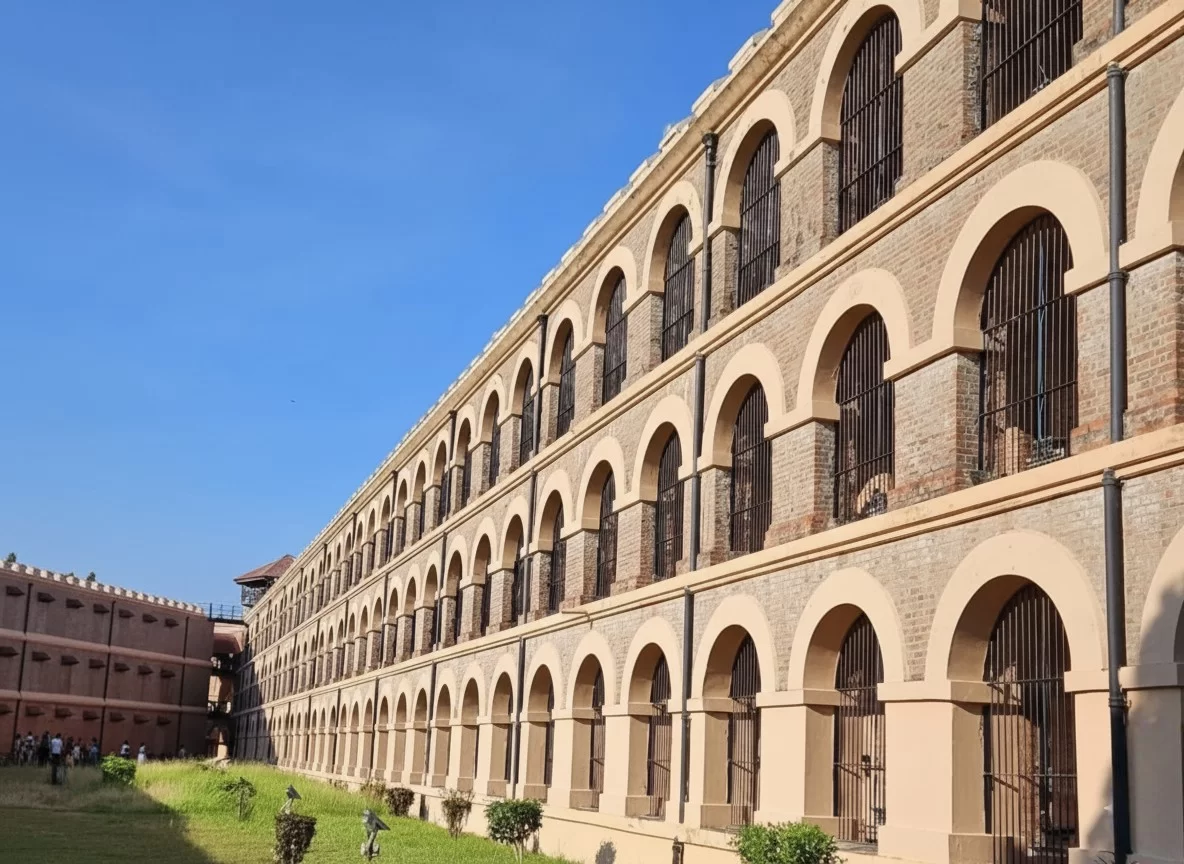
The architecture of Cellular Jail was specifically designed for solitary confinement, surveillance and strict control over prisoners. Completed in 1906, the original prison consisted of seven three-storey wings radiating from a central watchtower, resembling the spokes of a wheel. This arrangement allowed prison guards to monitor different sections of the building while limiting communication between inmates.
Each wing contained rows of individual cells secured by heavy iron doors. The cells were narrow, with small ventilation openings positioned high above the floor. Their entrances were arranged so that prisoners could not easily communicate with inmates in neighbouring wings. Historical government accounts commonly describe the completed prison as having 693 solitary cells, although some official historical records report different totals.
The central tower formed the main surveillance point, connecting the seven wings through corridors and controlled entrances. Prisoners were deliberately kept apart, making isolation a central feature of the prison's architecture rather than an incidental condition.
Only three of the original seven wings survive today, but the remaining structures still demonstrate the scale and purpose of the colonial prison. Visitors can examine the long corridors, individual cells and central tower to understand how the building was designed. Unlike the surrounding coastal attractions featured in a broader Port Blair travel guide, Cellular Jail offers an architectural record of colonial punishment and political imprisonment.
Freedom Fighters Imprisoned at Cellular Jail
Cellular Jail imprisoned numerous Indian freedom fighters who opposed British colonial rule. Revolutionaries from different regions were transported to the Andaman Islands, where they experienced solitary confinement, forced labour and strict prison discipline. Their imprisonment reflects the wide geographical reach of India's independence movement and the harsh measures used against anti-colonial activists.
Among the prominent freedom fighters associated with Cellular Jail were Vinayak Damodar Savarkar (Veer Savarkar), his brother Ganesh Damodar Savarkar, Barindra Kumar Ghose, Ullaskar Dutta, Sachindra Nath Sanyal and Batukeshwar Dutt. These revolutionaries were connected with different political organisations and movements challenging British authority. Their experiences varied, but imprisonment in the Andaman penal system became an important chapter in their individual histories.
Barindra Kumar Ghose and Ullaskar Dutta were associated with the Alipore Bomb Case, while other prisoners were connected with revolutionary activities in Bengal, Punjab, Maharashtra and elsewhere. Political prisoners also challenged prison conditions through collective protests and hunger strikes, demanding better treatment and recognition of their status.
Visitors can learn about these individuals through photographs, biographical displays and historical records preserved at the memorial. The historical sites of Port Blair provide additional context for understanding the islands' role in India's freedom struggle. Official historical information is also available through the Andaman and Nicobar Administration's Directorate of Art and Culture.
What to See Inside Cellular Jail National Memorial
Inside Cellular Jail National Memorial, visitors can explore preserved prison structures, historical galleries and commemorative spaces documenting the experiences of Indian freedom fighters. The memorial is particularly valuable for understanding the conditions of imprisonment and the architecture used to isolate political prisoners during British rule.
- Solitary Confinement Cells: Walk through surviving prison corridors and observe the small individual cells, iron doors and high ventilation openings that formed the basis of the isolation system.
- Veer Savarkar's Cell: Visit the cell associated with Vinayak Damodar Savarkar, one of the prison's best-known political inmates.
- Central Watchtower: Examine the central surveillance structure where the original seven prison wings converged, illustrating how the authorities monitored prisoners.
- Freedom Fighters' Gallery: View historical photographs, biographical information, records and exhibits commemorating imprisoned revolutionaries.
- Historical Artifacts and Displays: Discover exhibits relating to forced labour, prison conditions, punishment and resistance during the colonial period.
- Execution Area: See the preserved gallows section, which reflects one of the most disturbing aspects of the prison's history.
- Memorial Spaces: Spend time at the commemorative areas dedicated to remembering those who suffered and sacrificed their lives during the freedom struggle.
Allow approximately 1.5 to 2 hours for a thoughtful daytime visit, particularly if you plan to read the exhibits rather than simply walk through the building. Access to individual galleries or sections may vary because of maintenance or visitor management. Travellers planning additional sightseeing can include nearby Marina Park in their Port Blair itinerary after visiting the memorial.
Cellular Jail Light and Sound Show – Experience, Timings and Tickets
The Cellular Jail Light and Sound Show is an evening historical presentation that recreates important episodes from India's freedom struggle through narration, lighting, music and dramatic sound effects. Held within the prison complex, the programme describes the experiences of political prisoners, the harsh conditions of colonial imprisonment and the determination of revolutionaries who resisted British rule. The narration uses the perspective of an old peepal tree associated with the jail premises to connect different historical events.
According to the official Andaman and Nicobar Tourism e-Tourist portal, the published show schedule includes the following sessions:
- First Hindi Show: 5:50 PM, all days.
- Second Hindi Show: 6:50 PM on Tuesday, Thursday, Saturday and Sunday.
- Second English Show: 6:50 PM on Monday, Wednesday and Friday.
- Third Hindi Show: 7:50 PM, all days.
The published ticket price is ₹300 per adult and ₹150 per child aged 5–11 years. These are separate from the daytime Cellular Jail entry charges. Show availability, schedules and prices can change, so visitors should check the official Andaman Tourism e-Tourist booking portal before making arrangements.
Advance booking is advisable during busy travel periods because show seating is limited. Arrive ahead of the scheduled performance, keep your booking confirmation accessible and follow staff instructions regarding seating, photography and entry. Visitors interested in planning the rest of their evening can explore evening activities in Port Blair, although enough time should be reserved to attend the complete presentation without rushing.
Photography and Viewpoints at Cellular Jail
- The colonial-era architecture with its radial wing design offers powerful perspectives for heritage and documentary-style photography.
- Elevated viewpoints from the central watchtower provide a clear view of the symmetrical prison corridors, ideal for wide-angle compositions.
- Early morning and late afternoon lighting enhances the texture of brick walls, iron bars, and arched corridors, adding dramatic depth to images.
- Close-up shots of engraved plaques, preserved cells, and historical exhibits capture the emotional and historical significance of the site.
- The evening light and sound show provides atmospheric low-light photography opportunities, highlighting the structure against the night sky.
- Contrasting shadows along long corridors create striking lines and patterns, perfect for architectural storytelling photography.