


Best Winter Experiences in Sikkim
Explore memorable winter experiences in Sikkim, from snowy landscapes and frozen lakes to monastery visits, mountain views, local culture, photography, and scenic journeys.
+91 9910402252
admin@chalbanjare.com


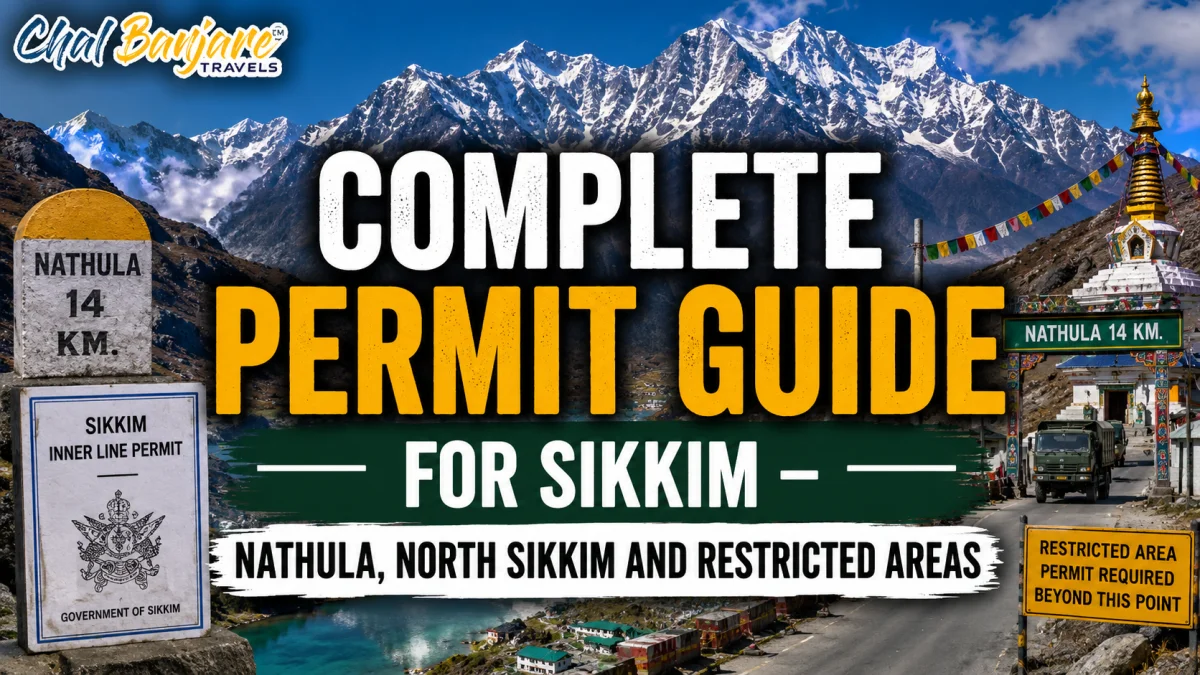
Understanding Sikkim permit requirements helps travellers plan visits to Nathula Pass North Sikkim and restricted border areas without document issues delays or unexpected route changes.
Travel permits are required for selected parts of Sikkim because the state shares sensitive international borders and contains protected routes controlled through tourism, police, civil administration, and security authorities. Destinations in North and East Sikkim may lie close to military installations, international boundaries, ecologically sensitive landscapes, or roads where visitor movement needs to be regulated. Permits allow authorities to record traveller details, approve eligible vehicles, manage daily visitor movement, and temporarily restrict access when security, weather, road, or environmental conditions make travel unsuitable.
Permit requirements should not be understood as ordinary attraction tickets. A permit authorises a specific traveller, vehicle, route, and travel period according to current conditions. Approval for one destination does not automatically provide access to every nearby border area. Tsomgo Lake, Baba Mandir, Nathula Pass, Lachung, Lachen, Yumthang Valley, Zero Point, Thangu, and Gurudongmar routes may follow different approval procedures and eligibility rules. Travellers must therefore finalise their destinations before submitting documents through a registered travel operator.
The permit system helps organise tourism across regions where ordinary unrestricted travel is not permitted. Completing the correct formalities protects travellers from checkpoint problems and supports safer movement through high-altitude roads, military zones, border landscapes, and environmentally sensitive mountain destinations.
The terms Restricted Area Permit and Protected Area Permit are primarily important for foreign nationals entering Sikkim and travelling beyond generally accessible areas. A Restricted Area Permit authorises an eligible foreign traveller to enter and stay within the permitted parts of Sikkim. It is commonly treated as the basic entry authorisation for foreign passport holders and is issued by designated authorities according to nationality, visa status, passport validity, proposed route, and prevailing government conditions.
A Protected Area Permit is an additional destination-specific permission required when an eligible foreign traveller wants to visit an approved protected route beyond the locations covered through ordinary entry permission. A valid Restricted Area Permit does not automatically provide access to every protected destination. Protected Area Permit applications generally require passport and visa copies, Restricted Area Permit details, photographs, an approved itinerary, and arrangements through a registered Sikkim travel agency. Some highly sensitive routes remain closed to foreign nationals regardless of whether they hold a Restricted Area Permit.
| Permit Type | Main Purpose | Important Limitation |
|---|---|---|
| Restricted Area Permit | Allows eligible foreign nationals to enter and stay in permitted parts of Sikkim | Does not provide automatic access to every protected route |
| Protected Area Permit | Allows eligible foreign nationals to visit specifically approved protected destinations | Valid only for the approved route dates and conditions |
| Domestic Tourist Permit | Allows Indian nationals to travel on selected restricted sightseeing routes | Destination and vehicle approval may still be required |
| Vehicle Permit | Authorises an approved vehicle to enter the permitted route | Traveller permission alone may not authorise the vehicle |
The distinction is important because foreign travellers may need both permission to enter Sikkim and separate approval for an accessible protected route. Indian travellers do not normally follow the same foreigner entry process, but they still require destination and vehicle permits for specified border and high-altitude circuits.
Indian nationals can generally enter Sikkim without a state-wide tourist entry permit, but they need permission for specified protected or restricted destinations. Applications are normally arranged through registered travel agencies or authorised vehicle operators using accepted photo identification, passport-sized photographs, traveller details, and the proposed route. Eligibility may also depend on age, health suitability, vehicle approval, road access, and current security instructions. Permit approval should never be assumed until the operator confirms that the documents and route have been accepted.
Foreign nationals, including Overseas Citizen of India holders for permit purposes, follow different rules. They require the applicable Restricted Area Permit to enter Sikkim and may need a Protected Area Permit for accessible protected routes. Passport, valid Indian visa, photographs, itinerary details, and registered travel agency arrangements are commonly required. Foreign travellers may also need to travel in an eligible group on certain routes. Nathula Pass and several highly sensitive border destinations remain unavailable to foreign passport holders, while access to North Sikkim is restricted to specifically approved locations.
Permit eligibility depends on nationality, documents, destination, travel group, vehicle arrangements, and current route conditions. Travellers should share accurate nationality and passport information with a registered operator before paying for restricted-area transport or accommodation, particularly when planning Nathula Pass, North Sikkim, or border-sensitive journeys.
Tsomgo Lake, Baba Mandir, and Nathula Pass lie on permit-controlled routes in East Sikkim. Indian travellers generally arrange permission through a Sikkim Tourism registered travel agency using accepted identification, recent photographs, traveller details, and an authorised local vehicle. The traveller permit and vehicle authorisation are linked to the approved date and route, so visitors should travel only with the vehicle and operator named within the arrangement. Ordinary entry into Gangtok does not provide permission to continue towards these protected mountain destinations.
Nathula Pass follows stricter eligibility rules because it lies directly on a sensitive international border. It is open only to eligible Indian nationals on authorised visiting days and remains subject to daily permit limits, security instructions, weather, snowfall, and road accessibility. Foreign nationals are not permitted to visit Nathula Pass. Foreign travellers may be permitted only as far as Tsomgo Lake when the necessary Protected Area Permit and vehicle permission have been arranged through a registered agency.
Travellers should treat Tsomgo Lake, Baba Mandir, and Nathula as separate permit-controlled experiences rather than guaranteed additions to Gangtok sightseeing. Documents should be submitted early, but final travel remains dependent on daily approval, the authorised route, vehicle availability, and safe mountain conditions.
Lachung, Lachen, Yumthang Valley, and Zero Point are reached through the protected North Sikkim road network and require permits arranged through registered local travel operators. Indian travellers generally submit accepted photo identification, passport-sized photographs, traveller details, and the selected itinerary before departure from Gangtok. Operators coordinate the traveller permission, authorised vehicle, checkpoints, accommodation, and route plan. Visitors should not expect to reach these destinations independently using an ordinary taxi that has not been approved for the protected circuit.
Permit coverage depends on the itinerary purchased. A Lachung and Yumthang Valley route does not necessarily include Lachen or every higher destination, while Zero Point may involve an additional journey beyond the main valley depending on weather, access, and operator arrangements. Foreign nationals face more restrictive rules and can visit only approved areas with a Protected Area Permit, registered agency arrangements, an authorised vehicle, and applicable group requirements. Current route openings must be confirmed because individual North Sikkim sectors can remain closed even when other destinations are accessible.
| North Sikkim Destination | Typical Permit Requirement | Important Planning Consideration |
|---|---|---|
| Lachung | Protected-route traveller and vehicle permission | Usually arranged within an organised overnight package |
| Lachen | Protected-route traveller and vehicle permission | Accessibility can differ from the Lachung sector |
| Yumthang Valley | Destination approval through the North Sikkim operator | Weather and road conditions determine final access |
| Zero Point | Route-specific approval or authorised extension | May involve additional transport arrangements and charges |
| Foreign Traveller Route | Protected Area Permit and registered agency arrangement | Only specifically approved destinations are accessible |
North Sikkim permits should be matched carefully with the confirmed package route. Travellers must verify whether Lachung, Lachen, Yumthang Valley, Zero Point, meals, accommodation, permits, and vehicle services are included instead of assuming one general North Sikkim permit covers every destination.
Gurudongmar Lake lies within an extremely sensitive and high-altitude sector of North Sikkim close to the international border. Indian travellers require an authorised route permit, approved vehicle, registered operator, and valid identification. Access remains dependent on military or police clearance, weather, snow, road conditions, traveller eligibility, and current administrative instructions. Even after the operator submits documents, permission can be withheld or the route can be shortened when authorities consider travel unsafe or operationally unsuitable.
Foreign nationals are not permitted to continue to Gurudongmar Lake under ordinary tourist arrangements. Official permit guidance limits foreign tourist permission in this sector to approved lower destinations such as Thangu, subject to a valid Protected Area Permit, vehicle authorisation, registered travel agency processing, and applicable group travel rules. Other roads close to international borders may also be unavailable regardless of traveller interest, package advertising, or the possession of a general Sikkim entry permit.
Routes close to Gurudongmar Lake and international borders require the greatest level of itinerary flexibility. Travellers should verify nationality eligibility before booking, carry original documents, use a registered operator, and maintain alternative plans because official access decisions can change according to security, altitude, road, and weather conditions.
Nathula Pass is one of the most regulated tourist destinations in Sikkim because it is located directly on the India China border. Indian citizens who wish to visit the pass must obtain a valid travel permit before departure from Gangtok. Visitors cannot apply independently at the border checkpoint, and permits are processed only through authorised Sikkim tour operators or registered travel agencies. Travellers should submit all required documents well before the planned travel date because applications are verified by the concerned authorities before approval is issued.
The documents generally include a government-issued photo identity proof such as Aadhaar Card, Passport, Voter ID Card, or Driving Licence along with recent passport-size photographs. Operators also require traveller details, proposed travel date, hotel information, and vehicle details while preparing the application. Original identification should always be carried during the journey because authorities verify permits and identity documents at multiple checkpoints between Gangtok and Nathula Pass.
Preparing accurate documents well in advance improves the chances of smooth permit processing. Although registered operators handle the application procedure, travellers remain responsible for providing correct identification, photographs, and travel details before the permit submission deadline.
Registered Sikkim travel operators act as the official link between tourists and the government authorities responsible for processing Nathula permits. After receiving traveller documents, operators verify identity details, prepare the required application forms, arrange authorised local vehicles, and submit applications through the prescribed government procedure. Since only approved local operators can process these permits, visitors should avoid relying on unofficial agents promising guaranteed approvals.
Once permits are approved, operators coordinate departure schedules, vehicle assignments, driver details, and sightseeing routes covering destinations such as Tsomgo Lake, Baba Mandir, and Nathula Pass wherever permitted. They also monitor weather forecasts, road conditions, and official advisories before departure. If authorities suspend permits because of snowfall, military requirements, or road closures, the operator normally informs travellers and suggests suitable alternatives based on prevailing conditions.
| Operator Responsibility | Purpose | Traveller Benefit |
|---|---|---|
| Document Verification | Checks application accuracy | Reduces permit processing errors |
| Permit Submission | Coordinates with government authorities | Official processing through authorised channels |
| Vehicle Arrangement | Provides approved local transport | Compliance with protected route rules |
| Travel Coordination | Organises sightseeing schedule | Smoother travel experience |
| Weather Monitoring | Tracks changing road conditions | Safer journey planning |
Using a registered local operator simplifies the permit process because they understand the latest administrative requirements and route conditions. Travellers should choose experienced agencies that clearly explain inclusions, documentation, permit timelines, and possible itinerary changes before confirming their booking.
Nathula permits are subject to government approval and are not guaranteed simply because documents have been submitted. Authorities regulate visitor numbers according to daily operational capacity, security requirements, weather conditions, military movement, and road safety. During peak travel seasons, school holidays, and long weekends, available permits may fill quickly, making advance planning extremely important.
Heavy snowfall, landslides, fog, road maintenance, military exercises, or security advisories may result in temporary closure of Nathula even when travellers already hold approved permits. Under such circumstances, operators usually modify sightseeing plans by focusing on destinations that remain accessible, such as Tsomgo Lake or Baba Mandir where conditions permit. Travellers should therefore maintain flexibility while planning East Sikkim itineraries rather than considering Nathula Pass as a guaranteed destination on every trip.
Nathula remains one of Sikkim's most rewarding mountain journeys, but access always depends on government approval and prevailing conditions. Flexible planning and early permit submission provide the best opportunity to experience this remarkable border destination safely and legally.
Lachung, Yumthang Valley, and Zero Point are among North Sikkim's most visited destinations, but all lie within protected regions where travel permits are compulsory. Indian travellers normally obtain these permits through registered Sikkim tour operators who submit traveller details, identity proof, photographs, accommodation information, and vehicle details before departure from Gangtok. Independent self-drive tourists cannot obtain direct permission to enter these restricted routes using privately arranged vehicles.
After permit approval, travellers usually begin the journey in authorised local vehicles accompanied by drivers familiar with mountain roads and checkpoint procedures. Permit verification takes place at multiple locations during the route. Depending on weather, snowfall, landslides, or road maintenance, authorities may shorten the itinerary or restrict travel beyond Yumthang Valley towards Zero Point even after the journey has started.
Travellers should consider permit approval only as one part of the journey because weather and mountain conditions continue to influence daily accessibility. Flexible itineraries help visitors enjoy North Sikkim without unnecessary disappointment if route modifications become necessary.
The Lachen circuit follows a separate protected route that includes destinations such as Thangu and Gurudongmar Lake. Permit applications are arranged through authorised travel operators using traveller identity documents, photographs, itinerary details, and approved local transport. Since Gurudongmar Lake lies in a highly sensitive border region at very high altitude, additional administrative checks, security considerations, and weather assessments influence whether travel proceeds according to the original plan.
Visitors should also understand that travelling to Gurudongmar Lake involves significant altitude gain within a relatively short period. Operators may advise itinerary adjustments based on weather forecasts, traveller health, or road conditions. If authorities restrict travel beyond Thangu, visitors must comply with official instructions even if accommodation and transport have already been arranged for the complete route.
| Destination | Permit Requirement | Special Consideration |
|---|---|---|
| Lachen | Protected route permit | Authorised local vehicle required |
| Thangu | Protected route approval | Weather dependent access |
| Gurudongmar Lake | Restricted high altitude permit | Security and altitude restrictions apply |
| Return Journey | Permit verification continues | Follow approved itinerary only |
| Route Changes | Official approval required | May occur due to weather or security |
The Lachen sector combines spectacular Himalayan scenery with strict administrative control. Travellers should remain flexible, prepare for altitude-related conditions, and follow instructions from operators, police, and military authorities throughout the journey.
Protected routes in North Sikkim operate under specific transportation regulations designed to improve safety and simplify permit management. Registered local vehicles authorised for protected routes transport visitors through checkpoint-controlled mountain roads. These drivers understand road conditions, permit verification procedures, and seasonal restrictions that may affect the itinerary. Travellers should avoid attempting restricted routes using unauthorised private vehicles because entry is generally not permitted.
Many North Sikkim itineraries operate as organised group departures because permit processing, accommodation allocation, and vehicle movement become easier when coordinated through registered operators. Foreign nationals travelling to permitted areas may also be required to follow additional group travel regulations depending on prevailing government rules. Travellers should confirm vehicle type, seating arrangements, luggage limits, pickup timing, and included sightseeing before finalising the booking.
North Sikkim's permit and vehicle regulations ensure organised movement through challenging Himalayan terrain. Travellers who work with experienced registered operators and follow official transport rules can enjoy a smoother journey while remaining compliant with current permit requirements and safety regulations.
Foreign nationals need the applicable Restricted Area Permit or Protected Area Permit to enter and travel through approved parts of Sikkim. The basic entry permission is generally issued after verification of the traveller's passport, valid Indian visa, recent photographs, application details, and intended period of stay. The terminology used by different authorities may include Restricted Area Permit, Protected Area Permit, or Inner Line Permit, but travellers should always confirm which permission applies to their nationality, entry point, and proposed itinerary.
A basic permit allowing entry into Sikkim does not provide unrestricted access to every destination. Foreign visitors planning protected routes must obtain additional destination-specific permission through a recognised travel agency registered with the Sikkim Tourism Department. The application may include passport and visa copies, existing entry-permit details, photographs, itinerary, accommodation information, group details, and the registered vehicle assigned to the journey. Travellers should not make non-refundable bookings for protected areas before their eligibility and route have been confirmed.
Foreign travellers should treat Sikkim entry permission and destination-specific protected-area approval as separate planning stages. Organising both through recognised channels helps prevent checkpoint problems and ensures the itinerary follows the routes currently approved for international visitors.
Foreign passport holders can generally visit many established destinations in Sikkim after obtaining the required entry permission. Commonly visited areas include Gangtok, Pelling, Yuksom, Ravangla, Namchi, Rumtek, and other approved cultural or nature destinations outside highly sensitive border sectors. The exact route permitted may depend on nationality, visa category, current government instructions, and the details recorded in the traveller's permit.
Access to protected destinations is more limited and requires separate approval. Foreign visitors may be allowed to visit Tsomgo Lake and specifically notified parts of North Sikkim through a registered travel agency, an authorised vehicle, and an eligible travel group. Official guidance may require two or more foreign travellers for selected Protected Area Permit applications. The approved permit specifies the destination, route, dates, and travel arrangement, so travellers cannot independently extend the journey to nearby restricted locations.
| Destination Category | General Foreign Traveller Access | Important Requirement |
|---|---|---|
| Gangtok and Major Towns | Accessible with valid Sikkim entry permission | Carry passport visa and permit during travel |
| Pelling Yuksom Ravangla and Namchi | Generally accessible on approved itineraries | Follow the route and stay period recorded in the permit |
| Tsomgo Lake | May be accessible with additional protected-area approval | Registered agency authorised vehicle and applicable group rules |
| Approved North Sikkim Areas | Limited access on specifically permitted routes | Protected Area Permit and organised travel required |
| Sensitive Border Routes | Closed or heavily restricted | Entry permission does not override destination restrictions |
Foreign travellers can still experience Sikkim's monasteries, towns, forests, villages, heritage attractions, and mountain scenery through a carefully planned eligible route. The itinerary should be prepared around officially accessible destinations rather than assuming that every location promoted to Indian tourists is open to international visitors.
Nathula Pass is not open to foreign nationals because it lies directly on a sensitive international border. A foreign traveller cannot obtain access merely by holding a valid Sikkim entry permit, travelling with Indian companions, or hiring a private vehicle. The permitted East Sikkim journey for eligible foreign tourists may extend only to an approved point such as Tsomgo Lake, subject to destination-specific permission and current operational conditions.
Gurudongmar Lake and several other highly sensitive North Sikkim border routes are also unavailable to foreign passport holders under ordinary tourist arrangements. Foreign travellers may receive permission only for specifically approved lower sections of the North Sikkim circuit, depending on the current government notification, group composition, operator arrangements, road access, and security clearance. Military checkpoints enforce the approved route, and no travel agent can legally guarantee entry beyond the limits stated on the permit.
Foreign visitors should confirm sensitive-route eligibility before paying for accommodation or transport. Building the journey around accessible destinations prevents last-minute disappointment and allows travellers to experience Sikkim responsibly while respecting border regulations and security requirements.
The most common way to obtain permits for Nathula Pass, Tsomgo Lake, Baba Mandir, North Sikkim, and other protected destinations is through a travel agency registered with the Sikkim Tourism Department. Travellers submit the required identification, photographs, nationality details, travel dates, hotel information, and selected route to the operator. The agency checks the documents, prepares the application, assigns an authorised vehicle, and submits the request through the applicable administrative process.
Travellers should choose an operator that clearly explains the proposed route, permit eligibility, vehicle category, package inclusions, document deadline, cancellation conditions, and alternatives if approval is denied. Payment for a vehicle or package does not itself guarantee permit issuance. The agency facilitates the process, but the final decision remains with the competent authorities and may depend on daily visitor limits, nationality, security instructions, weather, road access, and document accuracy.
A registered operator simplifies the process by coordinating traveller permission, vehicle approval, itinerary details, and checkpoint requirements together. Accurate documents and clear communication remain essential because operators cannot correct major identity or eligibility problems after the application deadline has passed.
Sikkim uses digital systems for selected permit and vehicle-approval processes, allowing authorised agencies and responsible departments to submit, process, download, or verify travel permissions electronically. Online processing can reduce paperwork and improve coordination between operators, permit offices, police, tourism authorities, and checkpoints. However, tourists should not assume that every protected-area permit can be completed independently through a public online form, as many routes still require a registered operator and authorised local vehicle.
Offline processing may be used through designated tourism offices, permit cells, district authorities, border entry points, or registered travel agencies, depending on the traveller category and permit required. Foreign travellers obtaining the applicable Sikkim entry permission may use authorised issuing offices, while destination-specific protected permits are generally coordinated through recognised agencies. Travellers should follow the process advised by the official authority or registered operator instead of using forms or instructions found on unofficial websites.
| Application Method | How It Is Commonly Used | Traveller Responsibility |
|---|---|---|
| Registered Agency Processing | Protected sightseeing routes and authorised vehicle arrangements | Submit accurate documents and confirmed travel dates |
| Government Online System | Electronic submission vehicle approval and permit management | Use only official or operator-directed channels |
| Tourism or Permit Office | Selected entry permissions and administrative processing | Carry original documents photographs and copies |
| Border Entry Office | Eligible entry-permit processing where officially authorised | Confirm office timing and required documents beforehand |
| Checkpoint Verification | Confirms approved travellers vehicles routes and dates | Carry originals and printed or authorised permit copies |
Online and offline options are parts of the same regulated permit system rather than interchangeable shortcuts. Travellers should identify the correct process for their nationality and destination, then use official authorities or registered agencies to avoid invalid applications, unnecessary payments, and rejected travel at checkpoints.
Permit approval is verified during the journey at designated police, tourism, administrative, and military checkpoints. Officials may examine the traveller list, original identification, permit validity, vehicle registration, driver details, approved destination, travel date, and route. Every traveller should carry the same original identity document used during the application because a different document or inconsistent information may delay verification or prevent onward travel.
Checkpoint officials can stop a journey when the permit is invalid, expired, altered, assigned to another vehicle, or inconsistent with traveller details. They may also restrict movement because of weather, snowfall, landslides, road damage, security instructions, or operational limits even when the paperwork is otherwise valid. Travellers must remain with the authorised group and vehicle and should not leave the approved route to visit unlisted border locations.
Checkpoint verification ensures that every traveller and vehicle matches the approved application. Keeping original documents organised, following the authorised route, and cooperating with officials allows the journey to proceed smoothly while protecting sensitive border regions and traveller safety.
Preparing complete and accurate travel documents is one of the most important steps before applying for permits in Sikkim. Since protected destinations involve police, tourism, and security verification, authorities require documents that clearly establish the traveller's identity and eligibility. Registered tour operators usually collect these documents several days before departure to allow sufficient time for application processing. Any mismatch between the submitted details and the original identity document can delay or even prevent permit approval.
Indian travellers generally submit a government-issued photo identity proof such as Aadhaar Card, Passport, Voter ID Card, or Driving Licence together with recent passport-size photographs. Foreign nationals normally provide passport copies, a valid Indian visa, photographs, and the applicable Sikkim entry permit or Protected Area Permit documents depending on the itinerary. Travellers should carry both printed photocopies and original documents throughout the journey because checkpoints may request verification at multiple locations.
Well-organised documents reduce application delays and simplify checkpoint verification during the journey. Travellers who prepare originals, photocopies, and digital backups remain better prepared for permit inspections throughout East and North Sikkim.
Permit expenses generally consist of two separate components. The first relates to official government processing wherever applicable, while the second covers the service charges collected by registered tour operators for preparing applications, coordinating documentation, arranging authorised vehicles, and completing administrative formalities. Since permit rules differ between destinations, travellers should request a detailed quotation showing exactly what has been included within the package price before making payment.
Many organised North Sikkim or Nathula tour packages include permit processing within the overall package cost rather than showing it separately. However, travellers should still confirm whether photography charges, parking, vehicle entry fees, sightseeing extensions, Zero Point transport, additional permits, or special destination charges are payable separately. Understanding these details before departure helps prevent confusion while travelling through protected areas.
| Expense Category | Purpose | Planning Advice |
|---|---|---|
| Government Permit Charges | Official processing where applicable | Confirm latest rates before booking |
| Operator Service Fee | Application preparation and coordination | Check whether included in the package |
| Authorised Vehicle Charges | Protected route transportation | Verify sightseeing coverage |
| Additional Route Costs | Extended sightseeing or optional destinations | Ask about extra payments in advance |
| Miscellaneous Expenses | Parking or local administrative costs | Request a complete cost breakdown |
A transparent quotation makes budgeting much easier. Travellers should compare complete inclusions instead of selecting an operator only because the initial advertised price appears lower than other available options.
Permit processing time depends on the destination, travel season, document accuracy, government workload, weather conditions, and security requirements. Applications submitted during major holidays, festival periods, long weekends, or peak tourism months may require additional processing because of increased visitor demand. Travellers should therefore avoid waiting until the final day before departure to provide their documents to the travel operator.
Providing documents several days before the planned journey gives operators enough time to verify details, correct application errors, and respond to any additional requests from the authorities. Last-minute changes involving traveller names, identity documents, travel dates, or destinations may require revised applications depending on current rules. Early planning also provides more flexibility if weather conditions or official instructions affect the original travel schedule.
Early permit preparation reduces unnecessary stress and improves the chances of smooth travel. Travellers who submit accurate documents well before departure are better positioned to handle unexpected administrative or weather-related changes affecting protected routes.
Permit approval alone does not guarantee that travel will take place exactly as planned. Sikkim's mountain roads remain highly dependent on weather conditions, and authorities regularly review safety before allowing vehicles to proceed towards protected destinations. Heavy snowfall, rainfall, landslides, dense fog, road damage, bridge maintenance, or poor visibility may result in temporary suspension of permits or closure of specific routes even after visitors have reached Gangtok.
Security considerations also influence permit validity because many protected destinations lie close to international borders and military installations. Government authorities may temporarily suspend tourist movement because of operational requirements, national security measures, or official advisories. Travellers should always follow instructions issued by police, military personnel, and local administration instead of attempting to continue independently beyond authorised checkpoints.
Travellers should treat protected-area permits as conditional approvals that remain subject to changing mountain conditions. Flexible itineraries and realistic expectations help visitors adapt comfortably when official authorities modify access for safety or security reasons.
Several protected destinations in North and East Sikkim are located at high elevations where reduced oxygen levels can affect travellers differently. Although permits primarily regulate administrative access, operators and local authorities may also consider health-related factors when organising journeys to very high-altitude destinations. Visitors experiencing serious medical conditions, breathing difficulties, or altitude-related symptoms should seek professional medical advice before planning such routes.
Rapid altitude gain, cold weather, and long mountain drives require travellers to remain physically prepared for the journey. Carrying prescribed medicines, drinking adequate water, avoiding unnecessary physical exertion immediately after arrival, and informing the operator about relevant medical concerns contribute to safer travel. Families travelling with elderly members or young children should discuss itinerary suitability before finalising high-altitude permit applications.
| Travel Factor | Potential Limitation | Recommended Preparation |
|---|---|---|
| High Altitude | Reduced oxygen availability | Travel gradually and stay hydrated |
| Cold Weather | Lower comfort and increased exposure | Carry proper winter clothing |
| Long Mountain Drives | Travel fatigue | Plan adequate rest and meals |
| Medical Conditions | Additional health considerations | Consult a doctor before travel |
| Remote Locations | Limited immediate facilities | Carry prescribed medicines |
Health preparation is an important part of protected-area travel planning. Travellers who understand altitude conditions and prepare accordingly can enjoy Sikkim's mountain landscapes more comfortably while reducing unnecessary health risks.
Administrative errors remain one of the most preventable reasons for permit delays or rejection. Incorrect spelling of names, mismatched identity numbers, missing photographs, expired documents, incomplete application forms, or inconsistent travel details may require applications to be corrected before approval. Travellers should carefully review every submitted document and immediately notify the operator if any personal information changes before departure.
Permit processing may also be affected if the assigned vehicle is not properly authorised for protected routes or if required travel arrangements remain incomplete. Registered operators usually verify vehicle approval before departure, but travellers should still confirm that transportation, accommodation, permits, and sightseeing plans have all been finalised together. A complete review before leaving Gangtok helps minimise avoidable administrative complications during the journey.
Careful preparation greatly reduces the risk of permit-related problems. Accurate documentation, authorised transport, and clear communication with registered operators help travellers complete protected-area journeys smoothly while complying with current administrative and security requirements.
Last-minute permit applications are one of the most common reasons travellers face avoidable uncertainty while planning Nathula Pass, Tsomgo Lake, Baba Mandir, North Sikkim, Yumthang Valley, Zero Point, Lachen, or Gurudongmar routes. During spring, summer holidays, autumn, snowfall periods, long weekends, and festival dates, registered operators may receive a large number of document submissions within a limited period. Vehicle availability and daily route approvals may also become restricted, making late applications more difficult to coordinate even when the traveller is otherwise eligible.
Travellers should submit documents to a registered operator several days before the planned journey and should avoid changing names, identity documents, destinations, or travel dates after the application has entered processing. Foreign nationals may need additional time because passport, visa, entry permission, group eligibility, itinerary, and protected-route documentation must be reviewed together. Early submission does not guarantee approval, but it gives the operator enough time to verify details and correct minor document problems before the intended departure.
Early applications improve planning confidence and provide time to handle document corrections, vehicle coordination, and route adjustments. Travellers should still maintain flexible expectations because permit availability remains subject to official approval, weather, road safety, security instructions, and daily operational limits.
Travellers should carry the same original photo identification used during the permit application because officials may verify documents at tourism, police, administrative, or military checkpoints. Presenting a different identification document can create difficulty when the name, number, age, nationality, or photograph does not match the approved traveller list. Documents should remain easily accessible inside the vehicle rather than being stored in luggage that is tied to the roof or placed beneath other bags.
Several clear photocopies and recent passport-sized photographs are useful because operators may require additional copies for route changes, corrected forms, or separate destination applications. Foreign travellers should maintain organised copies of their passport, valid Indian visa, Sikkim entry permission, Protected Area Permit, accommodation details, and registered operator information. Digital scans should also be saved offline, but travellers should not depend entirely on mobile access because network coverage may become weak on protected mountain routes.
| Document | Recommended Preparation | Why It Is Important |
|---|---|---|
| Original Identification | Carry the document used for the permit application | Required for checkpoint identity verification |
| Photocopies | Keep several clear copies in waterproof storage | Useful for applications and emergency replacement |
| Passport-Sized Photographs | Carry recent photographs for every traveller | May be required during permit processing |
| Foreign Traveller Papers | Organise passport visa and permit copies together | Supports nationality and route verification |
| Digital Backups | Save scans and screenshots offline | Provides backup when physical copies are misplaced |
| Operator Details | Save agency vehicle and driver contact information | Helpful during delays or checkpoint questions |
Organised document storage reduces delays and protects travellers from unnecessary complications during remote journeys. Originals, photocopies, photographs, offline scans, and operator details should be prepared before leaving Gangtok so that every checkpoint and permit requirement can be handled efficiently.
Permit-controlled destinations should never be placed within an itinerary that depends on perfect approval, visibility, weather, and road access. Even correctly issued permits may become unusable if snowfall, heavy rain, landslides, fog, road damage, security instructions, or military operations affect the route. Travellers should avoid scheduling a protected-area excursion immediately before an important flight, train, or distant hotel transfer because delays may disrupt the remaining holiday.
A flexible itinerary should include suitable alternatives around Gangtok or another nearby base. Monasteries, museums, markets, local viewpoints, cultural attractions, cafés, handicraft centres, and lower-altitude sightseeing can provide meaningful experiences when Nathula or North Sikkim routes are temporarily unavailable. Travellers should also understand the operator's cancellation, adjustment, and refund policies before payment because weather-related route changes may be handled differently by each accommodation and transport provider.
Flexible planning protects the complete Sikkim holiday from one unavailable route. Travellers who prepare alternative experiences and realistic travel buffers can respond calmly to permit, weather, or security changes while continuing to enjoy the state's cultural attractions and accessible mountain landscapes.
The final permit plan should begin with nationality because Indian and foreign travellers follow different eligibility rules for protected and border-sensitive destinations. Indian nationals can generally enter Sikkim without a state-wide tourist permit but need destination-specific permission for routes such as Nathula Pass, Tsomgo Lake, Baba Mandir, North Sikkim, Yumthang Valley, Zero Point, Thangu, and Gurudongmar Lake. The precise permit, authorised vehicle, and identity requirements depend on the selected route and current official instructions.
Foreign passport holders require the applicable entry permission for Sikkim and may need an additional Protected Area Permit for specifically approved routes. Access does not extend to every destination available to Indian travellers. Nathula Pass, Gurudongmar Lake, and other highly sensitive border sectors remain restricted, while approved access may be available to selected locations such as Tsomgo Lake and notified portions of North Sikkim through a registered travel agency. Travellers should confirm nationality eligibility before paying for non-refundable transport or remote accommodation.
| Traveller Category | General Permit Planning | Major Limitation |
|---|---|---|
| Indian Nationals | Destination-specific permits for notified protected routes | Approval remains subject to route and security conditions |
| Foreign Nationals | Entry permission with additional protected-route approval where eligible | Several sensitive border destinations remain inaccessible |
| Overseas Citizen of India Holders | Follow the applicable foreign-national permit procedure | Indian domestic-tourist access should not be assumed |
| Families | Prepare separate accepted documents for every traveller | Age and health may affect high-altitude suitability |
| Group Travellers | Submit one coordinated route and traveller list | Changes after approval may require revised processing |
Destination selection must follow actual eligibility rather than promotional itineraries. Confirming nationality rules before booking allows travellers to choose accessible lakes, valleys, monasteries, towns, and mountain routes while avoiding payment for destinations they cannot legally enter.
Permits, transportation, accommodation, and route planning should be coordinated through one complete itinerary because each element affects the others. Protected-area permits commonly record the traveller list, authorised vehicle, destination, and travel date. Changing the vehicle, route, or group after approval may require a revised application. North Sikkim journeys also depend on confirmed accommodation and meals because travellers stay overnight in remote regions with limited independent transport and dining facilities.
Travellers should verify the first departure point, vehicle category, driver details, luggage allowance, hotel arrangements, meal inclusions, permit processing, sightseeing coverage, and return timing before leaving Gangtok. The package should clearly state whether optional locations such as Zero Point or extended routes are included. Return travel should not be scheduled too tightly because checkpoint delays, weather, road conditions, and long mountain drives can change the expected arrival time.
Coordinating every booking around the approved route reduces administrative errors and last-minute confusion. A permit should never be planned separately from the vehicle, hotel, travel date, and destination sequence because protected-area access depends on these arrangements working together.
Before travelling to Nathula or North Sikkim, visitors should confirm that the registered operator has received accurate identification, photographs, nationality details, travel dates, accommodation information, and the final route. Original documents should be packed inside a waterproof organiser, while photocopies and offline digital scans provide backup. Travellers should also confirm vehicle authorisation, pickup timing, driver contact details, permit inclusions, luggage limits, meal arrangements, and any extra charges for optional route extensions.
The final check should include weather forecasts, current road access, warm clothing, personal medicines, hydration supplies, cash, power banks, and alternative sightseeing options. Permit approval should be reconfirmed before departure, but travellers must understand that official authorities can still stop movement if conditions become unsafe. Cooperation at checkpoints and respect for photography restrictions, military areas, border regulations, and environmental rules remain essential throughout the journey.
Successful permit planning depends on accurate documentation, legal eligibility, registered transport, realistic route coordination, and flexibility around Himalayan conditions. Travellers who complete this checklist can approach Nathula Pass and North Sikkim journeys with greater confidence while respecting the administrative, security, environmental, and safety requirements governing Sikkim's protected regions.


Get customized Sikkim tour planning based on season, altitude comfort, travel permits, and realistic road travel time. Whether you are visiting for scenic landscapes, monastery circuits, mountain views, or peaceful hill stays, our experts design practical
⚡ Quick Response | 💰 Free consultation | 🕒 24×7 expert support

